Stem Cell Clinical Research Center, National Joint Engineering Laboratory, Regenerative Medicine Center, The First Affiliated Hospital of Dalian Medical University, Dalian Medical University, China.
Dalian Innovation Institute of Stem Cell and Precision Medicine, China.
FEBS Open Bio. 2023 Sep;13(9):1772-1788. doi: 10.1002/2211-5463.13671. Epub 2023 Jul 26.
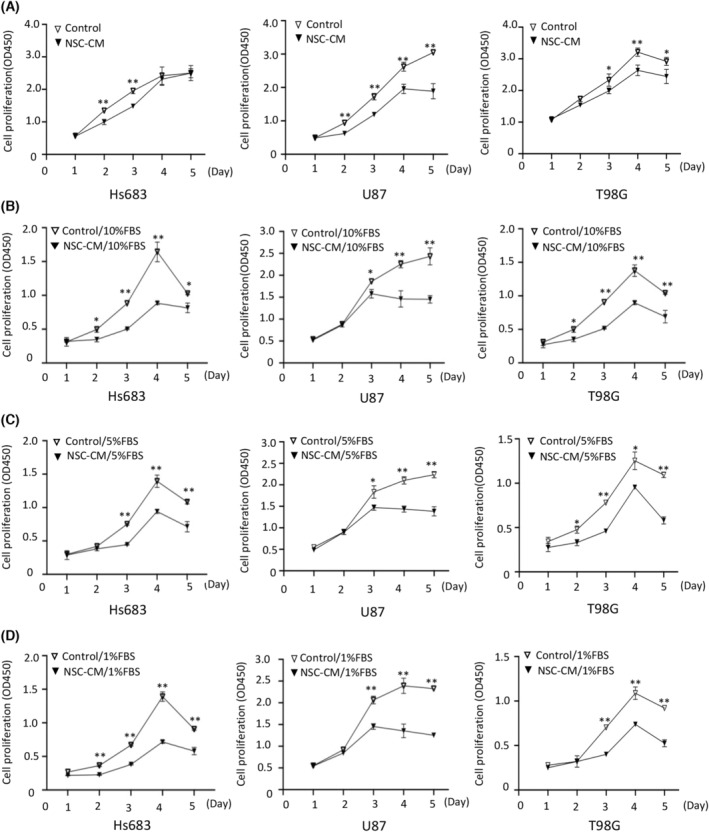
Neural stem cells (NSCs) play crucial roles in neurological disorders and tissue injury repair through exerting paracrine effects. However, the effects of NSC-derived factors on glioma progression remain unclear. This study aimed to evaluate the effects of human NSC-conditioned medium (NSC-CM) on the behaviour of glioma cells using an in vitro co-culture system. Cell counting kit-8 and 5-ethynyl-2'-deoxyuridine assays revealed that NSC-CM inhibited glioma cell proliferation and growth in a fetal bovine serum (FBS)-independent manner. In addition, our wound-healing assay demonstrated that NSC-CM repressed glioma cell migration, while results from transwell and 3D spheroid invasion assays indicated that NSC-CM also reduced the invasion capacity of glioma cells. Flow cytometry showed that NSC-CM prevented cell cycle progression from the G1 to S phase and promoted apoptosis. Western blotting was used to show that the expression of Wnt/β-catenin pathway-related proteins, including β-catenin, c-Myc, cyclin D1, CD44 and Met, was remarkably decreased in NSC-CM-treated glioma cells. Furthermore, the addition of a Wnt/β-catenin pathway activator, CHIR99021, significantly induced the expression of β-catenin and Met and increased the proliferative and invasive capabilities of control medium-treated glioma cells but not those of NSC-CM-treated glioma cells. The use of enzyme-linked immunosorbent assays (ELISA) revealed the secretion of some antitumour factors in human and rat NSCs, including interferon-α and dickkopf-1. Our data suggest that NSC-CM partially inhibits glioma cell progression by downregulating Wnt/β-catenin signalling. This study may serve as a basis for developing future antiglioma therapies based on NSC derivatives.
神经干细胞 (NSCs) 通过旁分泌作用在神经疾病和组织损伤修复中发挥关键作用。然而,NSC 衍生因子对神经胶质瘤进展的影响尚不清楚。本研究旨在通过体外共培养系统评估人 NSC 条件培养基 (NSC-CM) 对神经胶质瘤细胞行为的影响。细胞计数试剂盒-8 和 5-乙炔基-2'-脱氧尿苷检测表明,NSC-CM 以胎牛血清 (FBS) 独立的方式抑制神经胶质瘤细胞的增殖和生长。此外,我们的划痕愈合实验表明,NSC-CM 抑制神经胶质瘤细胞迁移,而 Transwell 和 3D 球体侵袭实验的结果表明,NSC-CM 还降低了神经胶质瘤细胞的侵袭能力。流式细胞术显示,NSC-CM 阻止细胞周期从 G1 期向 S 期的进展,并促进细胞凋亡。Western blot 用于显示 Wnt/β-catenin 通路相关蛋白的表达,包括β-catenin、c-Myc、cyclin D1、CD44 和 Met,在 NSC-CM 处理的神经胶质瘤细胞中显著降低。此外,添加 Wnt/β-catenin 通路激活剂 CHIR99021 显著诱导β-catenin 和 Met 的表达,并增加对照培养基处理的神经胶质瘤细胞的增殖和侵袭能力,但不增加 NSC-CM 处理的神经胶质瘤细胞的增殖和侵袭能力。酶联免疫吸附测定 (ELISA) 的使用揭示了人源和大鼠 NSCs 分泌的一些抗肿瘤因子,包括干扰素-α和 dickkopf-1。我们的数据表明,NSC-CM 通过下调 Wnt/β-catenin 信号通路部分抑制神经胶质瘤细胞的进展。这项研究可能为基于 NSC 衍生物开发未来的抗神经胶质瘤治疗方法提供依据。