Research Unit in Cell Biology, Laboratory of Biochemistry and Cell Biology URBC)-Namur Research Institute for Life Sciences (NARILIS), University of Namur, Namur, Belgium.
Research Unit in Microorganisms Biology (URBM)-Namur Research Institute for Life Sciences (NARILIS), University of Namur, Namur, Belgium.
PLoS Pathog. 2023 Jul 6;19(7):e1011471. doi: 10.1371/journal.ppat.1011471. eCollection 2023 Jul.
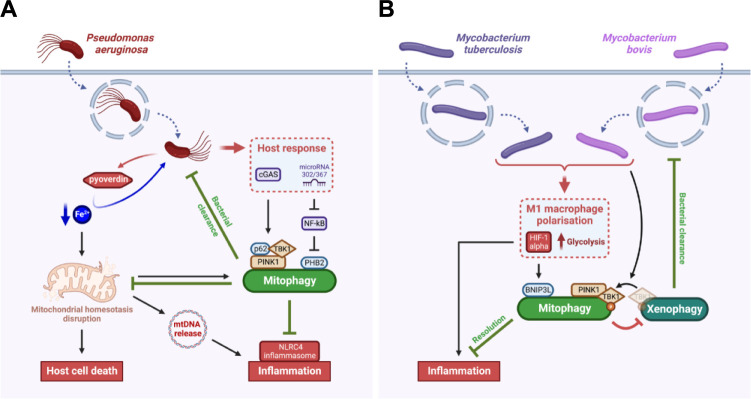
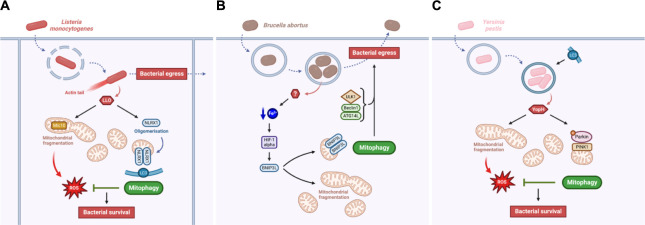
Mitochondria fulfil a plethora of cellular functions ranging from energy production to regulation of inflammation and cell death control. The fundamental role of mitochondria makes them a target of choice for invading pathogens, with either an intracellular or extracellular lifestyle. Indeed, the modulation of mitochondrial functions by several bacterial pathogens has been shown to be beneficial for bacterial survival inside their host. However, so far, relatively little is known about the importance of mitochondrial recycling and degradation pathways through mitophagy in the outcome (success or failure) of bacterial infection. On the one hand, mitophagy could be considered as a defensive response triggered by the host upon infection to maintain mitochondrial homeostasis. However, on the other hand, the pathogen itself may initiate the host mitophagy to escape from mitochondrial-mediated inflammation or antibacterial oxidative stress. In this review, we will discuss the diversity of various mechanisms of mitophagy in a general context, as well as what is currently known about the different bacterial pathogens that have developed strategies to manipulate the host mitophagy.
线粒体执行着多种细胞功能,从能量产生到炎症调节和细胞死亡控制。线粒体的基本作用使它们成为入侵病原体的首选目标,无论是细胞内还是细胞外生活方式。事实上,几种细菌病原体对线粒体功能的调节已被证明有利于细菌在宿主内的存活。然而,到目前为止,关于线粒体回收和降解途径(通过自噬)在细菌感染结果(成功或失败)中的重要性,人们知之甚少。一方面,自噬可以被认为是宿主在感染时触发的一种防御反应,以维持线粒体的动态平衡。然而,另一方面,病原体本身可能会引发宿主自噬,以逃避线粒体介导的炎症或抗菌氧化应激。在这篇综述中,我们将讨论自噬的各种机制在一般情况下的多样性,以及目前已知的不同细菌病原体是如何发展出操纵宿主自噬的策略的。