Department of Pathology, Amsterdam UMC, Location VUmc, Amsterdam, The Netherlands.
Blizard Institute, Barts and the London School of Medicine and Dentistry, Queen Mary University of London, London, UK.
Clin Exp Immunol. 2023 Dec 11;214(1):1-17. doi: 10.1093/cei/uxad075.
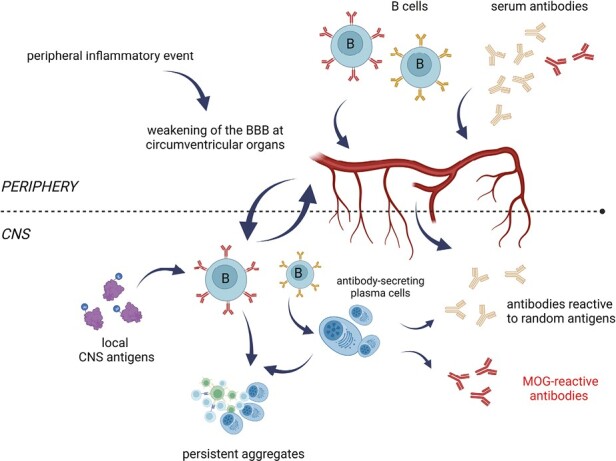
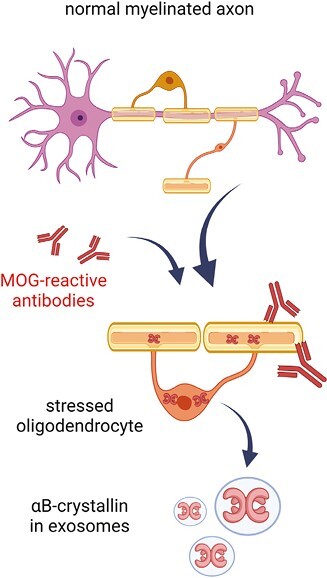
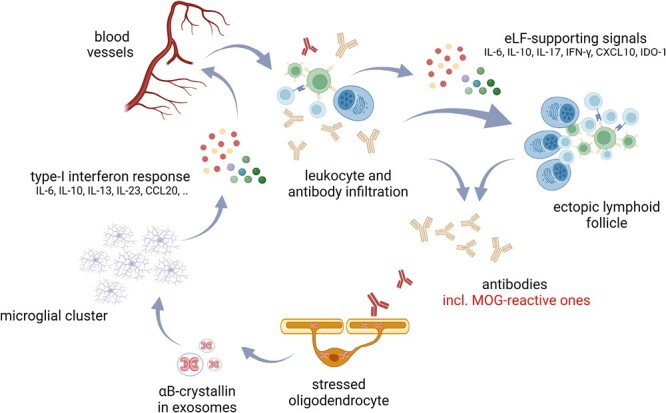
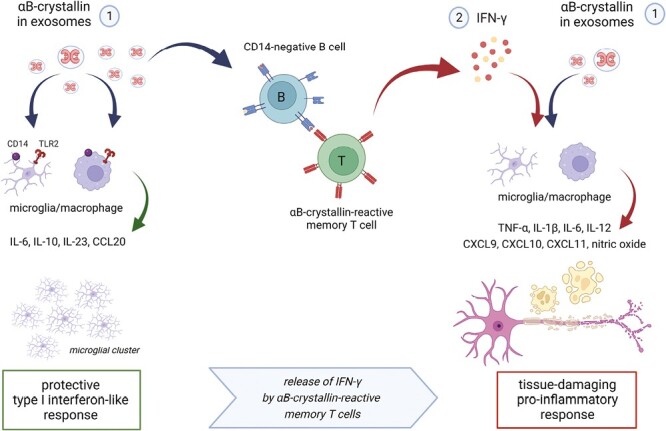
Multiple sclerosis (MS) is characterized by the chronic inflammatory destruction of myelinated axons in the central nervous system. Several ideas have been put forward to clarify the roles of the peripheral immune system and neurodegenerative events in such destruction. Yet, none of the resulting models appears to be consistent with all the experimental evidence. They also do not answer the question of why MS is exclusively seen in humans, how Epstein-Barr virus contributes to its development but does not immediately trigger it, and why optic neuritis is such a frequent early manifestation in MS. Here we describe a scenario for the development of MS that unifies existing experimental evidence as well as answers the above questions. We propose that all manifestations of MS are caused by a series of unfortunate events that usually unfold over a longer period of time after a primary EBV infection and involve periodic weakening of the blood-brain barrier, antibody-mediated CNS disturbances, accumulation of the oligodendrocyte stress protein αB-crystallin and self-sustaining inflammatory damage.
多发性硬化症(MS)的特征是中枢神经系统中髓鞘轴突的慢性炎症性破坏。为了阐明外周免疫系统和神经退行性事件在这种破坏中的作用,已经提出了几种观点。然而,没有一种由此产生的模型似乎与所有的实验证据相符。它们也没有回答为什么 MS 只发生在人类身上,为什么 Epstein-Barr 病毒有助于其发展但不会立即引发它,以及为什么视神经炎在 MS 中如此频繁地早期表现。在这里,我们描述了一个 MS 发展的情景,它统一了现有的实验证据,并回答了上述问题。我们提出,MS 的所有表现都是由一系列不幸事件引起的,这些事件通常在原发性 EBV 感染后较长时间内发生,涉及血脑屏障的周期性减弱、抗体介导的中枢神经系统紊乱、少突胶质细胞应激蛋白 αB-晶体蛋白的积累和自我维持的炎症损伤。