School of Interdisciplinary Informatics, College of Information Science and Technology, University of Nebraska at Omaha, Omaha, NE, USA.
Department of Biology, University of Nebraska at Omaha, Omaha, NE, USA.
Yearb Med Inform. 2023 Aug;32(1):89-98. doi: 10.1055/s-0043-1768723. Epub 2023 Jul 6.
A significant portion of individuals in the United States and worldwide experience diseases related to or driven by diet. As research surrounding user-centered design and the microbiome grows, movement of the spectrum of translational science from bench to bedside for improvement of human health through nutrition becomes more accessible. In this literature survey, we examined recent literature examining informatics research at the interface of nutrition and the microbiome.
The objective of this survey was to synthesize recent literature describing how technology is being applied to understand health at the interface of nutrition and the microbiome focusing on the perspective of the consumer.
A survey of the literature published between January 1, 2021 and October 10, 2022 was performed using the PubMed database and resulting literature was evaluated against inclusion and exclusion criteria.
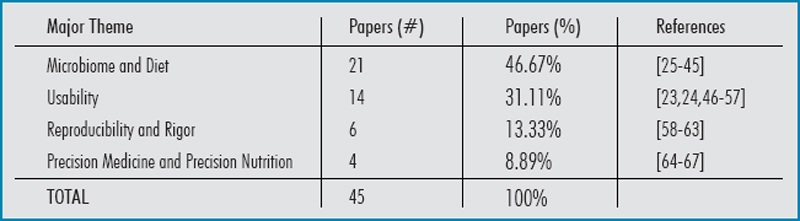
A total of 139 papers were retrieved and evaluated against inclusion and exclusion criteria. After evaluation, 45 papers were reviewed in depth revealing four major themes: (1) microbiome and diet, (2) usability,(3) reproducibility and rigor, and (4) precision medicine and precision nutrition.
A review of the relationships between current literature on technology, nutrition and the microbiome, and self-management of dietary patterns was performed. Major themes that emerged from this survey revealed exciting new horizons for consumer management of diet and disease, as well as progress towards elucidating the relationship between diet, the microbiome, and health outcomes. The survey revealed continuing interest in the study of diet-related disease and the microbiome and acknowledgement of needs for data re-use, sharing, and unbiased and rigorous measurement of the microbiome. The literature also showed trends toward enhancing the usability of digital interventions to support consumer health and home management, and consensus building around how precision medicine and precision nutrition may be applied in the future to improve human health outcomes and prevent diet-related disease.
美国和全球范围内相当一部分人患有与饮食相关或由饮食驱动的疾病。随着围绕以用户为中心的设计和微生物组的研究不断增加,通过营养改善人类健康的转化科学从实验室到临床的转变变得更加容易。在这项文献调查中,我们研究了最近研究营养与微生物组接口的文献。
本次调查的目的是综合最近的文献,描述技术如何应用于理解营养与微生物组接口的健康问题,重点关注消费者的角度。
使用 PubMed 数据库对 2021 年 1 月 1 日至 2022 年 10 月 10 日期间发表的文献进行了调查,并根据纳入和排除标准对所得文献进行了评估。
共检索到 139 篇论文,并根据纳入和排除标准进行了评估。经过评估,有 45 篇论文进行了深入审查,揭示了四个主要主题:(1)微生物组和饮食,(2)可用性,(3)可重复性和严谨性,(4)精准医学和精准营养。
对技术、营养与微生物组以及饮食模式自我管理方面的文献关系进行了综述。从这次调查中出现的主要主题揭示了消费者管理饮食和疾病的令人兴奋的新前景,以及在阐明饮食、微生物组和健康结果之间的关系方面取得的进展。调查显示,人们继续关注与饮食相关的疾病和微生物组的研究,并认识到需要重新使用数据、共享数据以及对微生物组进行无偏和严谨的测量。文献还显示出提高数字干预措施可用性以支持消费者健康和家庭管理的趋势,并就如何在未来应用精准医学和精准营养来改善人类健康结果和预防与饮食相关的疾病达成共识。