Avallone Martino, Pardo Joaquín, Mergiya Tadiwos F, Rájová Jana, Räsänen Atte, Davidsson Marcus, Åkerblom Malin, Quintino Luis, Kumar Darshan, Bramham Clive R, Björklund Tomas
Molecular Neuromodulation, Wallenberg Neuroscience Center, Lund University, Lund, Sweden.
Instituto de Investigaciones Bioquímicas de La Plata "Prof. Dr. Rodolfo R. Brenner" (INIBIOLP), Consejo Nacional de Investigaciones Científicas y Técnicas (CONICET)-Universidad Nacional de La Plata (UNLP), La Plata, Argentina.
Front Mol Neurosci. 2023 Jun 15;16:1140785. doi: 10.3389/fnmol.2023.1140785. eCollection 2023.
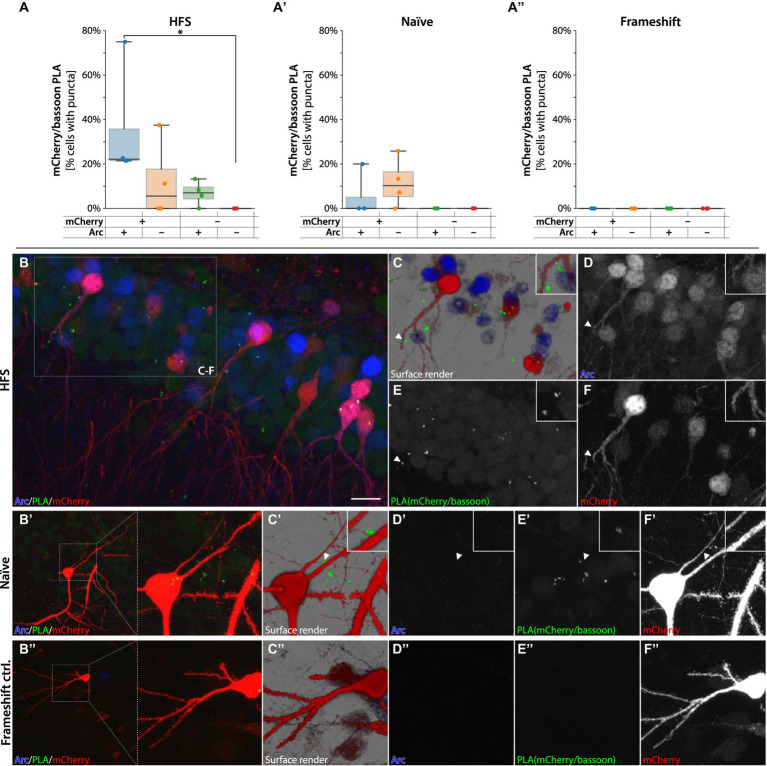
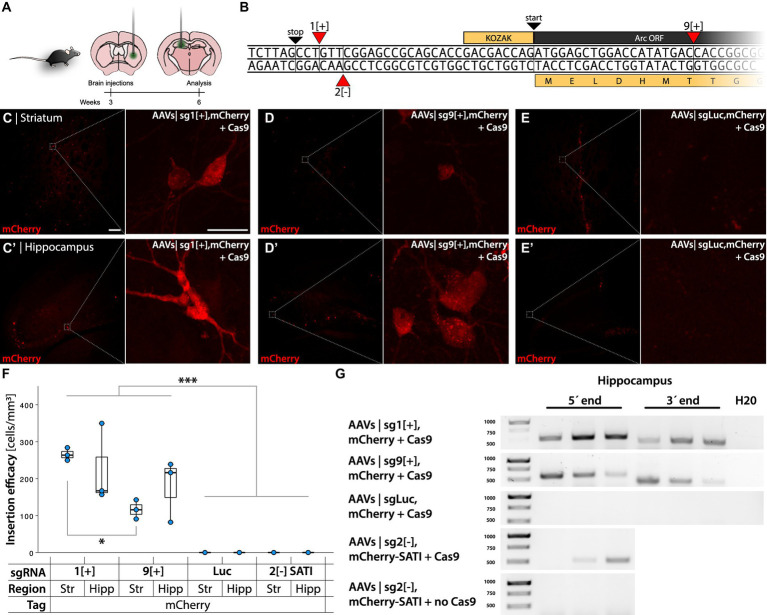
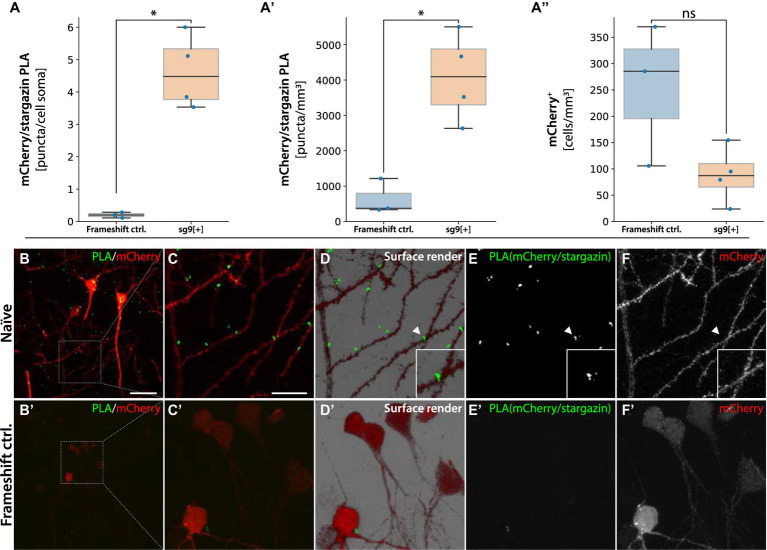
The activity-regulated cytoskeleton-associated (Arc) protein is essential for synaptic plasticity and memory formation. The Arc gene, which contains remnants of a structural GAG retrotransposon sequence, produces a protein that self-assembles into capsid-like structures harboring Arc mRNA. Arc capsids, released from neurons, have been proposed as a novel intercellular mechanism for mRNA transmission. Nevertheless, evidence for intercellular transport of Arc in the mammalian brain is still lacking. To enable the tracking of Arc molecules from individual neurons , we devised an adeno-associated virus (AAV) mediated approach to tag the N-terminal of the mouse Arc protein with a fluorescent reporter using CRISPR/Cas9 homologous independent targeted integration (HITI). We show that a sequence coding for mCherry can successfully be knocked in at the 5' end of the Arc open reading frame. While nine spCas9 gene editing sites surround the Arc start codon, the accuracy of the editing was highly sequence-dependent, with only a single target resulting in an in-frame reporter integration. When inducing long-term potentiation (LTP) in the hippocampus, we observed an increase of Arc protein highly correlated with an increase in fluorescent intensity and the number of mCherry-positive cells. By proximity ligation assay (PLA), we demonstrated that the mCherry-Arc fusion protein retains the Arc function by interacting with the transmembrane protein stargazin in postsynaptic spines. Finally, we recorded mCherry-Arc interaction with presynaptic protein Bassoon in mCherry-negative surrounding neurons at close proximity to mCherry-positive spines of edited neurons. This is the first study to provide support for inter-neuronal transfer of Arc in the mammalian brain.
活性调节细胞骨架相关蛋白(Arc)对于突触可塑性和记忆形成至关重要。Arc基因包含一个结构性GAG逆转录转座子序列的残余部分,它产生的蛋白质会自我组装成含有Arc mRNA的衣壳样结构。从神经元释放的Arc衣壳被认为是一种新型的mRNA细胞间传递机制。然而,哺乳动物大脑中Arc细胞间转运的证据仍然缺乏。为了能够追踪单个神经元中的Arc分子,我们设计了一种腺相关病毒(AAV)介导的方法,利用CRISPR/Cas9同源独立靶向整合(HITI)用荧光报告基因标记小鼠Arc蛋白的N端。我们表明,编码mCherry的序列可以成功敲入Arc开放阅读框的5'端。虽然九个spCas9基因编辑位点围绕着Arc起始密码子,但编辑的准确性高度依赖于序列,只有一个靶点导致了框内报告基因的整合。当在海马体中诱导长时程增强(LTP)时,我们观察到Arc蛋白的增加与荧光强度和mCherry阳性细胞数量的增加高度相关。通过邻近连接分析(PLA),我们证明了mCherry-Arc融合蛋白通过与突触后棘中的跨膜蛋白stargazin相互作用而保留了Arc功能。最后,我们记录了在编辑神经元的mCherry阳性棘附近的mCherry阴性周围神经元中,mCherry-Arc与突触前蛋白巴松管的相互作用。这是第一项为哺乳动物大脑中Arc的神经元间转移提供支持的研究。