Zepeda-Echavarria Alejandra, van de Leur Rutger R, van Sleuwen Meike, Hassink Rutger J, Wildbergh Thierry X, Doevendans Pieter A, Jaspers Joris, van Es René
Medical Technologies and Clinical Physics, Facilitation Department, University Medical Center Utrecht, Utrecht, Netherlands.
Department of Cardiology, Division of Heart and Lungs, University Medical Center Utrecht, Utrecht, Netherlands.
JMIR Cardio. 2023 Jul 7;7:e44003. doi: 10.2196/44003.
Electrocardiograms (ECGs) are used by physicians to record, monitor, and diagnose the electrical activity of the heart. Recent technological advances have allowed ECG devices to move out of the clinic and into the home environment. There is a great variety of mobile ECG devices with the capabilities to be used in home environments.
This scoping review aimed to provide a comprehensive overview of the current landscape of mobile ECG devices, including the technology used, intended clinical use, and available clinical evidence.
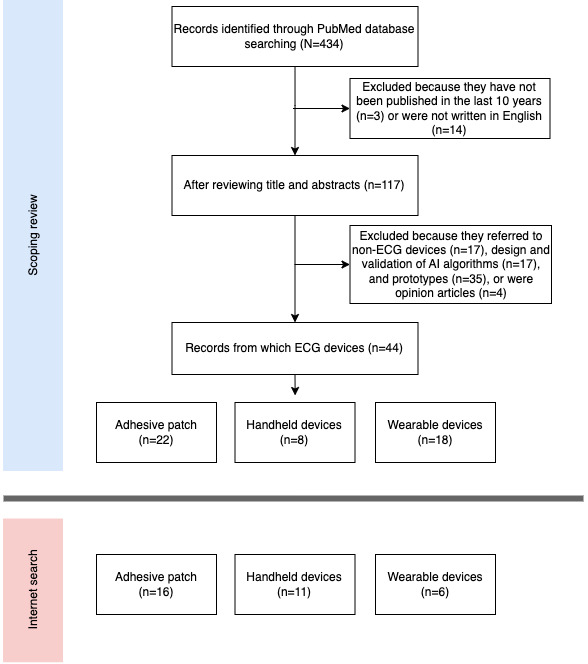
We conducted a scoping review to identify studies concerning mobile ECG devices in the electronic database PubMed. Secondarily, an internet search was performed to identify other ECG devices available in the market. We summarized the devices' technical information and usability characteristics based on manufacturer data such as datasheets and user manuals. For each device, we searched for clinical evidence on the capabilities to record heart disorders by performing individual searches in PubMed and ClinicalTrials.gov, as well as the Food and Drug Administration (FDA) 510(k) Premarket Notification and De Novo databases.
From the PubMed database and internet search, we identified 58 ECG devices with available manufacturer information. Technical characteristics such as shape, number of electrodes, and signal processing influence the capabilities of the devices to record cardiac disorders. Of the 58 devices, only 26 (45%) had clinical evidence available regarding their ability to detect heart disorders such as rhythm disorders, more specifically atrial fibrillation.
ECG devices available in the market are mainly intended to be used for the detection of arrhythmias. No devices are intended to be used for the detection of other cardiac disorders. Technical and design characteristics influence the intended use of the devices and use environments. For mobile ECG devices to be intended to detect other cardiac disorders, challenges regarding signal processing and sensor characteristics should be solved to increase their detection capabilities. Devices recently released include the use of other sensors on ECG devices to increase their detection capabilities.
医生使用心电图(ECG)来记录、监测和诊断心脏的电活动。最近的技术进步使ECG设备能够走出诊所,进入家庭环境。有各种各样的移动ECG设备具备在家庭环境中使用的能力。
本范围综述旨在全面概述移动ECG设备的当前情况,包括所使用的技术、预期的临床用途和可用的临床证据。
我们进行了一项范围综述,以在电子数据库PubMed中识别有关移动ECG设备的研究。其次,进行了互联网搜索,以识别市场上其他可用的ECG设备。我们根据制造商数据(如数据表和用户手册)总结了设备的技术信息和可用性特征。对于每个设备,我们通过在PubMed、ClinicalTrials.gov以及美国食品药品监督管理局(FDA)的510(k)上市前通知和De Novo数据库中进行单独搜索,寻找有关记录心脏疾病能力的临床证据。
通过PubMed数据库和互联网搜索,我们识别出58种具有可用制造商信息的ECG设备。形状、电极数量和信号处理等技术特征会影响设备记录心脏疾病的能力。在这58种设备中,只有26种(45%)有关于其检测心律紊乱(更具体地说是心房颤动)等心脏疾病能力的临床证据。
市场上可用的ECG设备主要用于检测心律失常。没有设备用于检测其他心脏疾病。技术和设计特征会影响设备的预期用途和使用环境。对于旨在检测其他心脏疾病的移动ECG设备,应解决信号处理和传感器特征方面的挑战,以提高其检测能力。最近发布的设备包括在ECG设备上使用其他传感器以提高其检测能力。