Department of Family Medicine, School for Public Health and Primary Care (CAPHRI), Maastricht University, Maastricht, The Netherlands
Department of General Practice, Amsterdam UMC Locatie Meibergdreef, Amsterdam, The Netherlands.
BMJ Open. 2022 Jun 29;12(6):e059172. doi: 10.1136/bmjopen-2021-059172.
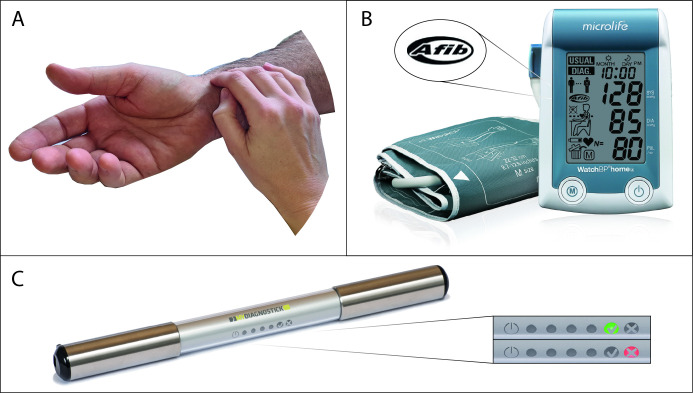
To determine the diagnostic accuracy of three tests-radial pulse palpation, an electronic blood pressure monitor and a handheld single-lead ECG device-for opportunistic screening for unknown atrial fibrillation (AF).
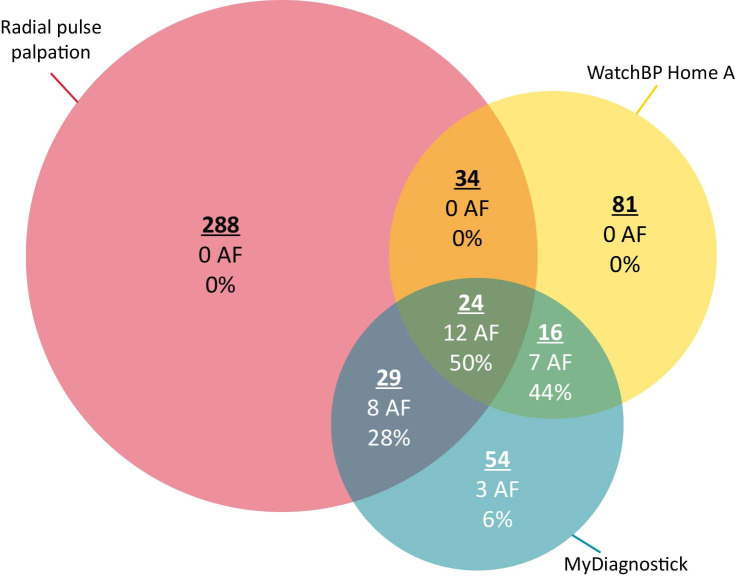
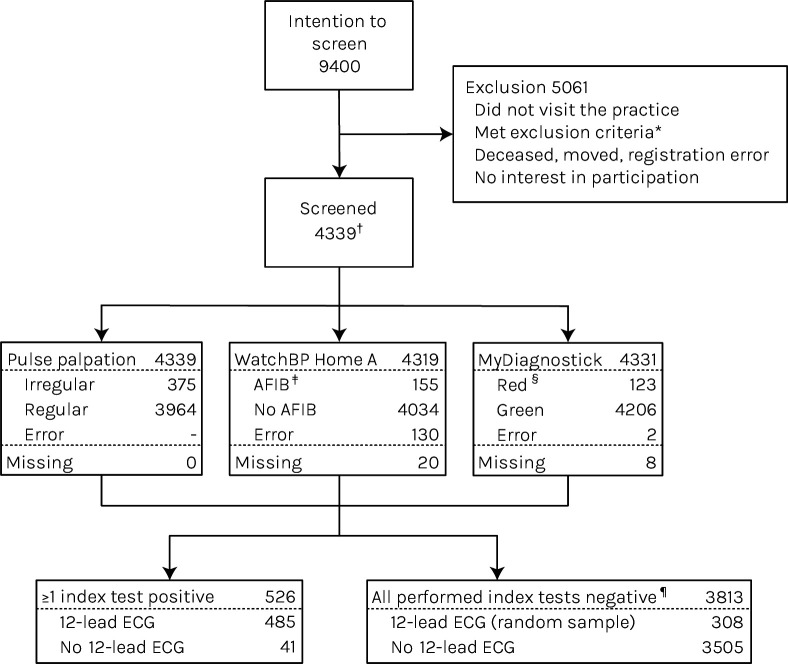
We performed a diagnostic accuracy study in the intention-to-screen arm of a cluster randomised controlled trial aimed at opportunistic screening for AF in general practice. We performed radial pulse palpation, followed by electronic blood pressure measurement (WatchBP Home A) and handheld ECG (MyDiagnostick) in random order. If one or more index tests were positive, we performed a 12-lead ECG at shortest notice. Similarly, to limit verification bias, a random sample of patients with three negative index tests received this reference test. Additionally, we analysed the dataset using multiple imputation. We present pooled diagnostic parameters.
47 general practices participated between September 2015 and August 2018.
In the electronic medical record system of the participating general practices (n=47), we randomly marked 200 patients of ≥65 years without AF. When they visited the practice for any reason, we invited them to participate. Exclusion criteria were terminal illness, inability to give informed consent or visit the practice or having a pacemaker or an implantable cardioverter-defibrillator.
Diagnostic accuracy of individual tests and test combinations to detect unknown AF.
We included 4339 patients; 0.8% showed new AF. Sensitivity and specificity were 62.8% (range 43.1%-69.7%) and 91.8% (91.7%-91.8%) for radial pulse palpation, 70.0% (49.0%-80.6%) and 96.5% (96.3%-96.7%) for electronic blood pressure measurement and 90.1% (60.8%-100%) and 97.9% (97.8%-97.9%) for handheld ECG, respectively. Positive predictive values were 5.8% (5.3%-6.1%), 13.8% (12.2%-14.8%) and 25.2% (24.2%-25.8%), respectively. All negative predictive values were ≥99.7%.
In detecting AF, electronic blood pressure measurement (WatchBP Home A), but especially handheld ECG (MyDiagnostick) showed better diagnostic accuracy than radial pulse palpation.
Netherlands Trial Register No. NL4776 (old NTR4914).
确定三种检测方法(桡动脉触诊、电子血压计和手持式单导心电图仪)在机会性筛查未知心房颤动(房颤)中的诊断准确性。
我们在一项旨在对全科医生进行房颤机会性筛查的集群随机对照试验的意向筛查臂中进行了一项诊断准确性研究。我们按照随机顺序进行桡动脉触诊,然后进行电子血压测量(WatchBP Home A)和手持式心电图(MyDiagnostick)。如果一个或多个指数测试呈阳性,我们将尽快进行 12 导联心电图检查。同样,为了限制验证偏倚,我们对三个阴性指数测试的随机样本患者进行了这项参考测试。此外,我们还使用多重插补分析了数据集。我们呈现了汇总的诊断参数。
47 家全科诊所参加了 2015 年 9 月至 2018 年 8 月的研究。
在参与全科医生的电子病历系统中(n=47),我们随机标记了 200 名≥65 岁且无房颤的患者。当他们因任何原因就诊时,我们邀请他们参加。排除标准为晚期疾病、无法知情同意或就诊、或装有起搏器或植入式心脏复律除颤器。
检测未知房颤的个体检测和检测组合的诊断准确性。
我们纳入了 4339 名患者;0.8%出现新发房颤。桡动脉触诊的敏感性和特异性分别为 62.8%(范围 43.1%-69.7%)和 91.8%(91.7%-91.8%),电子血压测量为 70.0%(49.0%-80.6%)和 96.5%(96.3%-96.7%),手持式心电图为 90.1%(60.8%-100%)和 97.9%(97.8%-97.9%)。阳性预测值分别为 5.8%(5.3%-6.1%)、13.8%(12.2%-14.8%)和 25.2%(24.2%-25.8%)。所有阴性预测值均≥99.7%。
在检测房颤方面,电子血压测量(WatchBP Home A),尤其是手持式心电图(MyDiagnostick)的诊断准确性优于桡动脉触诊。
荷兰试验登记号 NL4776(原 NTR4914)。