Department of Plant Physiology, Institute of Biology, Warsaw University of Life Sciences, SGGW, Nowoursynowska 159, 02-776, Warsaw, Poland.
Department of Botany, Institute of Biology, Warsaw University of Life Sciences, SGGW, Nowoursynowska 159, 02-776, Warsaw, Poland.
Planta. 2023 Jul 8;258(2):40. doi: 10.1007/s00425-023-04196-y.
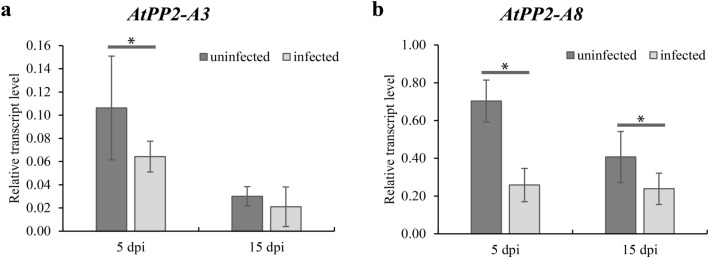
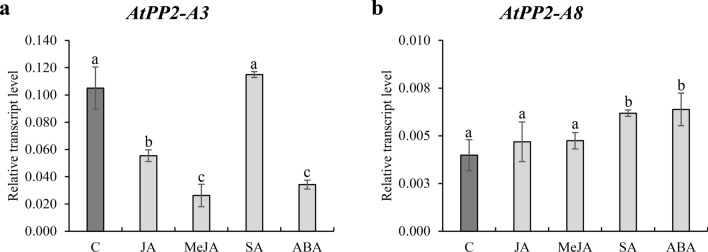
Expression levels of AtPP2-A3 and AtPP2-A8 are reduced in syncytia induced by Heterodera schachtii and decline of their expression levels decreases host susceptibility, whereas their overexpression promotes susceptibility to parasite. Plant-parasitic nematodes cause huge crop losses worldwide. Heterodera schachtii is a sedentary cyst-forming nematode that induces a feeding site called a syncytium via the delivery of secreted chemical substances (effectors) to host cells, which modulate host genes expression and phytohormone regulation patterns. Genes encoding the Nictaba-related lectin domain have been found among the plant genes with downregulated expression during the development of syncytia induced by H. schachtii in Arabidopsis thaliana roots. To investigate the role of two selected Nictaba-related genes in the plant response to beet cyst nematode parasitism, mutants and plants overexpressing AtPP2-A3 or AtPP2-A8 were infected, and promoter activity and protein localization were analyzed. In wild-type plants, AtPP2-A3 and AtPP2-A8 were expressed only in roots, especially in the cortex and rhizodermis. After nematode infection, their expression was switched off in regions surrounding a developing syncytium. Astonishingly, plants overexpressing AtPP2-A3 or AtPP2-A8 were more susceptible to nematode infection than wild-type plants, whereas mutants were less susceptible. Based on these results and changes in AtPP2-A3 and AtPP2-A8 expression patterns after treatments with different stress phytohormones, we postulate that the AtPP2-A3 and AtPP2-A8 genes play important roles in the defense response to beet cyst nematode infection.
AtPP2-A3 和 AtPP2-A8 的表达水平在 Heterodera schachtii 诱导的合胞体中降低,其表达水平的降低会降低宿主的易感性,而它们的过表达则会促进对寄生虫的易感性。植物寄生线虫在全球范围内造成巨大的作物损失。Heterodera schachtii 是一种定居的形成胞囊的线虫,通过向宿主细胞输送分泌的化学物质(效应物)来诱导一个称为合胞体的取食部位,从而调节宿主基因表达和植物激素调节模式。在拟南芥根系中,与 Nictaba 相关的凝集素结构域基因已被发现是在由 H. schachtii 诱导的合胞体发育过程中下调表达的植物基因之一。为了研究两个选定的与 Nictaba 相关基因在植物对甜菜胞囊线虫寄生反应中的作用,对突变体和过表达 AtPP2-A3 或 AtPP2-A8 的植物进行了感染,并分析了启动子活性和蛋白质定位。在野生型植物中,AtPP2-A3 和 AtPP2-A8 仅在根部表达,特别是在皮层和根表皮。在感染线虫后,它们的表达在发育中的合胞体周围的区域被关闭。令人惊讶的是,过表达 AtPP2-A3 或 AtPP2-A8 的植物比野生型植物更容易受到线虫感染,而突变体则不易受到感染。基于这些结果以及在受到不同应激植物激素处理后 AtPP2-A3 和 AtPP2-A8 表达模式的变化,我们假设 AtPP2-A3 和 AtPP2-A8 基因在对甜菜胞囊线虫感染的防御反应中发挥重要作用。