UMR 1253, iBrain, Université de Tours, INSERM, 37000, Tours, France.
University of Milano-Bicocca, Department of Psychology, Milan, Italy.
Transl Psychiatry. 2023 Jul 8;13(1):250. doi: 10.1038/s41398-023-02554-8.
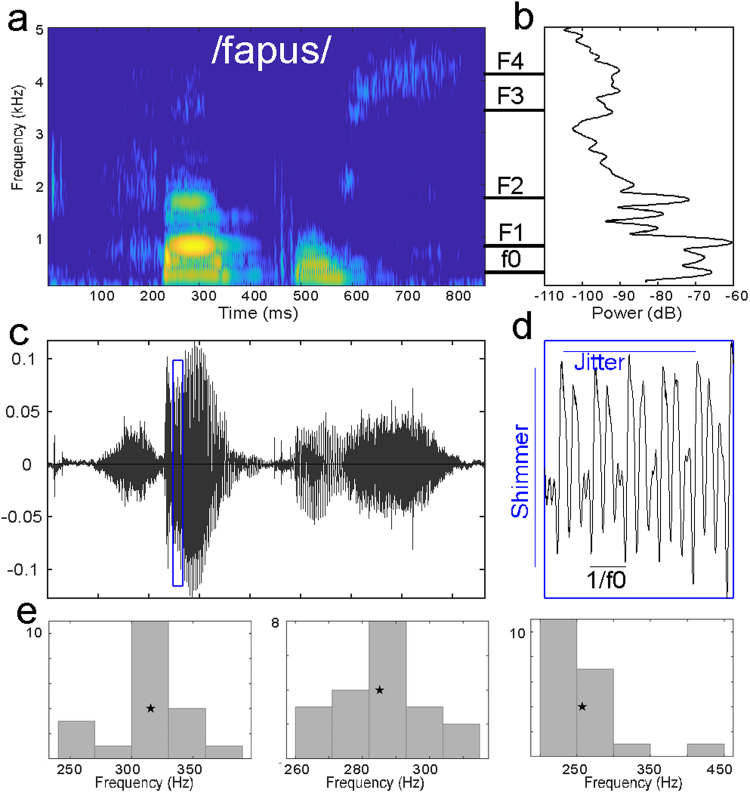
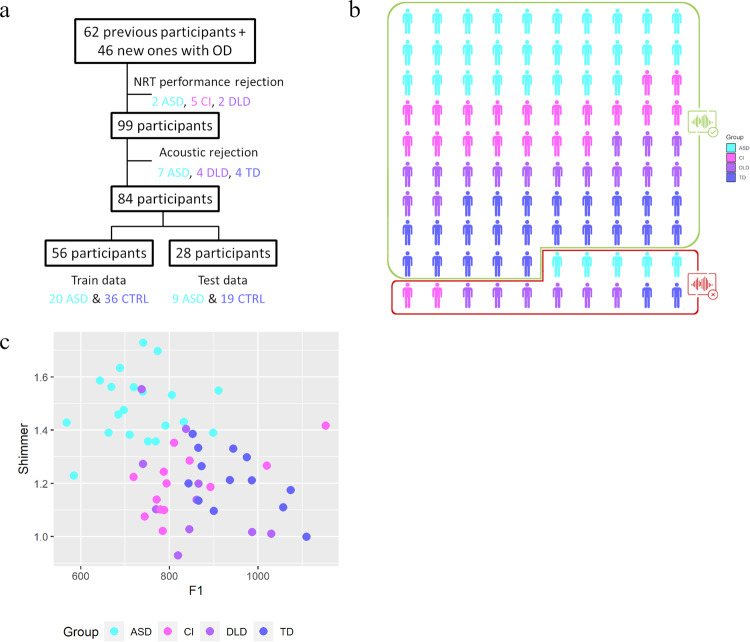
Early identification of children on the autism spectrum is crucial for early intervention with long-term positive effects on symptoms and skills. The need for improved objective autism detection tools is emphasized by the poor diagnostic power in current tools. Here, we aim to evaluate the classification performance of acoustic features of the voice in children with autism spectrum disorder (ASD) with respect to a heterogeneous control group (composed of neurotypical children, children with Developmental Language Disorder [DLD] and children with sensorineural hearing loss with Cochlear Implant [CI]). This retrospective diagnostic study was conducted at the Child Psychiatry Unit of Tours University Hospital (France). A total of 108 children, including 38 diagnosed with ASD (8.5 ± 0.25 years), 24 typically developing (TD; 8.2 ± 0.32 years) and 46 children with atypical development (DLD and CI; 7.9 ± 0.36 years) were enrolled in our studies. The acoustic properties of speech samples produced by children in the context of a nonword repetition task were measured. We used a Monte Carlo cross-validation with an ROC (Receiving Operator Characteristic) supervised k-Means clustering algorithm to develop a classification model that can differentially classify a child with an unknown disorder. We showed that voice acoustics classified autism diagnosis with an overall accuracy of 91% [CI95%, 90.40%-91.65%] against TD children, and of 85% [CI95%, 84.5%-86.6%] against an heterogenous group of non-autistic children. Accuracy reported here with multivariate analysis combined with Monte Carlo cross-validation is higher than in previous studies. Our findings demonstrate that easy-to-measure voice acoustic parameters could be used as a diagnostic aid tool, specific to ASD.
早期识别自闭症谱系障碍儿童对于早期干预至关重要,这对症状和技能有长期的积极影响。目前工具的诊断能力较差,强调了需要改进客观自闭症检测工具。在这里,我们旨在评估自闭症谱系障碍(ASD)儿童的语音声学特征的分类性能,相对于异质对照组(由神经典型儿童、发育性语言障碍儿童和人工耳蜗植入的感觉神经性听力损失儿童组成)。这项回顾性诊断研究在图尔大学医院(法国)的儿童精神病学系进行。共有 108 名儿童参与了我们的研究,包括 38 名被诊断为 ASD(8.5 ± 0.25 岁)、24 名神经典型发育儿童(8.2 ± 0.32 岁)和 46 名发育异常儿童(语言障碍和人工耳蜗植入)(7.9 ± 0.36 岁)。我们测量了儿童在非词重复任务中产生的语音样本的声学特性。我们使用蒙特卡罗交叉验证和 ROC(接收者操作特征)监督 K-均值聚类算法来开发一种分类模型,可以对患有未知疾病的儿童进行差异分类。我们表明,语音声学可以将自闭症诊断的总体准确率为 91%[CI95%,90.40%-91.65%]与神经典型儿童区分开来,与非自闭症儿童的异质组的准确率为 85%[CI95%,84.5%-86.6%]。与之前的研究相比,这里报告的使用多元分析结合蒙特卡罗交叉验证的准确性更高。我们的研究结果表明,易于测量的语音声学参数可作为 ASD 的特定诊断辅助工具。