School of Public Health, Peking University, 38 Xue Yuan Road, Haidian District, Beijing, 100191, China.
China Center for Health Development Studies, Peking University, 38 Xue Yuan Road, Haidian District, Beijing, 100191, China.
BMC Health Serv Res. 2023 Jul 8;23(1):737. doi: 10.1186/s12913-023-09758-0.
Vaccination is an important part of public health services. We aim to assess the efficiency of vaccination services in Beijing, the capital of China, and to further study the influencing factors of efficiency.
Using the immunization service data of Beijing, China in 2020, we firstly developed a data envelopment analysis (DEA) model to calculate the score of vaccination efficiency. Secondly, we used DEA model scenario simulations with different combinations of input-output factors to derive the magnitude of the effect of each input factor on the efficiency. Finally, combined with the data from the Beijing Regional Statistical Yearbook 2021, we developed the Tobit model to examine the effect of external social environmental factors on efficiency.
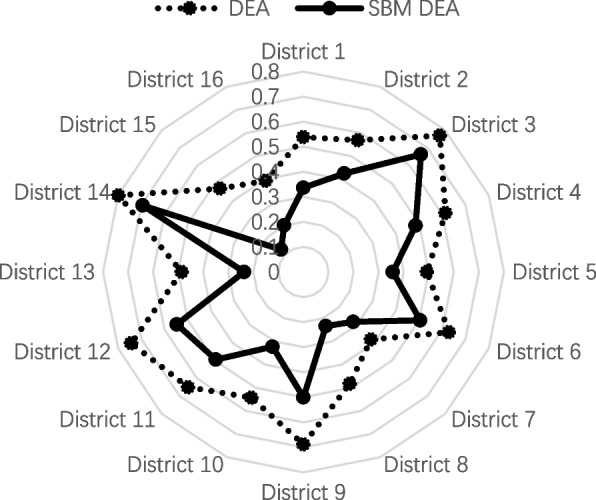
The average scores of efficiency of POVs (Point of Vaccination) in different areas of Beijing vary greatly. Different input factors had different degrees of positive effects on the efficiency score. In addition, the number of populations served by POV was positively associated with efficiency, the GDP and financial allocation of the POVs' district was also positively associated with efficiency score, while the total dependency ratio of the POVs' district was negatively associated with efficiency score.
The efficiency of vaccination services varied considerably across POVs. Constrained by limited resources, efficiency scores can be increased by increasing input factors that have a larger impact on efficiency score and reducing those that have a smaller impact on efficiency. In addition, the social environment should be considered in allocating vaccination resources, and more resources should be invested in areas with low levels of economic development, low financial allocation, and high population.
接种疫苗是公共卫生服务的重要组成部分。我们旨在评估中国首都北京的疫苗接种服务效率,并进一步研究效率的影响因素。
使用 2020 年中国北京市免疫服务数据,我们首先开发了一个数据包络分析(DEA)模型来计算疫苗接种效率得分。其次,我们使用 DEA 模型情景模拟不同的投入产出因素组合,得出每个投入因素对效率的影响程度。最后,结合 2021 年《北京区域统计年鉴》的数据,我们建立了 Tobit 模型,以检验外部社会环境因素对效率的影响。
北京市不同地区 POV(疫苗接种点)的效率平均得分差异很大。不同的投入因素对效率得分有不同程度的正向影响。此外,POV 服务的人口数量与效率呈正相关,POV 所在区的 GDP 和财政拨款与效率得分呈正相关,而 POV 所在区的总抚养比与效率得分呈负相关。
疫苗接种服务的效率在不同的 POV 之间存在显著差异。在资源有限的情况下,可以通过增加对效率得分影响较大的投入因素,减少对效率得分影响较小的投入因素来提高效率得分。此外,在分配疫苗接种资源时应考虑社会环境,应向经济发展水平低、财政拨款低、人口多的地区投入更多资源。