Alves Arielly da Hora, Nucci Mariana Penteado, Ennes do Valle Nicole Mastandrea, Missina Juliana Morais, Mamani Javier Bustamante, Rego Gabriel Nery Albuquerque, Dias Olivia Furiama Metropolo, Garrigós Murilo Montenegro, de Oliveira Fernando Anselmo, Gamarra Lionel Fernel
Hospital Israelita Albert Einstein, São Paulo 05529-060, São Paulo, Brazil.
Hospital das Clínicas HCFMUSP, Faculdade de Medicina, Universidade de São Paulo, São Paulo 05403-010, São Paulo, Brazil.
World J Stem Cells. 2023 Jun 26;15(6):632-653. doi: 10.4252/wjsc.v15.i6.632.
Induced pluripotent stem cells (iPSCs) show great ability to differentiate into any tissue, making them attractive candidates for pathophysiological investigations. The rise of organ-on-a-chip technology in the past century has introduced a novel way to make cell cultures that more closely resemble their environments, both structural and functionally. The literature still lacks consensus on the best conditions to mimic the blood-brain barrier (BBB) for drug screening and other personalized therapies. The development of models based on BBB-on-a-chip using iPSCs is promising and is a potential alternative to the use of animals in research.
To analyze the literature for BBB models on-a-chip involving iPSCs, describe the microdevices, the BBB construction, and applications.
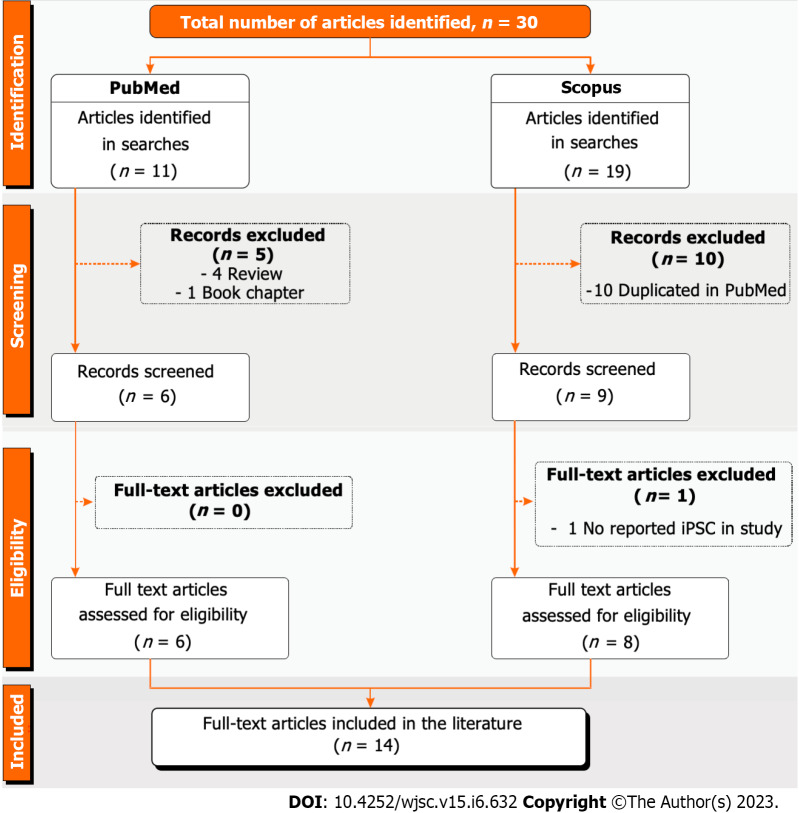
We searched for original articles indexed in PubMed and Scopus that used iPSCs to mimic the BBB and its microenvironment in microfluidic devices. Thirty articles were identified, wherein only 14 articles were finally selected according to the inclusion and exclusion criteria. Data compiled from the selected articles were organized into four topics: (1) Microfluidic devices design and fabrication; (2) characteristics of the iPSCs used in the BBB model and their differentiation conditions; (3) BBB-on-a-chip reconstruction process; and (4) applications of BBB microfluidic three-dimensional models using iPSCs.
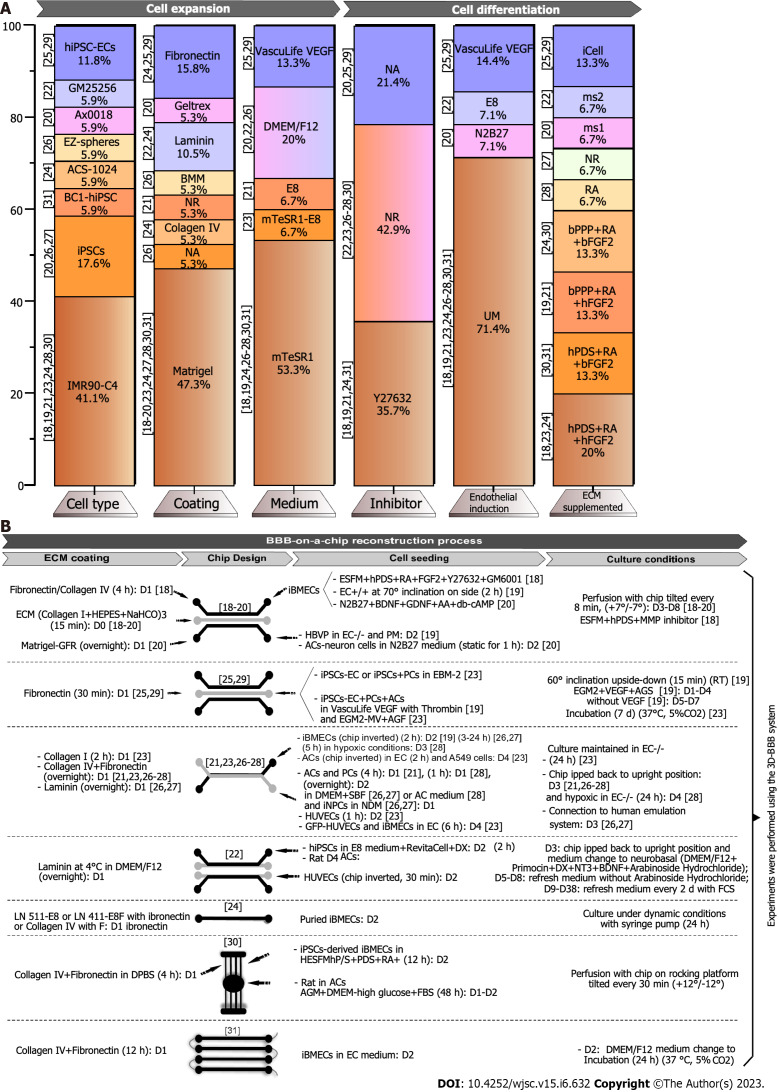
This study showed that BBB models with iPSCs in microdevices are quite novel in scientific research. Important technological advances in this area regarding the use of commercial BBB-on-a-chip were identified in the most recent articles by different research groups. Conventional polydimethylsiloxane was the most used material to fabricate in-house chips (57%), whereas few studies (14.3%) adopted polymethylmethacrylate. Half the models were constructed using a porous membrane made of diverse materials to separate the channels. iPSC sources were divergent among the studies, but the main line used was IMR90-C4 from human fetal lung fibroblast (41.2%). The cells were differentiated through diverse and complex processes either to endothelial or neural cells, wherein only one study promoted differentiation inside the chip. The construction process of the BBB-on-a-chip involved previous coating mostly with fibronectin/collagen IV (39.3%), followed by cell seeding in single cultures (36%) or co-cultures (64%) under controlled conditions, aimed at developing an BBB that mimics the human BBB for future applications.
This review evidenced technological advances in the construction of BBB models using iPSCs. Nonetheless, a definitive BBB-on-a-chip has not yet been achieved, hindering the applicability of the models.
诱导多能干细胞(iPSC)具有分化为任何组织的强大能力,使其成为病理生理学研究的理想候选对象。上个世纪芯片上器官技术的兴起引入了一种新方法,可制造出在结构和功能上更接近其体内环境的细胞培养物。关于模拟血脑屏障(BBB)用于药物筛选和其他个性化治疗的最佳条件,文献中仍未达成共识。基于iPSC的芯片上血脑屏障模型的开发前景广阔,并且是研究中替代动物使用的潜在选择。
分析涉及iPSC的芯片上血脑屏障模型的文献,描述微器件、血脑屏障构建及应用。
我们检索了PubMed和Scopus数据库中索引的原始文章,这些文章使用iPSC在微流控装置中模拟血脑屏障及其微环境。共识别出30篇文章,其中根据纳入和排除标准最终仅选择了14篇文章。从所选文章中整理的数据分为四个主题:(1)微流控装置设计与制造;(2)血脑屏障模型中使用的iPSC的特性及其分化条件;(3)芯片上血脑屏障的重建过程;(4)使用iPSC构建的血脑屏障微流控三维模型的应用。
本研究表明,微器件中含iPSC的血脑屏障模型在科研中颇为新颖。不同研究小组在最近的文章中确定了该领域在使用商业化芯片上血脑屏障方面的重要技术进展。传统聚二甲基硅氧烷是制造自制芯片最常用的材料(57%),而采用聚甲基丙烯酸甲酯的研究较少(14.3%)。一半的模型使用由不同材料制成的多孔膜来分隔通道。研究中的iPSC来源各不相同,但主要使用的是来自人胎儿肺成纤维细胞的IMR90-C4(41.2%)。细胞通过多样且复杂的过程分化为内皮细胞或神经细胞,其中只有一项研究在芯片内部促进分化。芯片上血脑屏障的构建过程大多先使用纤连蛋白/IV型胶原进行包被(39.3%),然后在受控条件下单细胞培养(36%)或共培养(64%)接种细胞,旨在构建一个模拟人类血脑屏障以供未来应用的血脑屏障。
本综述证明了使用iPSC构建血脑屏障模型的技术进展。尽管如此,尚未实现确定的芯片上血脑屏障,这阻碍了模型的适用性。