Amiri Parastoo, Pirnejad Habibollah, Bahaadinbeigy Kambiz, Baghini Mahdie Shojaei, Khazaee Parviz Rashidi, Niazkhani Zahra
Student Research Committee Kerman University of Medical Sciences Kerman Iran.
Patient Safety Research Center, Clinical Research Institute Urmia University of Medical Sciences Urmia Iran.
Health Sci Rep. 2023 Jul 5;6(7):e1394. doi: 10.1002/hsr2.1394. eCollection 2023 Jul.
As the nowadays provision of many healthcare services relies on technology, a better understanding of the factors contributing to the acceptance and use of technology in health care is essential. For Alzheimer's patients, an electronic personal health record (ePHR) is one such technology. Stakeholders should understand the factors affecting the adoption of this technology for its smooth implementation, adoption, and sustainable use. So far, these factors have not fully been understood for Alzheimer's disease (AD)-specific ePHR. Therefore, the present study aimed to understand these factors in ePHR adoption based on the perceptions and views of care providers and caregivers involved in AD care.
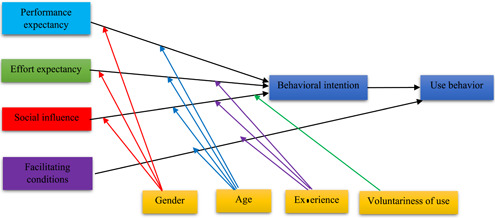
This qualitative study was conducted from February 2020 to August 2021 in Kerman, Iran. Seven neurologists and 13 caregivers involved in AD care were interviewed using semi-structured and in-depth interviews. All interviews were conducted through phone contacts amid Covid-19 imposed restrictions, recorded, and transcribed verbatim. The transcripts were coded using thematic analysis based on the unified theory of acceptance and use of technology (UTAUT) model. ATLAS.ti8 was used for data analysis.
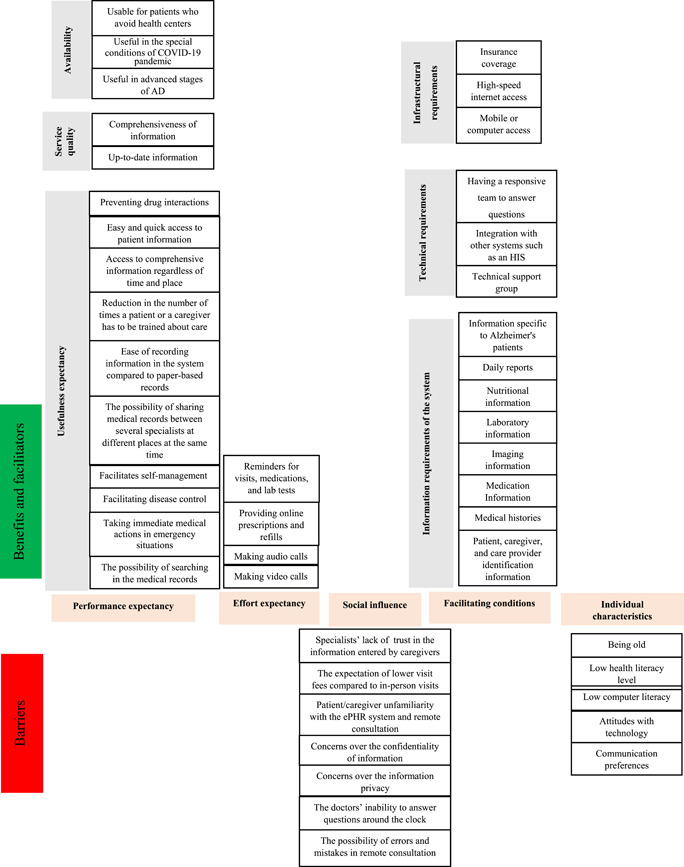
The factors affecting ePHR adoption in our study comprised subthemes under the five main themes of performance expectancy, effort expectancy, social influence, facilitating conditions of the UTAUT model, and the participants' sociodemographic factors. From the 37 facilitating factors and 13 barriers identified for ePHR adoption, in general, the participants had positive attitudes toward the ease of use of this system. The stated obstacles were dependent on the participants' sociodemographic factors (such as age and level of education) and social influence (including concern about confidentiality and privacy). In general, the participants considered ePHRs efficient and useful in increasing neurologists' information about their patients and managing their symptoms in order to provide better and timely treatment.
The present study gives a comprehensive insight into the acceptance of ePHR for AD in a developing setting. The results of this study can be utilized for similar healthcare settings with regard to technical, legal, or cultural characteristics. To develop a useful and user-friendly system, ePHR developers should involve users in the design process to take into account the functions and features that match their skills, requirements, and preferences.
由于当今许多医疗服务的提供依赖技术,因此更好地理解影响医疗保健中技术接受和使用的因素至关重要。对于阿尔茨海默病患者而言,电子个人健康记录(ePHR)就是这样一种技术。利益相关者应了解影响该技术采用的因素,以实现其顺利实施、采用和可持续使用。到目前为止,针对阿尔茨海默病(AD)特定的ePHR,这些因素尚未得到充分理解。因此,本研究旨在基于参与AD护理的医护人员和照料者的认知与观点,了解ePHR采用过程中的这些因素。
本定性研究于2020年2月至2021年8月在伊朗克尔曼进行。对7名神经科医生和13名参与AD护理的照料者进行了半结构化深入访谈。所有访谈均在新冠疫情限制期间通过电话联系进行,录音并逐字转录。基于技术接受与使用统一理论(UTAUT)模型,采用主题分析法对转录文本进行编码。使用ATLAS.ti8进行数据分析。
本研究中影响ePHR采用的因素包括UTAUT模型的五个主要主题下的子主题,即绩效期望、努力期望、社会影响、促进条件以及参与者的社会人口统计学因素。在确定的37个促进因素和13个阻碍ePHR采用的因素中,总体而言,参与者对该系统的易用性持积极态度。所述障碍取决于参与者的社会人口统计学因素(如年龄和教育程度)以及社会影响(包括对保密性和隐私的担忧)。总体而言,参与者认为ePHR在增加神经科医生对患者的信息了解以及管理患者症状以便提供更好、更及时的治疗方面是高效且有用的。
本研究全面深入地了解了在发展中环境下AD患者对ePHR的接受情况。本研究结果可用于具有类似技术、法律或文化特征的医疗保健环境。为开发一个有用且用户友好的系统,ePHR开发者应让用户参与设计过程,以考虑与他们的技能水平、需求和偏好相匹配的功能和特性。