Hernandez-Hernandez Gonzalo, O'Dwyer Samantha C, Matsumoto Collin, Tieu Mindy, Fong Zhihui, Yang Pei-Chi, Lewis Timothy J, Fernando Santana L, Clancy Colleen E
Department of Physiology & Membrane Biology, Center for Precision Medicine and Data Science, University of California School of Medicine, Davis, California, 95616.
Department of Mathematics, University of California, Davis, California, 95616.
bioRxiv. 2024 Jan 6:2023.06.24.546394. doi: 10.1101/2023.06.24.546394.
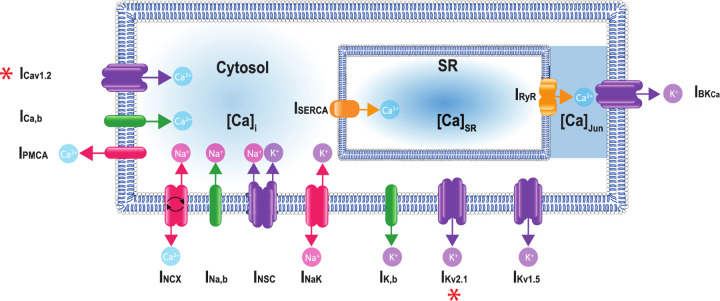
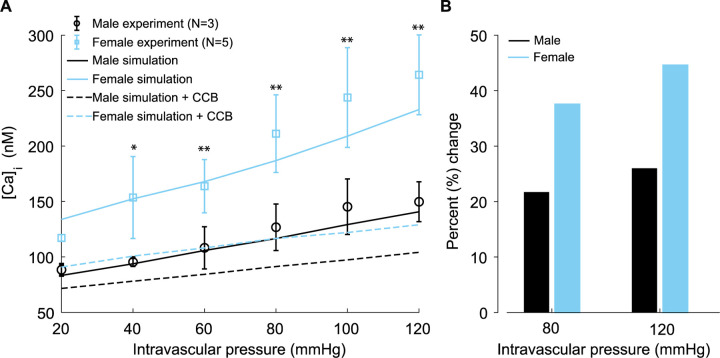
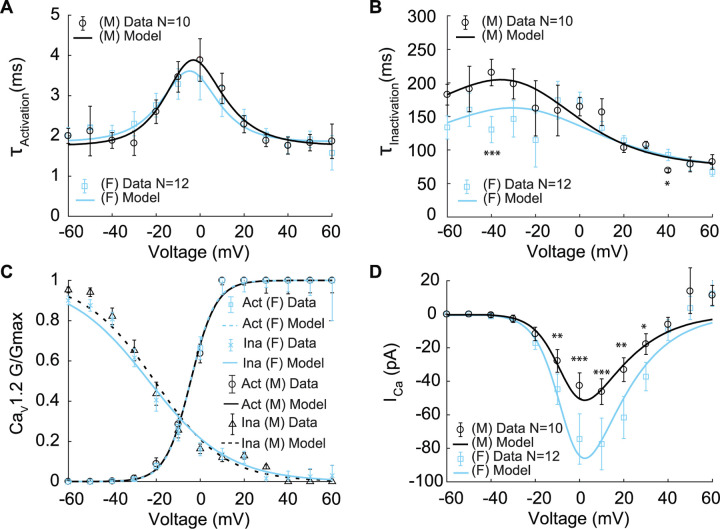
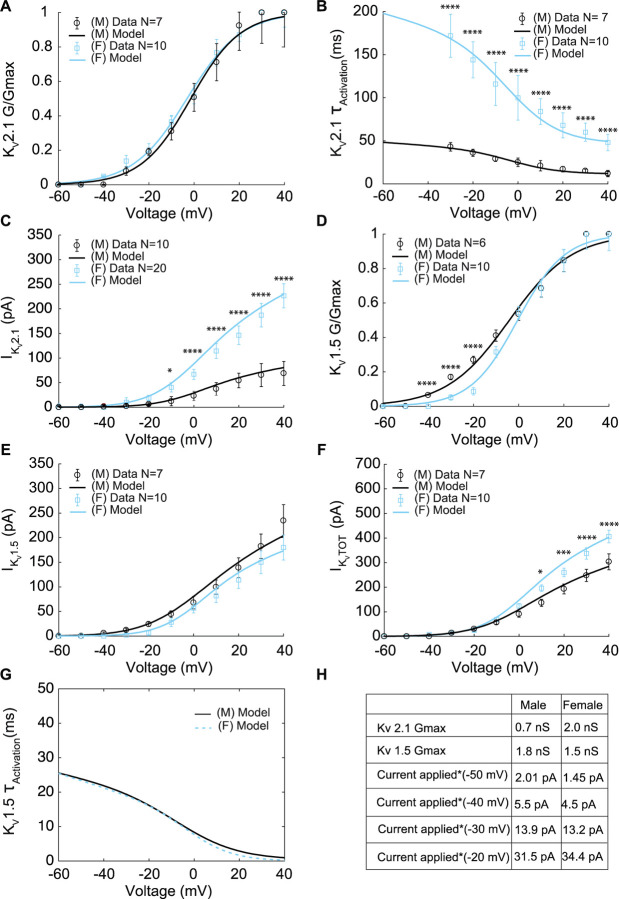
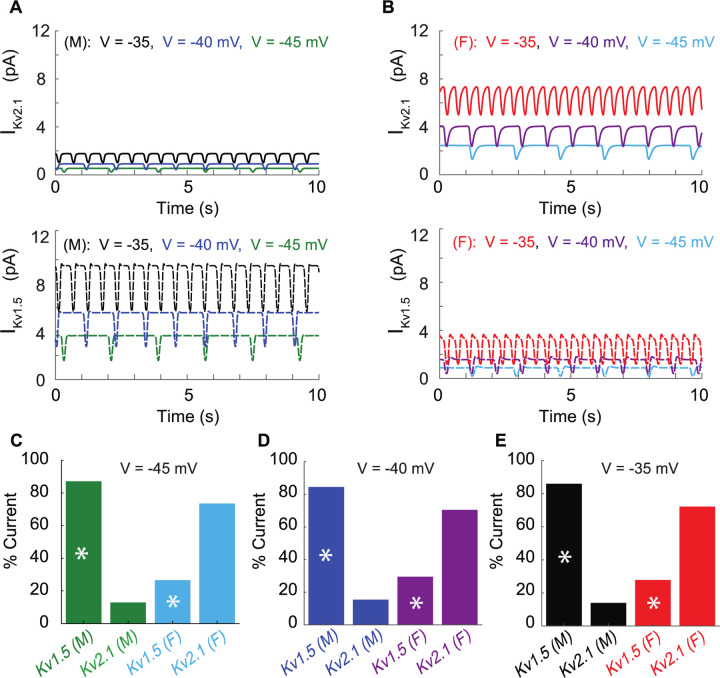
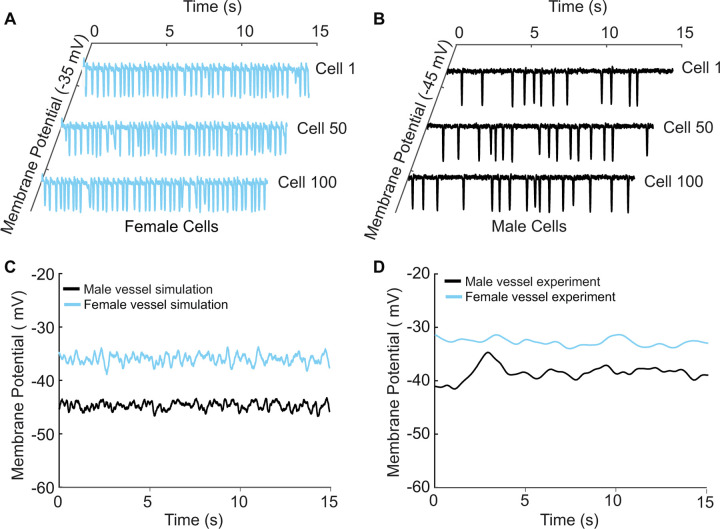
The function of the smooth muscle cells lining the walls of mammalian systemic arteries and arterioles is to regulate the diameter of the vessels to control blood flow and blood pressure. Here, we describe an model, which we call the "Hernandez-Hernandez model", of electrical and signaling in arterial myocytes based on new experimental data indicating sex-specific differences in male and female arterial myocytes from murine resistance arteries. The model suggests the fundamental ionic mechanisms underlying membrane potential and intracellular signaling during the development of myogenic tone in arterial blood vessels. Although experimental data suggest that K1.5 channel currents have similar amplitudes, kinetics, and voltage dependencies in male and female myocytes, simulations suggest that the K1.5 current is the dominant current regulating membrane potential in male myocytes. In female cells, which have larger K2.1 channel expression and longer time constants for activation than male myocytes, predictions from simulated female myocytes suggest that K2.1 plays a primary role in the control of membrane potential. Over the physiological range of membrane potentials, the gating of a small number of voltage-gated K channels and L-type channels are predicted to drive sex-specific differences in intracellular and excitability. We also show that in an idealized computational model of a vessel, female arterial smooth muscle exhibits heightened sensitivity to commonly used channel blockers compared to male. In summary, we present a new model framework to investigate the potential sex-specific impact of anti-hypertensive drugs.
哺乳动物体循环动脉和小动脉壁内衬的平滑肌细胞的功能是调节血管直径,以控制血流和血压。在此,我们基于新的实验数据描述了一种动脉肌细胞电信号和钙信号的模型,我们称之为“埃尔南德斯 - 埃尔南德斯模型”,该数据表明来自小鼠阻力动脉的雄性和雌性动脉肌细胞存在性别特异性差异。该模型揭示了动脉血管肌源性张力形成过程中膜电位和细胞内钙信号传导的基本离子机制。尽管实验数据表明,K1.5通道电流在雄性和雌性肌细胞中的幅度、动力学和电压依赖性相似,但模拟结果表明,K1.5电流是调节雄性肌细胞膜电位的主导电流。在雌性细胞中,K2.1通道表达量比雄性肌细胞大,激活时间常数也更长,对模拟雌性肌细胞的预测表明,K2.1在膜电位控制中起主要作用。在膜电位的生理范围内,预计少量电压门控K通道和L型钙通道的门控会导致细胞内钙和兴奋性的性别特异性差异。我们还表明,在一个理想化的血管计算模型中,与雄性相比,雌性动脉平滑肌对常用的钙通道阻滞剂表现出更高的敏感性。总之,我们提出了一个新的模型框架来研究抗高血压药物潜在的性别特异性影响。