Karanth Shraddha, Feng Shuyi, Patra Debasmita, Pradhan Abani K
Department of Nutrition and Food Science, University of Maryland, College Park, MD, United States.
University of Maryland Extension, College of Agriculture and Natural Resources, College Park, MD, United States.
Front Microbiol. 2023 Jun 22;14:1198124. doi: 10.3389/fmicb.2023.1198124. eCollection 2023.
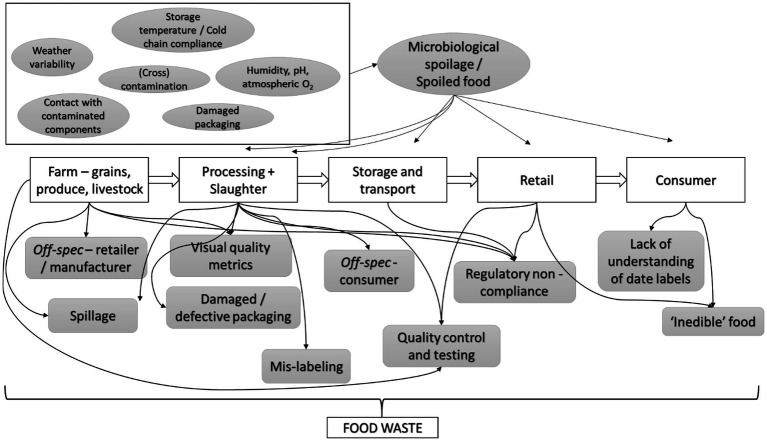
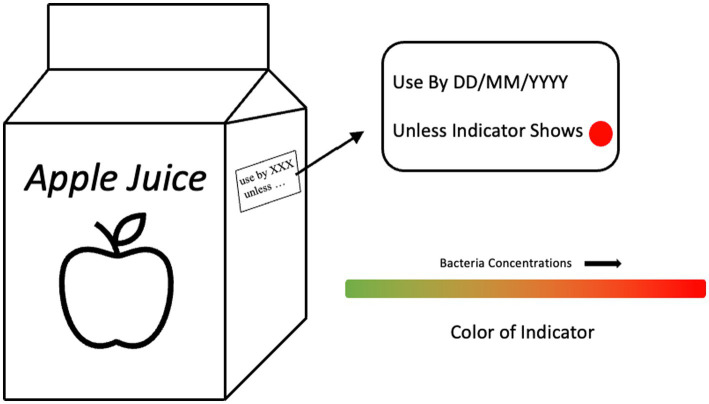
Ensuring a safe and adequate food supply is a cornerstone of human health and food security. However, a significant portion of the food produced for human consumption is wasted annually on a global scale. Reducing harvest and postharvest food waste, waste during food processing, as well as food waste at the consumer level, have been key objectives of improving and maintaining sustainability. These issues can range from damage during processing, handling, and transport, to the use of inappropriate or outdated systems, and storage and packaging-related issues. Microbial growth and (cross)contamination during harvest, processing, and packaging, which causes spoilage and safety issues in both fresh and packaged foods, is an overarching issue contributing to food waste. Microbial causes of food spoilage are typically bacterial or fungal in nature and can impact fresh, processed, and packaged foods. Moreover, spoilage can be influenced by the intrinsic factors of the food (water activity, pH), initial load of the microorganism and its interaction with the surrounding microflora, and external factors such as temperature abuse and food acidity, among others. Considering this multifaceted nature of the food system and the factors driving microbial spoilage, there is an immediate need for the use of novel approaches to predict and potentially prevent the occurrence of such spoilage to minimize food waste at the harvest, post-harvest, processing, and consumer levels. Quantitative microbial spoilage risk assessment (QMSRA) is a predictive framework that analyzes information on microbial behavior under the various conditions encountered within the food ecosystem, while employing a probabilistic approach to account for uncertainty and variability. Widespread adoption of the QMSRA approach could help in predicting and preventing the occurrence of spoilage along the food chain. Alternatively, the use of advanced packaging technologies would serve as a direct prevention strategy, potentially minimizing (cross)contamination and assuring the safe handling of foods, in order to reduce food waste at the post-harvest and retail stages. Finally, increasing transparency and consumer knowledge regarding food date labels, which typically are indicators of food quality rather than food safety, could also contribute to reduced food waste at the consumer level. The objective of this review is to highlight the impact of microbial spoilage and (cross)contamination events on food loss and waste. The review also discusses some novel methods to mitigate food spoilage and food loss and waste, and ensure the quality and safety of our food supply.
确保安全充足的食物供应是人类健康和粮食安全的基石。然而,全球每年有很大一部分供人类食用的食物被浪费。减少收获后和收获前的食物浪费、食品加工过程中的浪费以及消费者层面的食物浪费,一直是改善和维持可持续性的关键目标。这些问题涵盖范围广泛,从加工、处理和运输过程中的损坏,到使用不当或过时的系统,以及与储存和包装相关的问题。收获、加工和包装过程中的微生物生长和(交叉)污染会导致新鲜食品和包装食品出现变质和安全问题,这是造成食物浪费的一个首要问题。食物变质的微生物原因通常是细菌或真菌,会影响新鲜、加工和包装食品。此外,变质会受到食品的内在因素(水分活度、pH值)、微生物的初始载量及其与周围微生物群落的相互作用,以及温度滥用和食品酸度等外部因素的影响。考虑到食品系统的这种多面性以及导致微生物变质的因素,迫切需要采用新方法来预测并可能预防此类变质的发生,以尽量减少收获、收获后、加工和消费者层面的食物浪费。定量微生物变质风险评估(QMSRA)是一个预测框架,它分析食品生态系统中各种条件下微生物行为的信息,同时采用概率方法来考虑不确定性和可变性。广泛采用QMSRA方法有助于预测和预防食物链中变质的发生。或者,使用先进的包装技术将作为一种直接预防策略,有可能最大限度地减少(交叉)污染并确保食品的安全处理,从而减少收获后和零售阶段的食物浪费。最后,提高消费者对食品日期标签的透明度和认知度(日期标签通常是食品质量而非食品安全的指标),也有助于减少消费者层面的食物浪费。本综述的目的是强调微生物变质和(交叉)污染事件对食物损失和浪费的影响。综述还讨论了一些减轻食物变质、食物损失和浪费,并确保我们食物供应质量和安全的新方法。