Pacher Nicola, Burtscher Johanna, Johler Sophia, Etter Danai, Bender Denisse, Fieseler Lars, Domig Konrad J
Institute of Food Science, Department of Food Science and Technology, University of Natural Resources and Life Sciences, Vienna, Muthgasse 18, 1190 Vienna, Austria.
Institute for Food Safety and Hygiene, Vetsuisse Faculty, University of Zurich, Winterthurerstr. 272, 8057 Zurich, Switzerland.
Foods. 2022 Sep 29;11(19):3021. doi: 10.3390/foods11193021.
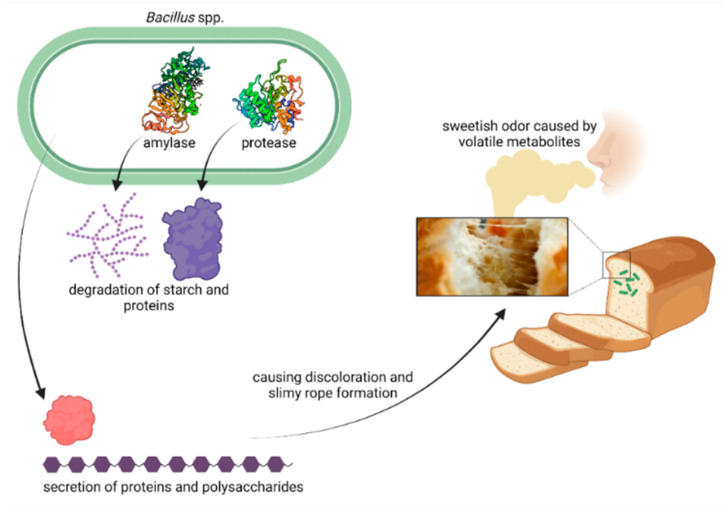
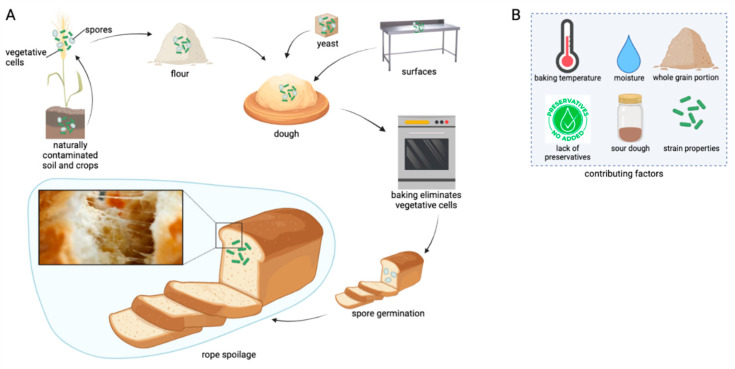
As bread is a very important staple food, its spoilage threatens global food security. Ropy bread spoilage manifests in sticky and stringy degradation of the crumb, slime formation, discoloration, and an odor reminiscent of rotting fruit. Increasing consumer demand for preservative-free products and global warming may increase the occurrence of ropy spoilage. , , , the group, , , , , , and were reported to cause ropiness in bread. Process hygiene does not prevent ropy spoilage, as contamination of flour with these species is unavoidable due to their occurrence as a part of the endophytic commensal microbiota of wheat and the formation of heat-stable endospores that are not inactivated during processing, baking, or storage. To date, the underlying mechanisms behind ropy bread spoilage remain unclear, high-throughput screening tools to identify rope-forming bacteria are missing, and only a limited number of strategies to reduce rope spoilage were described. This review provides a current overview on (i) routes of entry of endospores into bread, (ii) bacterial species implicated in rope spoilage, (iii) factors influencing rope development, and (iv) methods used to assess bacterial rope-forming potential. Finally, we pinpoint key gaps in knowledge and related challenges, as well as future research questions.
由于面包是一种非常重要的主食,其变质威胁着全球粮食安全。粘性面包变质表现为面包心出现粘性和丝状降解、形成黏液、变色以及产生类似腐烂水果的气味。消费者对无防腐剂产品需求的增加以及全球变暖可能会增加粘性变质的发生率。据报道,[具体微生物名称1]、[具体微生物名称2]、[具体微生物名称3]、[具体微生物名称4]、[具体微生物名称5]、[具体微生物名称6]和[具体微生物名称7]会导致面包产生粘性。工艺卫生无法防止粘性变质,因为这些微生物会作为小麦内生共生微生物群的一部分出现,并且会形成热稳定的内生孢子,这些孢子在加工、烘焙或储存过程中不会失活,所以面粉不可避免地会被这些微生物污染。迄今为止,粘性面包变质背后的潜在机制仍不清楚,缺少用于鉴定产粘性细菌的高通量筛选工具,并且仅描述了有限数量的减少粘性变质的策略。本综述提供了关于以下方面的当前概述:(i)[具体微生物名称8]内生孢子进入面包的途径,(ii)与粘性变质有关的细菌种类,(iii)影响粘性形成的因素,以及(iv)用于评估细菌产生粘性潜力的方法。最后,我们指出了知识方面的关键差距和相关挑战,以及未来的研究问题。