Department of Gastroenterology, Second Hospital of Dalian Medical University, Dalian 116000, Liaoning Province, China.
State Key Laboratory of Pathogen and Biosecurity, Institute of Microbiology and Epidemiology, Academy of Military Medical Sciences, Beijing 100071, China.
World J Gastroenterol. 2023 Jun 28;29(24):3793-3806. doi: 10.3748/wjg.v29.i24.3793.
Formyl peptide receptor 2 (Fpr2) is an important receptor in host resistance to bacterial infections. In previous studies, we found that the liver of Fpr2 mice is the most severely damaged target organ in bloodstream infections, although the reason for this is unclear.
To investigate the role of Fpr2 in liver homeostasis and host resistance to bacterial infections.
Transcriptome sequencing was performed on the livers of Fpr2 and wild-type (WT) mice. Differentially expressed genes (DEGs) were identified in the Fpr2 and WT mice, and the biological functions of DEGs were analyzed by Gene Ontology (GO) and Kyoto Encyclopedia of Genes and Genomes (KEGG) en-richment analysis. Quantitative real time-polymerase chain reaction (qRT-PCR) and western blot (WB) analyses were used to further validate the expression levels of differential genes. Cell counting kit-8 assay was employed to investigate cell survival. The cell cycle detection kit was used to measure the distribution of cell cycles. The Luminex assay was used to analyze cytokine levels in the liver. The serum biochemical indices and the number of neutrophils in the liver were measured, and hepatic histopathological analysis was performed.
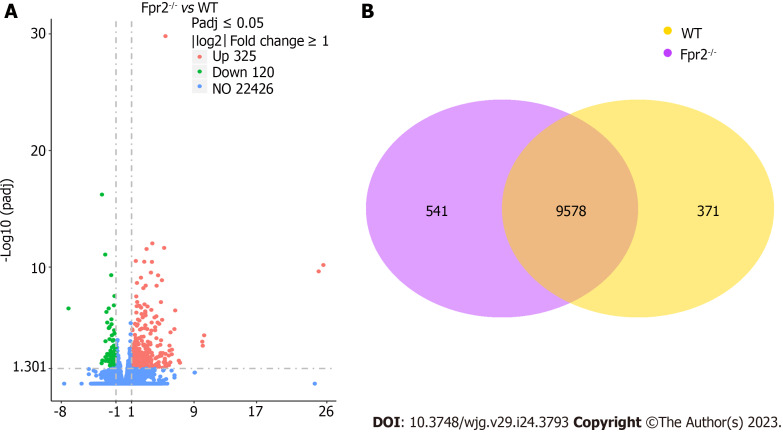
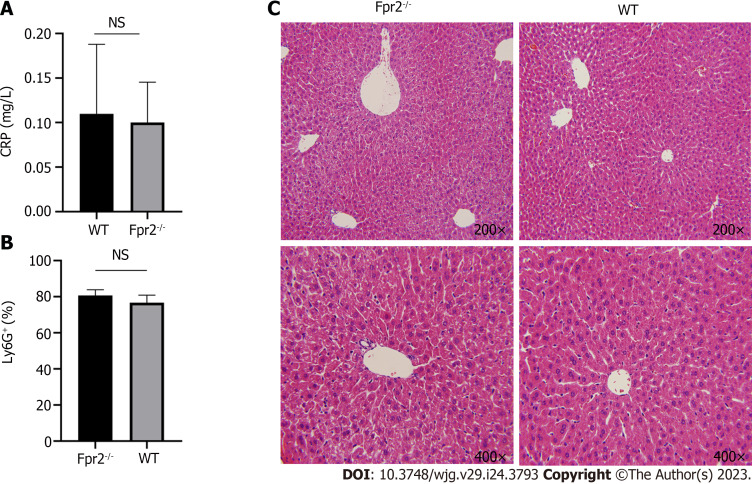
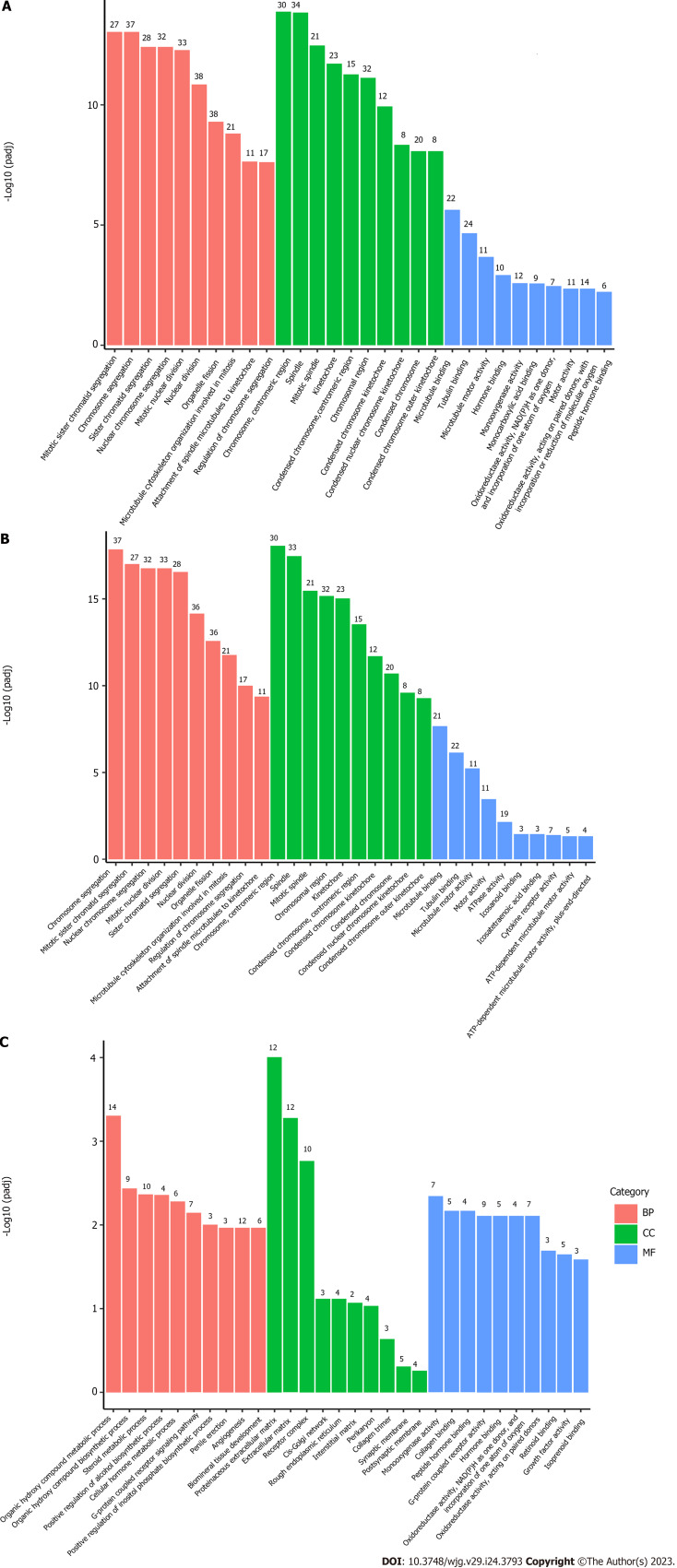
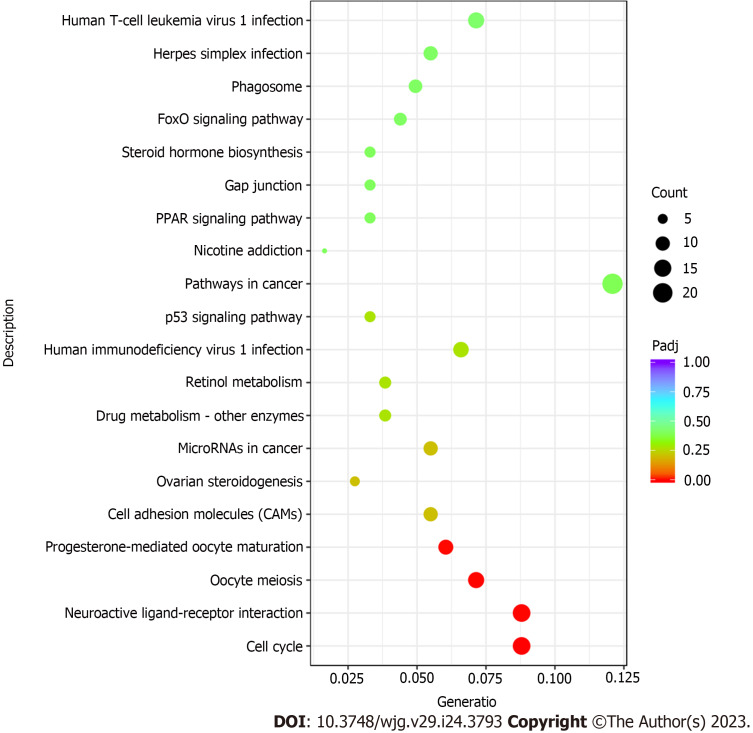
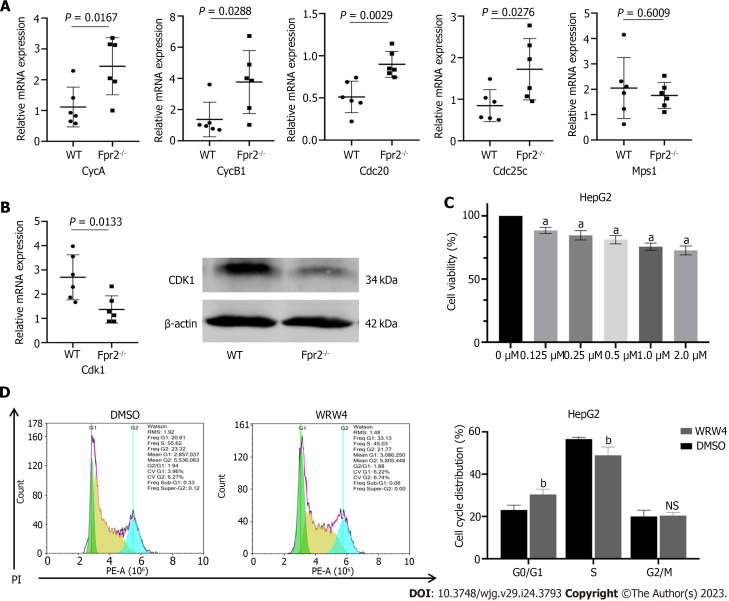
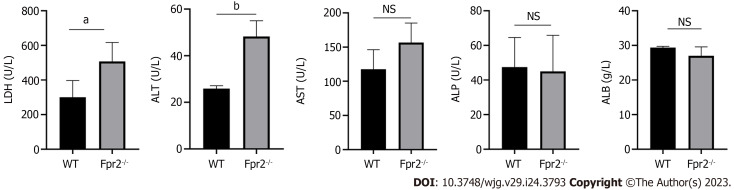
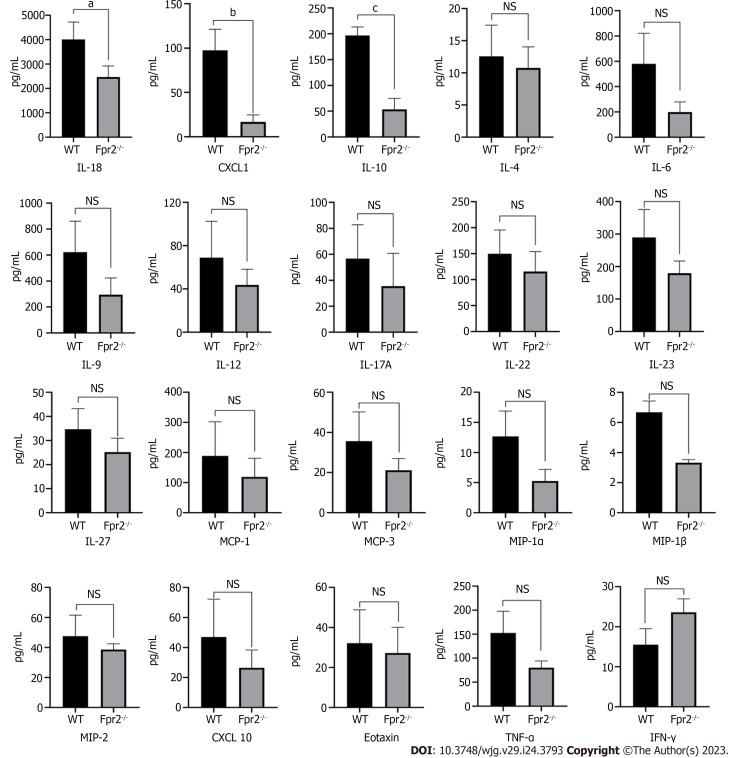
Compared with the WT group, 445 DEGs, including 325 upregulated genes and 120 downregulated genes, were identified in the liver of Fpr2 mice. The enrichment analysis using GO and KEGG showed that these DEGs were mainly related to cell cycle. The qRT-PCR analysis confirmed that several key genes (, , , , and ) involved in the cell cycle had significant changes. The WB analysis confirmed a decrease in the expression of CDK1 protein. WRW4 (an antagonist of Fpr2) could inhibit the proliferation of HepG2 cells in a concentration dependent manner, with an increase in the number of cells in the G0/G1 phase, and a decrease in the number of cells in the S phase. Serum alanine aminotransferase levels increased in Fpr2 mice. The Luminex assay measurements showed that interleukin (IL)-10 and chemokine (C-X-C motif) ligand (CXCL)-1 levels were significantly reduced in the liver of Fpr2 mice. There was no difference in the number of neutrophils, serum C-reactive protein levels, and liver pathology between WT and Fpr2 mice.
Fpr2 participates in the regulation of cell cycle and cell proliferation, and affects the expression of IL-10 and CXCL-1, thus playing an important protective role in maintaining liver homeostasis.
形式肽受体 2(Fpr2)是宿主抵抗细菌感染的重要受体。在以前的研究中,我们发现 Fpr2 小鼠的肝脏是血流感染中受损最严重的靶器官,尽管其原因尚不清楚。
研究 Fpr2 在肝脏稳态和宿主抵抗细菌感染中的作用。
对 Fpr2 和野生型(WT)小鼠的肝脏进行转录组测序。鉴定 Fpr2 和 WT 小鼠中的差异表达基因(DEGs),并通过基因本体论(GO)和京都基因与基因组百科全书(KEGG)富集分析分析 DEGs 的生物学功能。采用定量实时聚合酶链反应(qRT-PCR)和蛋白质印迹(WB)分析进一步验证差异基因的表达水平。细胞计数试剂盒-8 测定用于研究细胞存活。细胞周期检测试剂盒用于测量细胞周期的分布。Luminex 测定用于分析肝脏中的细胞因子水平。测量血清生化指标和肝脏中性粒细胞数量,并进行肝组织病理学分析。
与 WT 组相比,Fpr2 小鼠肝脏中鉴定出 445 个 DEGs,包括 325 个上调基因和 120 个下调基因。使用 GO 和 KEGG 的富集分析表明,这些 DEGs 主要与细胞周期有关。qRT-PCR 分析证实了几个关键基因(,,,,和)参与细胞周期的变化。WB 分析证实 CDK1 蛋白表达减少。WRW4(Fpr2 的拮抗剂)可浓度依赖性抑制 HepG2 细胞的增殖,G0/G1 期细胞数量增加,S 期细胞数量减少。Fpr2 小鼠血清丙氨酸氨基转移酶水平升高。Luminex 测定表明,Fpr2 小鼠肝脏中白细胞介素(IL)-10 和趋化因子(C-X-C 基序)配体(CXCL)-1 水平显著降低。WT 和 Fpr2 小鼠之间中性粒细胞数量、血清 C 反应蛋白水平和肝组织病理学无差异。
Fpr2 参与细胞周期和细胞增殖的调节,并影响 IL-10 和 CXCL-1 的表达,从而在维持肝脏稳态方面发挥重要的保护作用。