Key Laboratory of Livestock and Poultry Multi-Omics, Ministry of Agriculture and Rural Affairs, College of Animal Science and Technology, Sichuan Agricultural University, Chengdu 611130, China; Farm Animal Genetic Resource Exploration and Innovation Key Laboratory of Sichuan Province, Sichuan Agricultural University, Chengdu 611130, China.
Sichuan Lilaisinuo Biotechnology Co. LTD, Chengdu 611130, China.
Poult Sci. 2023 Sep;102(9):102879. doi: 10.1016/j.psj.2023.102879. Epub 2023 Jun 18.
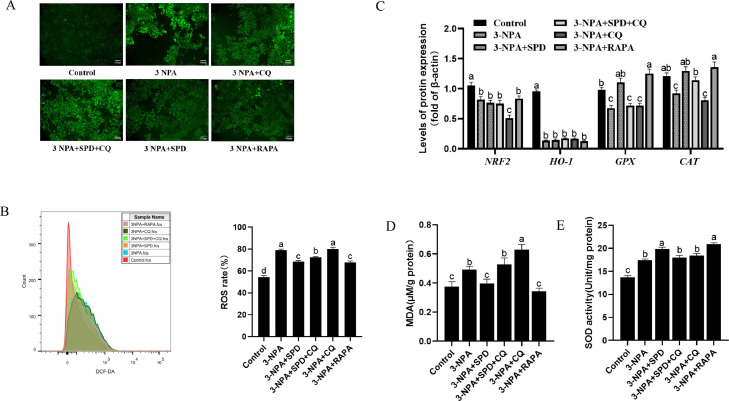
Spermidine have been reported a role in antioxidative, antiaging, and antiinflammatory. Oxidative stress causes granulosa cell (GC) apoptosis, follicular atresia, and impairs poultry reproductive functions. Studies have found that autophagy is the protective mechanism against antioxidant stress and apoptosis in cells. However, the relationship between spermidine-induced autophagy, oxidative stress, and apoptosis in goose GCs remains unclear. In this study, we investigated the autophagy mechanism to mediate spermidine effects on the alleviation of oxidative stress and apoptosis in goose GCs. Follicular GCs were treated with spermidine combination with 3-Nitropropanoic acid (3-NPA), rapamycin (RAPA), and chloroquine (CQ) or with hydrogen peroxide, RAPA, and CQ. Spermidine upregulated the ratio of LC3-II/I, inhibited the accumulation of p62 protein, and induced autophagy. 3-NPA treatment significantly increased ROS production, MDA content, SOD activity, cleaved CASPASE-3 protein expression, and decreased BCL-2 protein expression in follicular GCs. Spermidine inhibited oxidative stress and apoptosis induced by 3-NPA. In addition, hydrogen peroxide-induced oxidative stress was inhibited by spermidine. However, the inhibitory effect of spermidine was eliminated under chloroquine. Our results demonstrated that spermidine relieved oxidative stress and apoptosis of GCs by inducing autophagy, indicating that spermidine has a great potential to maintain proteostasis and sustain granulosa cell viability in geese.
精胺已被报道具有抗氧化、抗衰老和抗炎作用。氧化应激导致颗粒细胞 (GC) 凋亡、卵泡闭锁,并损害家禽的生殖功能。研究发现,自噬是细胞对抗氧化应激和凋亡的保护机制。然而,精胺诱导的自噬、氧化应激和凋亡之间的关系在鹅 GC 中尚不清楚。在这项研究中,我们研究了自噬机制,以介导精胺对减轻鹅 GC 中氧化应激和凋亡的作用。卵泡 GC 用精胺与 3-硝基丙酸 (3-NPA)、雷帕霉素 (RAPA) 和氯喹 (CQ) 或过氧化氢、RAPA 和 CQ 联合处理。精胺上调 LC3-II/I 的比值,抑制 p62 蛋白的积累,并诱导自噬。3-NPA 处理显著增加卵泡 GC 中的 ROS 产生、MDA 含量、SOD 活性、裂解 CASPASE-3 蛋白表达,并降低 BCL-2 蛋白表达。精胺抑制 3-NPA 诱导的氧化应激和凋亡。此外,精胺抑制了过氧化氢诱导的氧化应激。然而,在氯喹下,精胺的抑制作用被消除。我们的结果表明,精胺通过诱导自噬来减轻 GC 的氧化应激和凋亡,表明精胺在维持鹅颗粒细胞的蛋白质平衡和维持其活力方面具有很大的潜力。