Hospital Sírio-Libanês, Rua Barata Ribeiro, 142, 2O andar, São Paulo, SP, 01308-000, Brazil.
Universidade Federal de São Paulo (Unifesp), São Paulo, Brazil.
Health Res Policy Syst. 2023 Jul 10;21(1):71. doi: 10.1186/s12961-023-01017-2.
Health evidence needs to be communicated and disseminated in a manner that is clearly understood by decision-makers. As an inherent component of health knowledge translation, communicating results of scientific studies, effects of interventions and health risk estimates, in addition to understanding key concepts of clinical epidemiology and interpreting evidence, represent a set of essential instruments to reduce the gap between science and practice. The advancement of digital and social media has reshaped the concept of health communication, introducing new, direct and powerful communication platforms and gateways between researchers and the public. The objective of this scoping review was to identify strategies for communicating scientific evidence in healthcare to managers and/or population.
We searched Cochrane Library, Embase®, MEDLINE® and other six electronic databases, in addition to grey literature, relevant websites from related organizations for studies, documents or reports published from 2000, addressing any strategy for communicating scientific evidence on healthcare to managers and/or population.
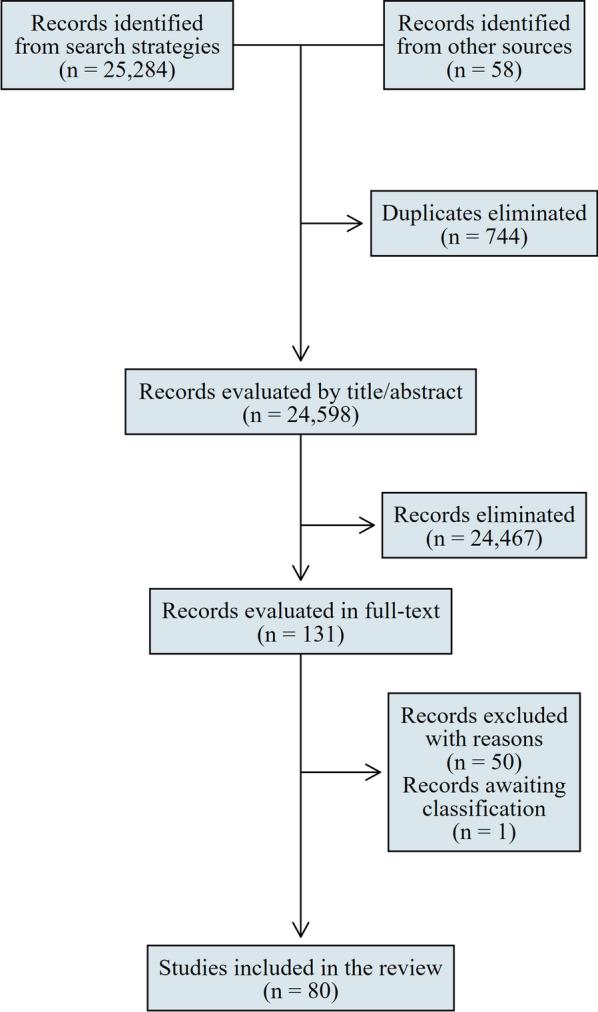
Our search identified 24 598 unique records, of which 80 met the inclusion criteria and addressed 78 strategies. Most strategies focused on risk and benefit communication in health, were presented by textual format and had been implemented and somehow evaluated. Among the strategies evaluated and appearing to yield some benefit are (i) risk/benefit communication: natural frequencies instead of percentages, absolute risk instead relative risk and number needed to treat, numerical instead nominal communication, mortality instead survival; negative or loss content appear to be more effective than positive or gain content; (ii) evidence synthesis: plain languages summaries to communicate the results of Cochrane reviews to the community were perceived as more reliable, easier to find and understand, and better to support decisions than the original summaries; (iii) teaching/learning: the Informed Health Choices resources seem to be effective for improving critical thinking skills.
Our findings contribute to both the knowledge translation process by identifying communication strategies with potential for immediate implementation and to future research by recognizing the need to evaluate the clinical and social impact of other strategies to support evidence-informed policies. Trial registration protocol is prospectively available in MedArxiv (doi.org/10.1101/2021.11.04.21265922).
健康证据需要以决策者能够理解的方式进行沟通和传播。作为健康知识转化的固有组成部分,除了理解临床流行病学的关键概念和解释证据外,沟通科学研究结果、干预效果和健康风险估计,以及传达科学证据,代表了一系列减少科学与实践之间差距的基本工具。数字和社交媒体的进步改变了健康沟通的概念,为研究人员和公众之间引入了新的、直接的和强大的沟通平台和门户。本范围综述的目的是确定向管理者和/或公众传达医疗保健科学证据的策略。
我们搜索了 Cochrane 图书馆、Embase®、MEDLINE® 和其他六个电子数据库,以及灰色文献,来自相关组织的相关网站上的研究、文件或报告,这些研究、文件或报告发表于 2000 年,涉及向管理者和/或公众传达医疗保健科学证据的任何策略。
我们的搜索确定了 24598 条独特的记录,其中 80 条符合纳入标准,涉及 78 种策略。大多数策略侧重于健康风险和效益沟通,以文本格式呈现,并已实施并进行了某种评估。在评估的策略中,似乎有一些益处的策略包括:(i)风险/效益沟通:使用自然频率而不是百分比、绝对风险而不是相对风险和需要治疗的人数、数值而不是名义沟通、死亡率而不是生存率;负面或损失内容似乎比正面或增益内容更有效;(ii)证据综合:使用通俗易懂的摘要向社区传达 Cochrane 综述的结果被认为比原始摘要更可靠、更容易找到和理解、更好地支持决策;(iii)教学/学习:知情健康选择资源似乎可以有效提高批判性思维技能。
我们的研究结果有助于知识转化过程,确定了具有立即实施潜力的沟通策略,并通过认识到需要评估其他支持循证政策的策略的临床和社会影响,为未来的研究做出贡献。试验注册方案在 MedArxiv(doi.org/10.1101/2021.11.04.21265922)中进行了前瞻性注册。