Nampoolsuksan Chawisa, Akaraviputh Thawatchai, Methasate Asada, Swangsri Jirawat, Trakarnsanga Atthaphorn, Phalanusitthepha Chainarong, Parakonthun Thammawat, Taweerutchana Voraboot, Srisuworanan Nicha, Suwatthanarak Tharathorn, Tawantanakorn Thikhamporn, Lohsiriwat Varut, Chinswangwatanakul Vitoon
Department of Surgery, Faculty of Medicine Siriraj Hospital, Mahidol University, Bangkok, Thailand.
Clin Endosc. 2024 May;57(3):335-341. doi: 10.5946/ce.2023.018. Epub 2023 Jun 21.
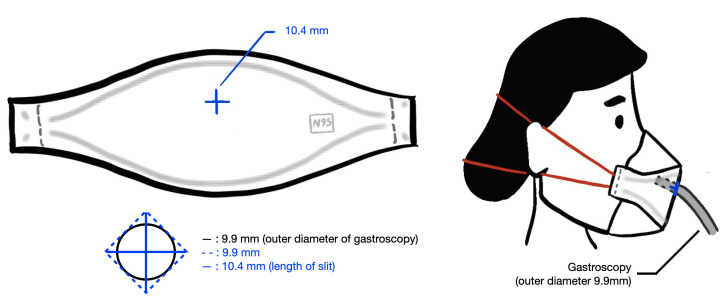
BACKGROUND/AIMS: The coronavirus disease 2019 pandemic has affected the worldwide practice of upper gastrointestinal endoscopy. Here we designed a modified N95 respirator with a channel for endoscope insertion and evaluated its efficacy in upper gastrointestinal endoscopy.
Thirty patients scheduled for upper gastrointestinal endoscopy were randomized into the modified N95 (n=15) or control (n=15) group. The mask was placed on the patient after anesthesia administration and particles were counted every minute before (baseline) and during the procedure by a TSI AeroTrak particle counter (9306-04; TSI Inc.) and categorized by size (0.3, 0.5, 1, 3, 5, and 10 µm). Differences in particle counts between time points were recorded.
During the procedure, the modified N95 group displayed significantly smaller overall particle sizes than the control group (median [interquartile range], 231 [54-385] vs. 579 [213-1,379]×103/m3; p=0.056). However, the intervention group had a significant decrease in 0.3-µm particles (68 [-25-185] vs. 242 [72-588]×103/m3; p=0.045). No adverse events occurred in either group. The device did not cause any inconvenience to the endoscopists or patients.
This modified N95 respirator reduced the number of particles, especially 0.3-µm particles, generated during upper gastrointestinal endoscopy.
背景/目的:2019年冠状病毒病大流行影响了全球上消化道内镜检查的实践。在此,我们设计了一种带有内镜插入通道的改良型N95口罩,并评估了其在上消化道内镜检查中的效果。
30例计划接受上消化道内镜检查的患者被随机分为改良N95组(n = 15)和对照组(n = 15)。在给予麻醉后将口罩戴在患者身上,并在操作前(基线)和操作过程中每分钟使用TSI AeroTrak颗粒计数器(9306 - 04;TSI公司)对颗粒进行计数,并按尺寸(0.3、0.5、1、3、5和10 µm)分类。记录各时间点之间颗粒计数的差异。
在操作过程中,改良N95组的总体颗粒尺寸明显小于对照组(中位数[四分位间距],231 [54 - 385]对579 [213 - 1379]×10³/m³;p = 0.056)。然而,干预组0.3 µm颗粒有显著减少(68 [-25 - 185]对242 [72 - 588]×10³/m³;p = 0.045)。两组均未发生不良事件。该装置未给内镜医师或患者带来任何不便。
这种改良型N95口罩减少了上消化道内镜检查过程中产生的颗粒数量,尤其是0.3 µm颗粒。