Morales-Muñoz Isabel, Hett Danielle, Humpston Clara, Mallikarjun Pavan K, Marwaha Steven
Institute for Mental Health University of Birmingham Birmingham UK.
Department of Public Health Solutions Mental Health Unit Finnish Institute for Health and Welfare Helsinki Finland.
JCPP Adv. 2022 Jun 24;2(3):e12089. doi: 10.1002/jcv2.12089. eCollection 2022 Sep.
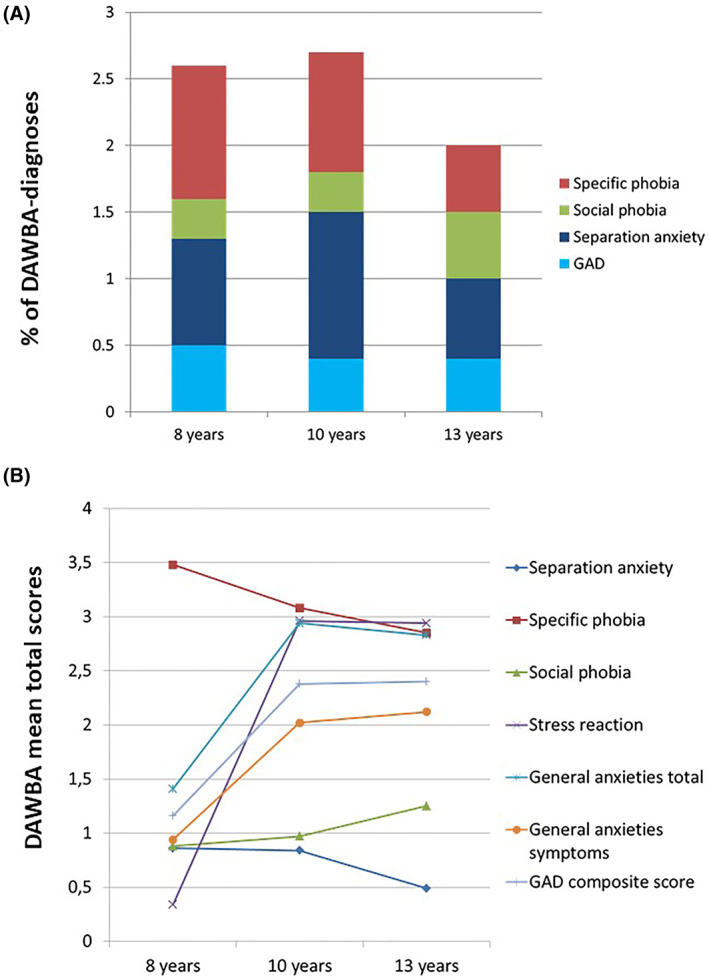
Patterns of development and underlying factors explaining anxiety disorders in children and adolescents are under-researched, despite their high prevalence, impact and associations with other mental disorders. We aimed to a] understand the pattern and persistence of specific anxiety disorders; b] examine differing trajectories of symptoms of specific anxiety disorders and; c] examine socio-demographic and health-related predictors of persistent anxiety disorder-specific symptoms, across middle childhood to early adolescence.
The current study used data from 8122 participants in the Avon Longitudinal Study of Parents and Children birth cohort. The Development and Wellbeing Assessment questionnaire was administered to parents to capture child and adolescent anxiety total scores and DAWBA-derived diagnoses. Separation anxiety, specific phobia, social anxiety, acute stress reaction, and generalized anxiety at 8, 10 and 13 years were selected. Further, we included the following socio-demographic and health-related predictors: sex, birth weight, sleep difficulties at 3.5 years, ethnicity, family adversity, maternal age at birth, maternal postnatal anxiety, maternal postnatal depression, maternal bonding, maternal socio-economic status and maternal education.
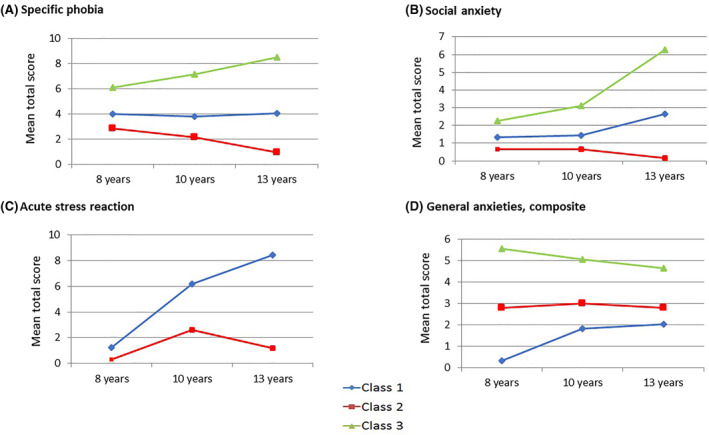
Different anxiety disorders presented different prevalence and patterns of development over time. Further, latent class growth analyses yielded a trajectory characterized by individuals with persistent high levels of anxiety across childhood and adolescence; for specific phobia (high = 5.8%; moderate = 20.5%; low = 73.6%), social anxiety (high = 3.4%; moderate = 12.1%; low = 84.5%), acute stress reaction (high = 1.9%; low = 98.1%) and generalized anxiety (high = 5.4%; moderate = 21.7%; low = 72.9%). Finally, the risk factors associated with each of the persistent high levels of anxiety disorders were child sleeping difficulties and postnatal maternal depression and anxiety.
Our findings show that a small group of children and young adolescents continue to suffer from frequent and severe anxiety. When considering treatment strategies for anxiety disorders in this group, children's sleep difficulties and postnatal maternal depression and anxiety need to be assessed as these may predict a more prolonged and severe course of illness.
尽管儿童和青少年焦虑症患病率高、影响大且与其他精神障碍有关联,但对其发展模式及解释焦虑症的潜在因素的研究仍不充分。我们旨在:a] 了解特定焦虑症的模式和持续性;b] 研究特定焦虑症症状的不同轨迹;c] 研究从中童年到青春期持续存在的特定焦虑症症状的社会人口统计学和健康相关预测因素。
本研究使用了埃文亲子纵向研究出生队列中8122名参与者的数据。向家长发放了发育与幸福感评估问卷,以获取儿童和青少年焦虑总分及源自发育与幸福感评估问卷的诊断结果。选取了8岁、10岁和13岁时的分离焦虑、特定恐惧症、社交焦虑、急性应激反应和广泛性焦虑。此外,我们纳入了以下社会人口统计学和健康相关预测因素:性别、出生体重、3.5岁时的睡眠困难、种族、家庭逆境、母亲生育年龄、母亲产后焦虑、母亲产后抑郁、母婴联结、母亲社会经济地位和母亲教育程度。
不同的焦虑症呈现出不同的患病率和随时间变化的发展模式。此外,潜在类别增长分析得出了一种轨迹,其特征是在童年和青春期焦虑水平持续较高的个体;特定恐惧症(高 = 5.8%;中 = 20.5%;低 = 73.6%)、社交焦虑(高 = 3.4%;中 = 12.1%;低 = 84.5%)、急性应激反应(高 = 1.9%;低 = 98.1%)和广泛性焦虑(高 = 5.4%;中 = 21.7%;低 = 72.9%)。最后,与每种持续高水平焦虑症相关的风险因素是儿童睡眠困难以及母亲产后抑郁和焦虑。
我们的研究结果表明,一小部分儿童和青少年持续遭受频繁且严重的焦虑。在考虑该群体焦虑症的治疗策略时,需要评估儿童的睡眠困难以及母亲产后抑郁和焦虑,因为这些可能预示着病程更长且更严重。