
静息和运动后摄入甜菜根汁的代谢生物标志物。
Metabolic Biomarkers of Red Beetroot Juice Intake at Rest and after Physical Exercise.
机构信息
NMR-Based Metabolomics Laboratory (NMLab), Sapienza University of Rome, 00185 Rome, Italy.
Department of Environmental Biology, Sapienza University of Rome, 00185 Rome, Italy.
出版信息
Nutrients. 2023 Apr 22;15(9):2026. doi: 10.3390/nu15092026.
BACKGROUND
Red beetroot is known to be a health-promoting food. However, little attention is placed on intestinal bioactive compound absorption. The aim of the study was to assess the urinary red beetroot juice (RBJ) intake biomarkers and possible differences in RBJ's micronutrient absorption at rest or after physical exercise.
METHODS
This is a three-armed, single-blind study, involving seven healthy volunteers which were randomly divided into three groups and alternatively assigned to three experimental sessions: RBJ intake at rest, RBJ intake with physical activity, and placebo intake with physical activity. For each session, urine samples were collected before and 120, 180, and 240 min after the intake of RBJ or placebo. The same sampling times were employed for the experimental session at rest. The RBJ metabolic composition was also characterized to identify the urinary biomarkers derived from the intake.
RESULTS
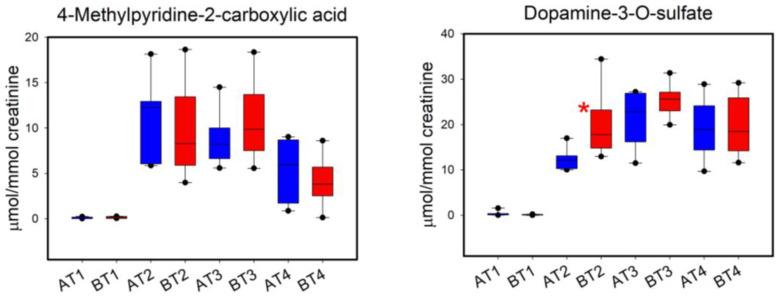
4-methylpyridine-2-carboxylic acid, dopamine-3-O-sulfate, glutamine, and 3-hydroxyisobutyrate were identified as RBJ intake biomarkers. Physical activity significantly increased only the dopamine-3-O-sulfate excretion 120 min after RBJ intake.
CONCLUSIONS
Urinary dopamine-3-O-sulfate is related to RBJ dopamine content, while 4-methylpyridine-2-carboxylic acid is a betanin or betalamic acid catabolite. The different excretions of these metabolites following physical activity suggest a possible effect on the RBJ uptake depending on different transport processes through the mucosa, namely diffusion-mediated transport for dopamine and saturable transcellular transport for betalamic acid derivatives. These results open new perspectives in improving the absorption of natural bioactive molecules through physical activity.
背景
众所周知,红甜菜根是一种有益健康的食物。然而,人们对其肠道生物活性化合物的吸收关注甚少。本研究旨在评估尿中红甜菜根汁(RBJ)的摄入量生物标志物,以及在休息或运动后 RBJ 中微量营养素吸收的差异。
方法
这是一项三臂、单盲研究,涉及 7 名健康志愿者,他们被随机分为三组,并分别分配到三个实验组:休息时摄入 RBJ、运动时摄入 RBJ 或运动时摄入安慰剂。对于每个实验组,在摄入 RBJ 或安慰剂前和 120、180 和 240 分钟后采集尿样。在休息时的实验组中也采用相同的采样时间。还对 RBJ 的代谢成分进行了特征分析,以确定源自摄入的尿液生物标志物。
结果
鉴定出 4-甲基吡啶-2-羧酸、多巴胺-3-O-硫酸盐、谷氨酰胺和 3-羟基异丁酸为 RBJ 摄入量的生物标志物。运动仅显著增加了 RBJ 摄入 120 分钟后多巴胺-3-O-硫酸盐的排泄。
结论
尿中多巴胺-3-O-硫酸盐与 RBJ 中的多巴胺含量有关,而 4-甲基吡啶-2-羧酸是甜菜碱或甜菜酰胺酸的代谢产物。这些代谢物在运动后的不同排泄表明,RBJ 摄取可能会受到不同的黏膜转运过程的影响,即多巴胺的扩散介导转运和甜菜酰胺酸衍生物的饱和跨细胞转运。这些结果为通过运动来提高天然生物活性分子的吸收提供了新的视角。




 Zotero 插件