Institute of Geosciences, Goethe University Frankfurt, 60438, Frankfurt am Main, Germany.
Department of Human Evolution, Max Planck Institute for Evolutionary Anthropology, 04103, Leipzig, Germany.
Commun Biol. 2023 Jul 11;6(1):711. doi: 10.1038/s42003-023-05085-6.
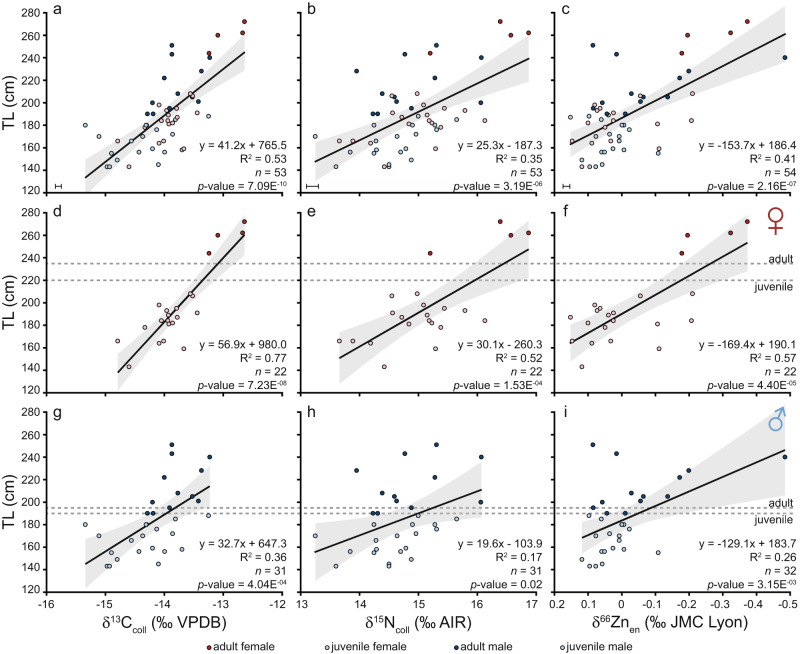
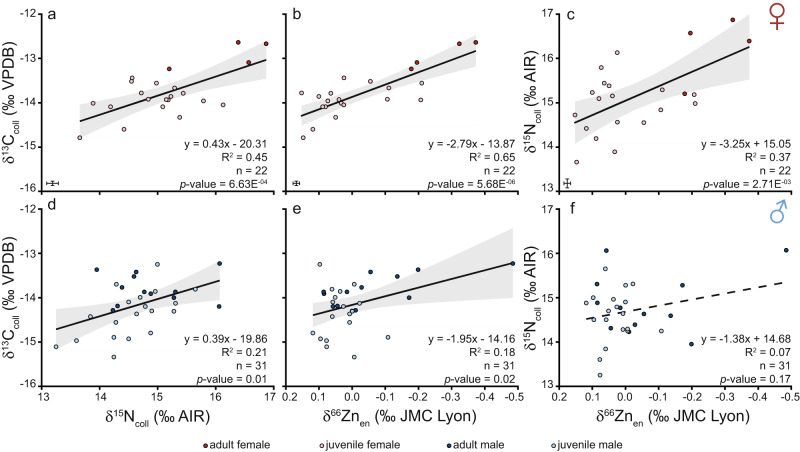
Trophic ecology and resource use are challenging to discern in migratory marine species, including sharks. However, effective management and conservation strategies depend on understanding these life history details. Here we investigate whether dental enameloid zinc isotope (δZn) values can be used to infer intrapopulation differences in foraging ecology by comparing δZn with same-tooth collagen carbon and nitrogen (δC, δN) values from critically endangered sand tiger sharks (Carcharias taurus) from Delaware Bay (USA). We document ontogeny and sex-related isotopic differences indicating distinct diet and habitat use at the time of tooth formation. Adult females have the most distinct isotopic niche, likely feeding on higher trophic level prey in a distinct habitat. This multi-proxy approach characterises an animal's isotopic niche in greater detail than traditional isotope analysis alone and shows that δZn analysis can highlight intrapopulation dietary variability thereby informing conservation management and, due to good δZn fossil tooth preservation, palaeoecological reconstructions.
营养生态学和资源利用对于包括鲨鱼在内的洄游海洋物种来说难以识别。然而,有效的管理和保护策略取决于对这些生活史细节的理解。在这里,我们通过比较濒危的砂鲛(Carcharias taurus)的牙齿珐琅质锌同位素(δZn)值与同齿胶原碳和氮(δC、δN)值,研究了δZn 是否可用于推断种群内觅食生态的差异。我们记录了个体发育和性别相关的同位素差异,这些差异表明在牙齿形成时存在不同的饮食和生境利用。成年雌性具有最独特的同位素生态位,可能以不同的生境为食,捕食更高营养级别的猎物。这种多探针方法比传统的同位素分析更详细地描述了动物的同位素生态位,并表明 δZn 分析可以突出种群内饮食的可变性,从而为保护管理提供信息,并且由于良好的 δZn 化石牙齿保存,还可以进行古生态学重建。