School of Forensic Medicine, Shanxi Medical University, Jinzhong, 030600, Shanxi, People's Republic of China.
Shanxi Key Laboratory of Forensic Medicine, Jinzhong, 030600, Shanxi, People's Republic of China.
Sci Rep. 2023 Jul 11;13(1):11190. doi: 10.1038/s41598-023-38246-y.
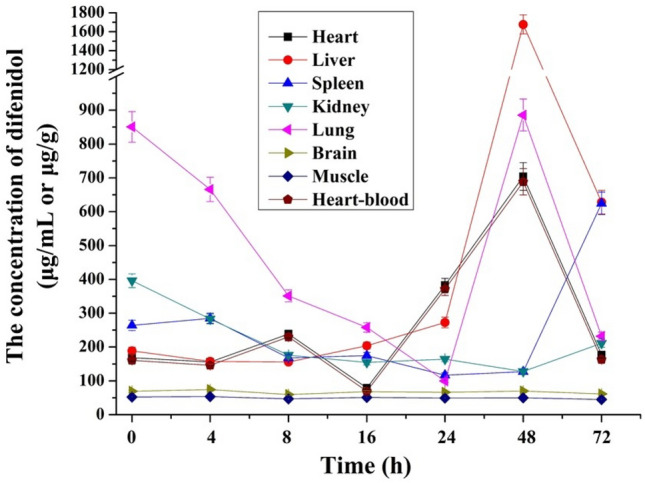
A gas chromatography-mass spectrometry (GC-MS) method for the determination of difenidol hydrochloride in biological specimens has been developed. The method exhibited excellent recovery (> 90%) and precision (RSD < 10%), and the LOD was 0.05 μg/mL or μg/g, which met the requirements of bioanalytical method. Through the animal model of the forensic toxicokinetics, the dynamic distribution, postmortem redistribution (PMR) and stability in specimen preservation process of difenidol in animals were studied. The experimental results showed that after intragastric administration, the difenidol's concentrations in the heart-blood and various organs increased over time except stomach, and then decreased gradually after reaching the peaks of concentration. The toxicological kinetics equation and toxicokinetic parameters were established by processing the data of the mean drug concentration of difenidol changing with time. In PMR experiment, the concentrations of difenidol in some organs closer to the gastrointestinal tract (heart-blood, heart, liver, lung, kidney, and spleen) changed significantly at different time points. But the concentration of difenidol in brain tissues which were far away from the gastrointestinal tract and muscles with larger overall mass was relatively stable. PMR of difenidol was therefore confirmed. Thus, the effect of PMR on the concentration of difenidol in the specimens should be considered in cases involving difenidol poisoning or death. Furthermore, the stability of difenidol in heart-blood samples from poisoned rats was investigated at various time points and under different preservation conditions (20 °C, 4 °C, - 20 °C and 20 °C (1% NaF)) for a period of two months. Difenidol was stable and did not decompose in the preserved blood. Therefore, this study provided the experimental basis for the forensic identification of the cases of difenidol hydrochloride poisoning (death). PMR has been verified by practical lethal cases.
建立了一种气相色谱-质谱联用(GC-MS)法测定生物样本中盐酸二芬尼朵的方法。该方法表现出良好的回收率(>90%)和精密度(RSD<10%),检出限为 0.05μg/mL 或μg/g,符合生物分析方法的要求。通过法医毒代动力学动物模型,研究了二芬尼朵在动物体内的动态分布、死后再分布(PMR)和标本保存过程中的稳定性。实验结果表明,灌胃后,除胃外,心-血和各器官中二芬尼朵的浓度随时间逐渐增加,然后在达到浓度峰值后逐渐下降。通过处理二芬尼朵随时间变化的平均药物浓度数据,建立了毒代动力学方程和毒代动力学参数。在 PMR 实验中,在不同时间点,靠近胃肠道的一些器官(心-血、心脏、肝脏、肺、肾脏和脾脏)中二芬尼朵的浓度变化明显。但是,远离胃肠道且整体质量较大的脑组织中二芬尼朵的浓度相对稳定。因此,证实了二芬尼朵的 PMR。因此,在涉及二芬尼朵中毒或死亡的案例中,应考虑 PMR 对标本中二芬尼朵浓度的影响。此外,还在不同保存条件(20°C、4°C、-20°C 和 20°C(1%NaF))下,在不同时间点研究了中毒大鼠心-血样本中二芬尼朵的稳定性,持续两个月。二芬尼朵在保存的血液中稳定,不会分解。因此,本研究为盐酸二芬尼朵中毒(死亡)案例的法医鉴定提供了实验依据。PMR 已通过实际致命案例得到验证。