
公民科学数据揭示了大斑蝶对气候物候响应的区域异质性。
Citizen science data reveal regional heterogeneity in phenological response to climate in the large milkweed bug, .
作者信息
Garretson Alexis, Cuddy Tedra, Duffy Alexandra G, Forkner Rebecca E
机构信息
Graduate School of Biomedical Sciences Tufts University Boston Massachusetts USA.
The Jackson Laboratory Bar Harbor Maine USA.
出版信息
Ecol Evol. 2023 Jul 10;13(7):e10213. doi: 10.1002/ece3.10213. eCollection 2023 Jul.
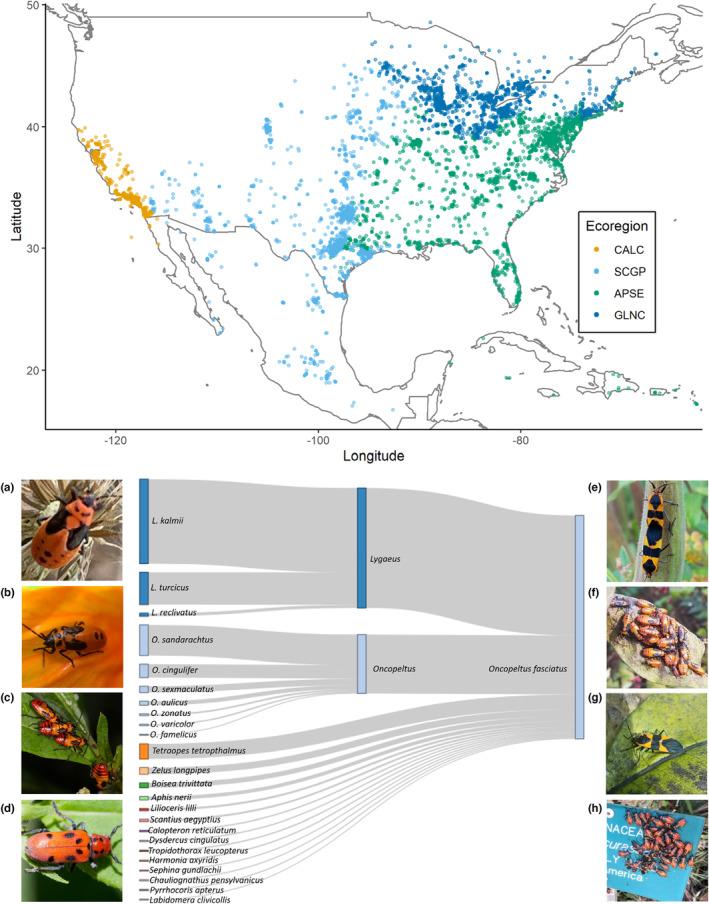
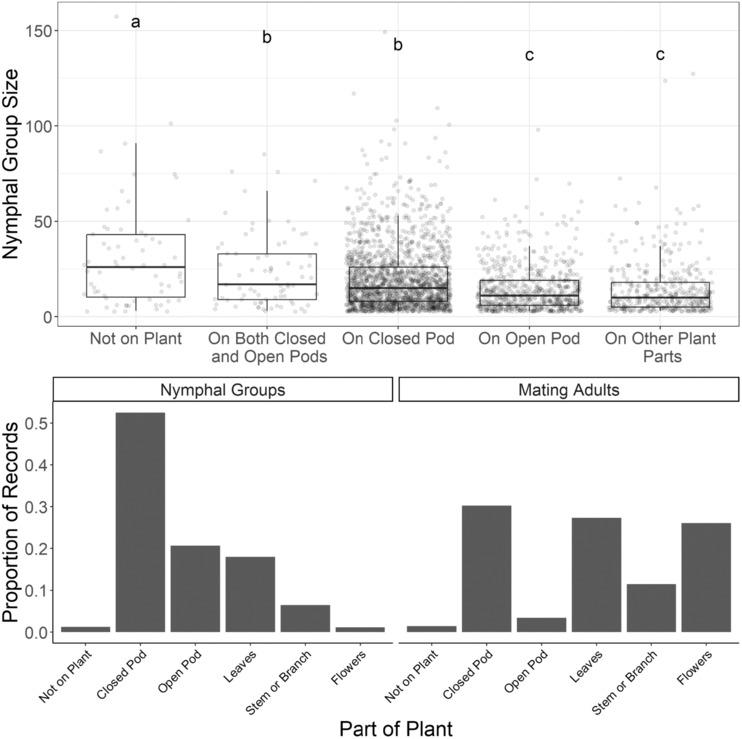
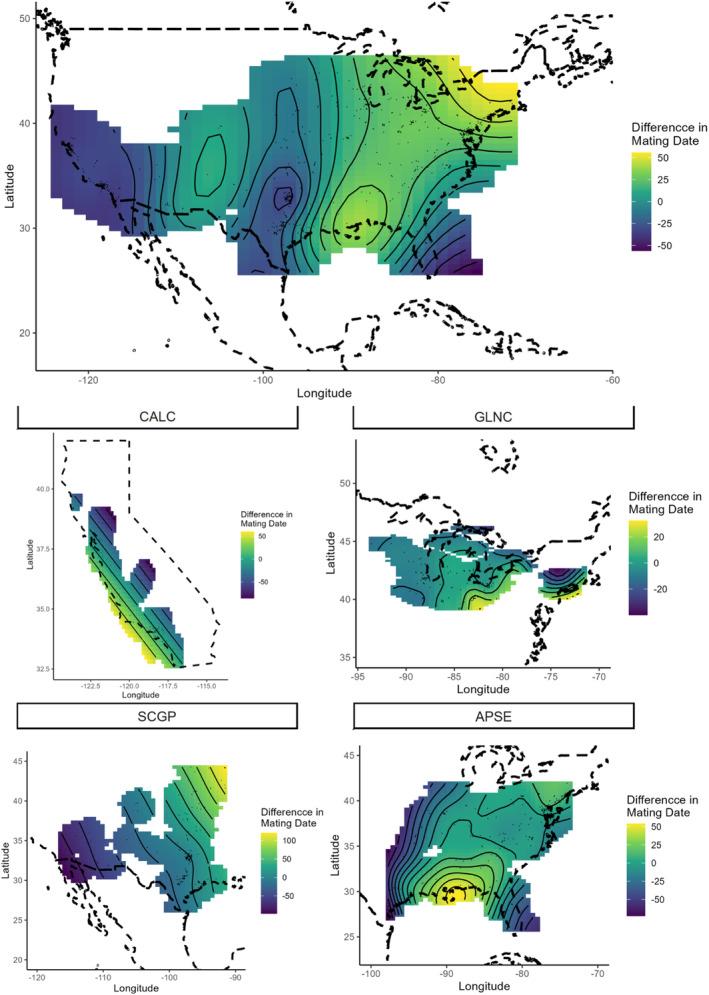
Regional populations of geographically widespread species may respond to different environmental factors across the species' range, generating divergent effects of climate change on life-history phenology. Using thousands of citizen science observations extracted from iNaturalist and associated with corresponding temperature, precipitation, elevation, and daylength information, we examined the drivers of adult mating and of nymphal phenology, development, and group size for populations of the large milkweed bug, , in different ecoregions. Research-grade iNaturalist images were correctly identified 98.3% of the time and yielded more than 3000 observations of nymphal groups and 1000 observations of mating adults spanning 18 years. Mating phenology showed distinct regional patterns, ranging from year-round mating in California to temporally restricted mating in the Great Lakes Northeastern Coast ecoregion. Relative temperature increases of 1°C for a given daylength expanded the mating season by more than a week in western ecoregions. While increases in relative temperature delayed mating phenology in all ecoregions, greater winter precipitation advanced mating in the California ecoregion. In the eastern ecoregions, nymphal phenology was delayed by increases in summer rainfall but was advanced by relative temperature increases, whereas in western regions, relative temperature increases delayed nymphal phenology. Furthermore, accumulated growing degree days (AGDD) was a poor predictor of developmental progression, as we found a positive but weak correlation between AGDD and age structure only for the Appalachian Southeast North America and the Great Lakes Northern Coast ecoregions. These complex phenological responses of are just one example of how populations may be differentially susceptible to a diversity of climatic effects; using data across a species' whole distribution is critical for exposing regional variations, especially for species with large, continental-scale ranges. This study demonstrates the potential of photodocumented biodiversity data to aid in the monitoring of life history, host plant-insect interactions, and climate responsiveness.
地理分布广泛的物种的区域种群可能会对物种分布范围内不同的环境因素做出反应,从而产生气候变化对生活史物候的不同影响。利用从iNaturalist中提取的数千条公民科学观测数据,并将其与相应的温度、降水、海拔和日照时长信息相关联,我们研究了大斑蝶不同生态区域种群的成虫交配以及若虫物候、发育和群体大小的驱动因素。研究级iNaturalist图像的识别准确率为98.3%,产生了超过3000条若虫群体观测数据和1000条跨越18年的交配成虫观测数据。交配物候呈现出明显的区域模式,从加利福尼亚全年交配到五大湖东北海岸生态区域受时间限制的交配。在给定日照时长下,相对温度每升高1°C,西部生态区域的交配季节就会延长一周以上。虽然相对温度升高在所有生态区域都延迟了交配物候,但冬季降水量增加使加利福尼亚生态区域的交配提前。在东部生态区域,夏季降雨量增加会延迟若虫物候,但相对温度升高会使其提前,而在西部地区,相对温度升高会延迟若虫物候。此外,累积生长度日(AGDD)对发育进程的预测能力较差,因为我们发现AGDD与年龄结构之间仅在北美阿巴拉契亚东南部和五大湖北部海岸生态区域存在正相关但较弱的关系。大斑蝶这种复杂的物候反应只是种群可能对多种气候影响有不同易感性的一个例子;利用物种整个分布范围内的数据对于揭示区域差异至关重要,特别是对于具有大陆尺度分布范围的物种。这项研究证明了有照片记录的生物多样性数据在监测生活史、寄主植物 - 昆虫相互作用和气候响应方面的潜力。



 Zotero 插件