Wang Xiaodan, Deng Weiping, Zhao Jiehui, Guo Yongchao, Lai Haifang, Hu Yueliang, Kang Wenyan, Li Yong, Zuo Junli
Department of Neurology and Institute of Neurology, Ruijin Hospital, Shanghai Jiao Tong University School of Medicine, Shanghai, 200025, People's Republic of China.
Department of General Practice, Daning Community Health Service Center, Shanghai, 200072, People's Republic of China.
Infect Drug Resist. 2023 Jul 6;16:4443-4452. doi: 10.2147/IDR.S409615. eCollection 2023.
Nutrition is an important prevention in old patients with COVID-19. However, in China, there are few studies on the correlation between nutrition and COVID-19.
A total of 148 hospitalized COVID-19 (65.7 ± 16.0 [range: from 21 to 101] years old) patients were enrolled in this study. The information of demographic, biochemical results, vaccination doses, types of COVID-19, PCR test negative conversion time, and scores of Mini Nutritional Assessment Short Form (MNA-SF) for evaluating nutritional status were recorded. We first explored the relationships between MNA-SF performance and the severities of COVID-19 in the groups with non-vaccinated, vaccinated, and all the patients using multivariable ordinal logistic regression. Further, we explored the relationships between performance of MNA-SF and the time of negative conversion of PCR in the groups with non-vaccinated, vaccinated, and all the patients using COX proportional hazards survival regression.
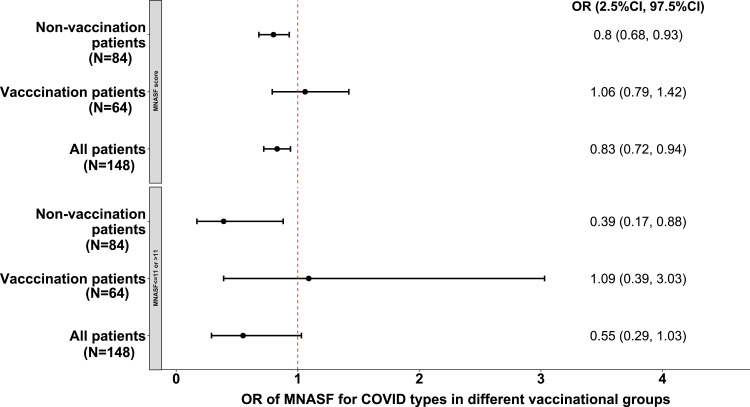
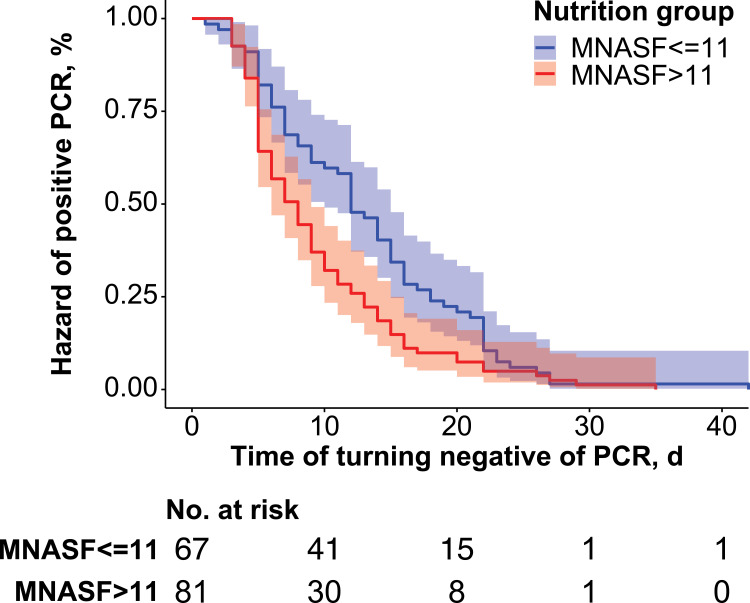
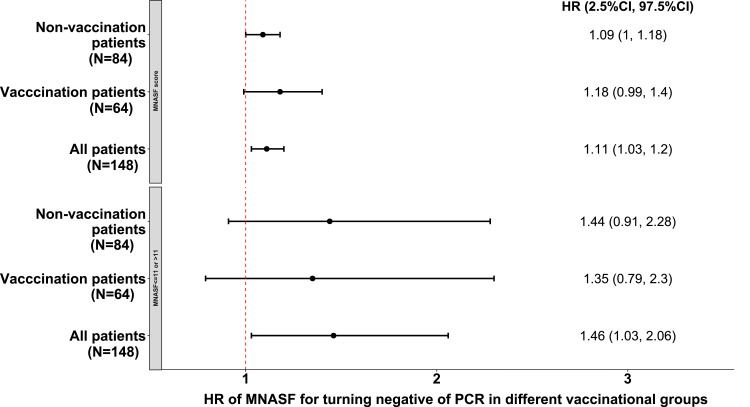
Group of patients with malnutrition or at risk of malnutrition group was associated with older of the age, those who had not been vaccinated, in fewer people who were asymptomatic type and in more people who showed longer of the negative conversion time of PCR, lower of the BMI, and the lower of the hemoglobin level. Each additional increase of one point of MNA-SF was associated with a 17% decrease in the odds of a worse type of COVID-19 in all patients, and the significant result exists in non-vaccinated patients. One point increase of MNA-SF was associated with increased 11% of hazard ratios of turning negative of PCR and well-nourished group was associated with increased 46% of hazard ratio of turning negative of PCR.
Higher nutrition is associated with less severity of COVID-19, especially in the non-vaccinated group. Higher nutrition is also associated with shorter time of turning negative of PCR in non-ICU COVID-19 patients.
营养是老年 COVID-19 患者的一项重要预防措施。然而,在中国,关于营养与 COVID-19 之间相关性的研究较少。
本研究共纳入 148 例住院的 COVID-19 患者(年龄 65.7±16.0[范围:21 至 101 岁])。记录了人口统计学信息、生化结果、疫苗接种剂量、COVID-19 类型、PCR 检测阴性转换时间以及用于评估营养状况的简易营养评估简表(MNA-SF)评分。我们首先使用多变量有序逻辑回归探讨了未接种疫苗组、接种疫苗组和所有患者中 MNA-SF 表现与 COVID-19 严重程度之间的关系。此外,我们使用 COX 比例风险生存回归探讨了未接种疫苗组、接种疫苗组和所有患者中 MNA-SF 表现与 PCR 阴性转换时间之间的关系。
营养不良或有营养不良风险组的患者与年龄较大、未接种疫苗、无症状类型患者较少以及 PCR 阴性转换时间较长、BMI 较低和血红蛋白水平较低的患者相关。在所有患者中,MNA-SF 每增加 1 分,COVID-19 病情加重类型的几率降低 17%,在未接种疫苗的患者中存在显著结果。MNA-SF 增加 1 分与 PCR 转阴风险比增加 11%相关,营养良好组与 PCR 转阴风险比增加 46%相关。
营养状况较好与 COVID-19 病情较轻相关,尤其是在未接种疫苗的人群中。营养状况较好还与非 ICU 的 COVID-19 患者 PCR 转阴时间较短相关。