Squires Mathieu, Green Jordan Howard, Patel Rakesh, Aleem Ilyas
Department of Orthopaedic Surgery, University of Michigan, Ann Arbor, MI, USA.
J Spine Surg. 2023 Jun 30;9(2):139-148. doi: 10.21037/jss-22-78. Epub 2023 Mar 17.
Vertebral compression fractures are common and result in significant pain and loss of function. Treatment strategy, however, remains controversial. We conducted a meta-analysis of randomized trials to elucidate the impact of bracing on these injuries.
A comprehensive literature review utilizing Embase, OVID MEDLINE, and the Cochrane Library was performed to identify randomized trials evaluating brace therapy for adult patients with thoracic and lumbar compression fractures. Two independent reviewers assessed the eligibility of studies and risk of bias. The primary assessed outcome was pain after injury. Secondary outcomes were function, quality of life, opioid use, and kyphotic progression [anterior vertebral body compression percentage (AVBCP)]. Continuous variables were analyzed using mean differences and standardized mean differences, and dichotomous variables were analyzed using odds ratios in random-effects models. GRADE criteria were applied.
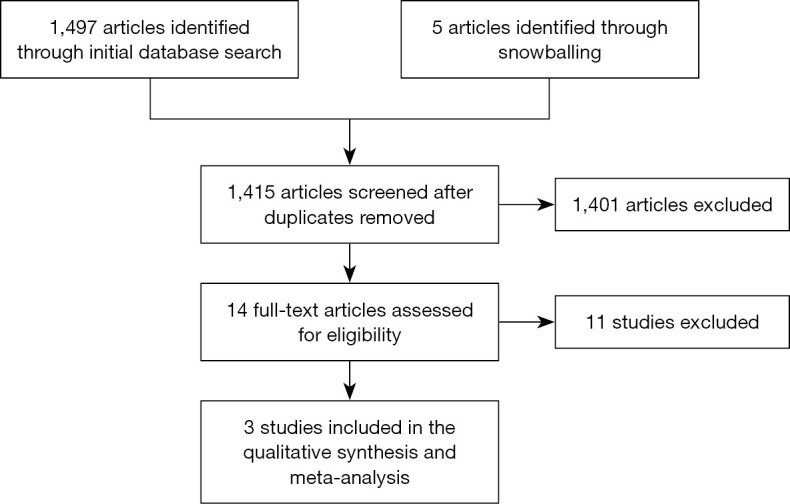
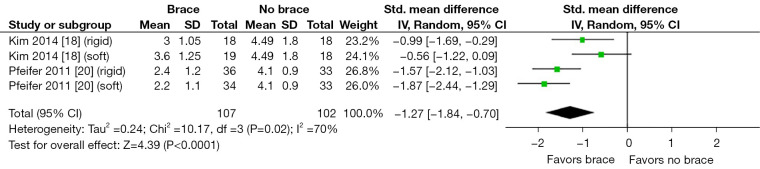
Of 1,502 articles, a total of 3 studies with 447 patients (96% female) were included. Fifty-four patients were managed without a brace, and 393 with a brace (195 rigid, 198 soft). At 3 to 6 months post-injury, rigid bracing resulted in significantly less pain compared to no brace (SMD =-1.32, 95% CI: -1.89 to -0.76, P<0.05, I=41%), though this diminished at long-term follow-up of 48 weeks. Radiographic kyphosis, opioid use, function, or quality of life were not significantly different at any timepoint.
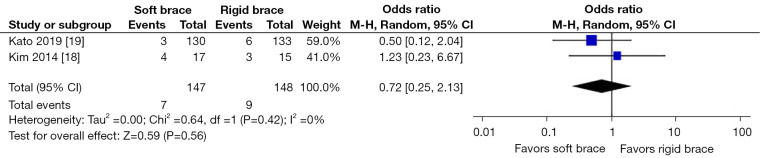
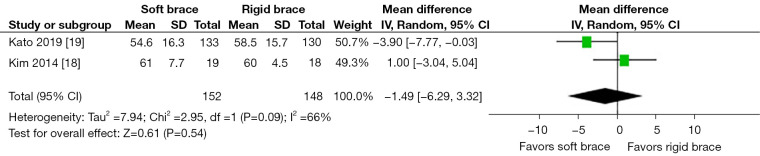
Moderate quality evidence demonstrates rigid bracing of vertebral compression fractures may decrease pain up to 6 months post-injury, though there is no difference in radiographic parameters, opioid use, function, or quality of life at short- or long-term follow-up. No difference was found between rigid and soft bracing; therefore, soft bracing may be an adequate alternative.
椎体压缩性骨折很常见,会导致严重疼痛和功能丧失。然而,治疗策略仍存在争议。我们进行了一项随机试验的荟萃分析,以阐明支具对这些损伤的影响。
利用Embase、OVID MEDLINE和Cochrane图书馆进行全面的文献综述,以确定评估支具治疗成人胸腰椎压缩性骨折的随机试验。两名独立的评审员评估了研究的 eligibility 和偏倚风险。主要评估结果是受伤后的疼痛。次要结果是功能、生活质量、阿片类药物使用和后凸畸形进展[椎体前缘压缩百分比(AVBCP)]。连续变量使用平均差和标准化平均差进行分析,二分变量在随机效应模型中使用比值比进行分析。应用了GRADE标准。
在1502篇文章中,共纳入3项研究,447例患者(96%为女性)。54例患者未使用支具治疗,393例使用支具治疗(195例使用硬支具,198例使用软支具)。受伤后3至6个月,与不使用支具相比,硬支具导致的疼痛明显减轻(SMD=-1.32,95%CI:-1.89至-0.76,P<0.05,I=41%),尽管在48周的长期随访中这种差异有所减小。在任何时间点,影像学后凸畸形、阿片类药物使用、功能或生活质量均无显著差异。
中等质量的证据表明,椎体压缩性骨折的硬支具治疗可能会在受伤后6个月内减轻疼痛,尽管在短期或长期随访中,影像学参数、阿片类药物使用、功能或生活质量并无差异。硬支具和软支具之间未发现差异;因此,软支具可能是一种合适的替代方案。