Le Boterff Quentin, Rabah Ayah, Carment Loïc, Bendjemaa Narjes, Térémetz Maxime, Alouit Anaëlle, Levy Agnes, Tanguy Guillaume, Morin Valentine, Amado Isabelle, Cuenca Macarena, Turc Guillaume, Maier Marc A, Krebs Marie-Odile, Lindberg Påvel G
INSERM U1266 Institut de Psychiatrie et Neurosciences de Paris, Paris, France.
GHU Paris Psychiatrie & Neurosciences, Paris, France.
Front Psychiatry. 2023 Jun 26;14:1200864. doi: 10.3389/fpsyt.2023.1200864. eCollection 2023.
We performed a pilot study on whether tablet-based measures of manual dexterity can provide behavioral markers for detection of first-episode psychosis (FEP), and whether cortical excitability/inhibition was altered in FEP.
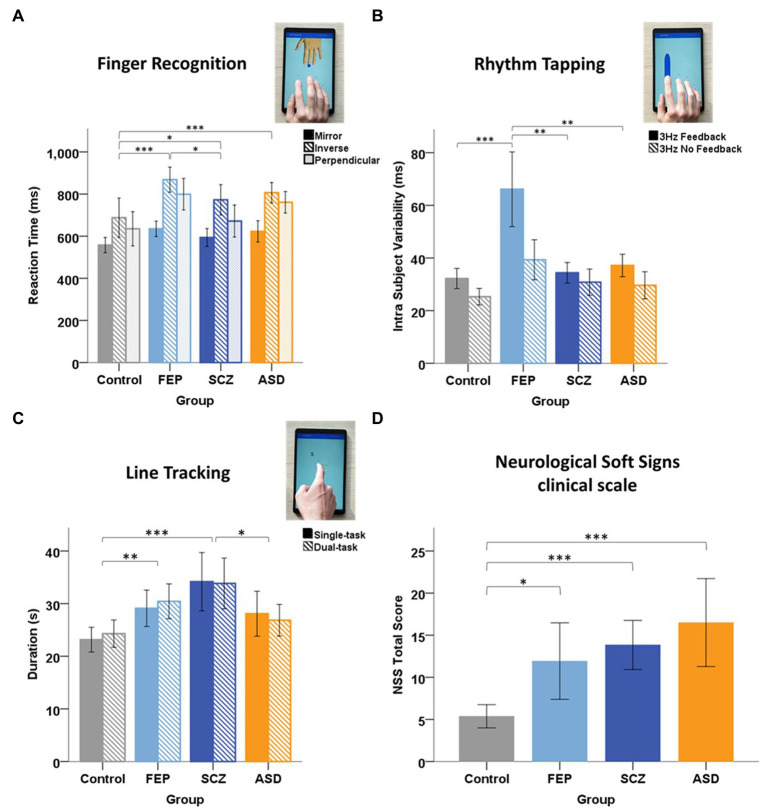
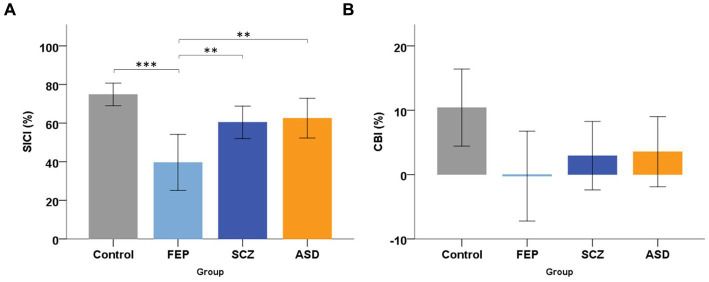
Behavioral and neurophysiological testing was undertaken in persons diagnosed with FEP ( = 20), schizophrenia (SCZ, = 20), autism spectrum disorder (ASD, = 20), and in healthy control subjects ( = 20). Five tablet tasks assessed different motor and cognitive functions: Finger Recognition for effector (finger) selection and mental rotation, Rhythm Tapping for temporal control, Sequence Tapping for control/memorization of motor sequences, Multi Finger Tapping for finger individuation, and Line Tracking for visuomotor control. Discrimination of FEP (from other groups) based on tablet-based measures was compared to discrimination through clinical neurological soft signs (NSS). Cortical excitability/inhibition, and cerebellar brain inhibition were assessed with transcranial magnetic stimulation.
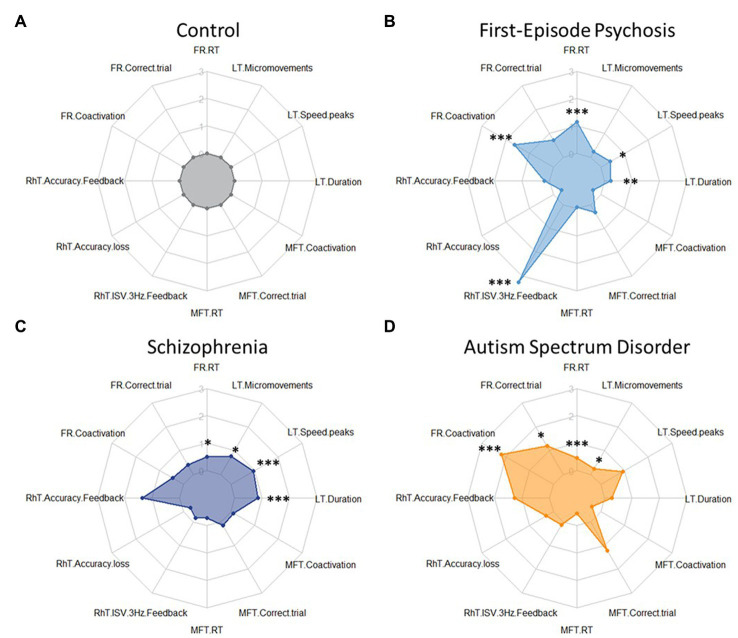
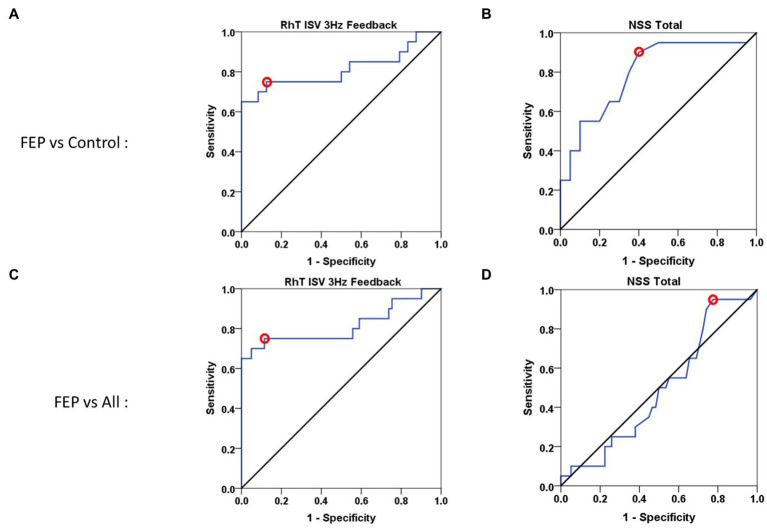
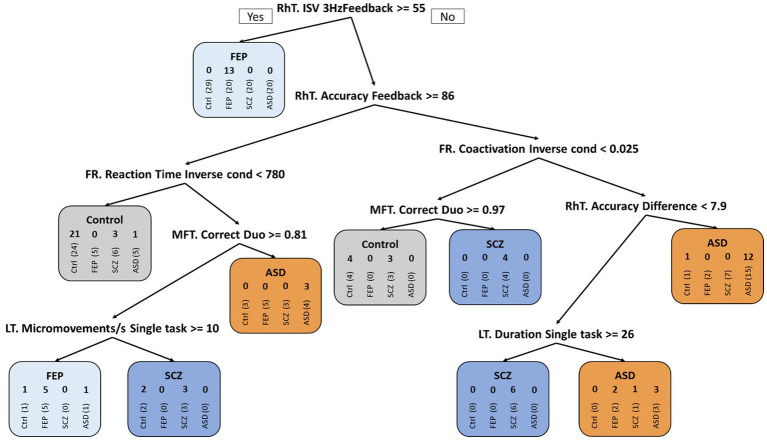
Compared to controls, FEP patients showed slower reaction times and higher errors in Finger Recognition, and more variability in Rhythm Tapping. Variability in Rhythm Tapping showed highest specificity for the identification of FEP patients compared to all other groups (FEP vs. ASD/SCZ/Controls; 75% sensitivity, 90% specificity, AUC = 0.83) compared to clinical NSS (95% sensitivity, 22% specificity, AUC = 0.49). Random Forest analysis confirmed FEP discrimination vs. other groups based on dexterity variables (100% sensitivity, 85% specificity, balanced accuracy = 92%). The FEP group had reduced short-latency intra-cortical inhibition (but similar excitability) compared to controls, SCZ, and ASD. Cerebellar inhibition showed a non-significant tendency to be weaker in FEP.
FEP patients show a distinctive pattern of dexterity impairments and weaker cortical inhibition. Easy-to-use tablet-based measures of manual dexterity capture neurological deficits in FEP and are promising markers for detection of FEP in clinical practice.
我们开展了一项初步研究,旨在探讨基于平板电脑的手部灵巧度测量能否为首发精神病(FEP)的检测提供行为标志物,以及FEP患者的皮质兴奋性/抑制是否发生改变。
对诊断为FEP(n = 20)、精神分裂症(SCZ,n = 20)、自闭症谱系障碍(ASD,n = 20)的患者以及健康对照者(n = 20)进行行为和神经生理学测试。五项平板电脑任务评估了不同的运动和认知功能:用于效应器(手指)选择和心理旋转的手指识别、用于时间控制的节奏敲击、用于运动序列控制/记忆的序列敲击、用于手指个体化的多指敲击以及用于视觉运动控制的线条追踪。将基于平板电脑测量对FEP(与其他组区分)的判别与通过临床神经学软体征(NSS)进行的判别进行比较。采用经颅磁刺激评估皮质兴奋性/抑制以及小脑脑抑制。
与对照组相比,FEP患者在手指识别任务中反应时间较慢且错误较多,在节奏敲击中变异性更大。与所有其他组相比,节奏敲击中的变异性对FEP患者的识别具有最高特异性(FEP与ASD/SCZ/对照组相比;灵敏度75%,特异性90%,AUC = 0.83),而临床NSS的相应数据为(灵敏度95%,特异性22%,AUC = 0.49)。随机森林分析证实基于灵巧度变量可将FEP与其他组区分开来(灵敏度100%,特异性85%,平衡准确率 = 92%)。与对照组、SCZ组和ASD组相比,FEP组的短潜伏期皮质内抑制降低(但兴奋性相似)。小脑抑制在FEP组中显示出减弱的非显著趋势。
FEP患者表现出独特的灵巧度损伤模式和较弱的皮质抑制。易于使用的基于平板电脑的手部灵巧度测量可捕捉FEP中的神经功能缺损,有望成为临床实践中检测FEP的标志物。