Molecular Ophthalmology, Department of Ophthalmology, University Hospital Essen, University Duisburg-Essen, Essen, Germany.
Department of Oto-Rhino-Laryngology, Head and Neck Surgery, University Hospital Essen, University Duisburg-Essen, Essen, Germany.
Front Endocrinol (Lausanne). 2023 Jun 26;14:1211473. doi: 10.3389/fendo.2023.1211473. eCollection 2023.
Graves' disease (GD) is an autoimmune disorder caused by autoantibodies against the thyroid stimulating hormone receptor (TSHR) leading to overstimulation of the thyroid gland. Thyroid eye disease (TED) is the most common extra thyroidal manifestation of GD. Therapeutic options to treat TED are very limited and novel treatments need to be developed. In the present study we investigated the effect of linsitinib, a dual small-molecule kinase inhibitor of the insulin-like growth factor 1 receptor (IGF-1R) and the Insulin receptor (IR) on the disease outcome of GD and TED.
Linsitinib was administered orally for four weeks with therapy initiating in either the early ("active") or the late ("chronic") phases of the disease. In the thyroid and the orbit, autoimmune hyperthyroidism and orbitopathy were analyzed serologically (total anti-TSHR binding antibodies, stimulating anti TSHR antibodies, total T4 levels), immunohistochemically (H&E-, CD3-, TNFa- and Sirius red staining) and with immunofluorescence (F4/80 staining). An MRI was performed to quantify tissue remodeling inside the orbit.
Linsitinib prevented autoimmune hyperthyroidism in the state of the disease, by reducing morphological changes indicative for hyperthyroidism and blocking T-cell infiltration, visualized by CD3 staining. In the state of the disease linsitinib had its main effect in the orbit. Linsitinib reduced immune infiltration of T-cells (CD3 staining) and macrophages (F4/80 and TNFa staining) in the orbita in experimental GD suggesting an additional, direct effect of linsitinib on the autoimmune response. In addition, treatment with linsitinib normalized the amount of brown adipose tissue in both the and group. An MRI of the group was performed and revealed a marked decrease of inflammation, visualized by F MR imaging, significant reduction of existing muscle edema and formation of brown adipose tissue.
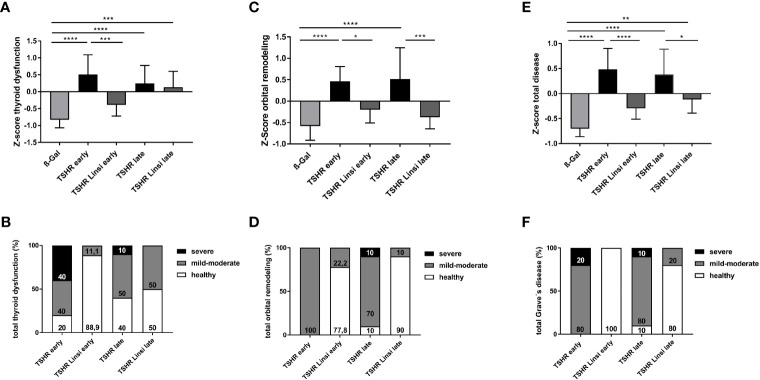
Here, we demonstrate that linsitinib effectively prevents development and progression of thyroid eye disease in an experimental murine model for Graves' disease. Linsitinib improved the total disease outcome, indicating the clinical significance of the findings and providing a path to therapeutic intervention of Graves' Disease. Our data support the use of linsitinib as a novel treatment for thyroid eye disease.
格雷夫斯病(GD)是一种自身免疫性疾病,由针对甲状腺刺激激素受体(TSHR)的自身抗体引起,导致甲状腺过度刺激。甲状腺眼病(TED)是 GD 最常见的甲状腺外表现。治疗 TED 的治疗选择非常有限,需要开发新的治疗方法。在本研究中,我们研究了双小分子激酶抑制剂 linisitinib 对 GD 和 TED 疾病结果的影响。
linisitinib 口服给药四周,治疗开始于疾病的早期(“活跃”期)或晚期(“慢性”期)。在甲状腺和眼眶中,通过血清学(总抗 TSHR 结合抗体、刺激抗 TSHR 抗体、总 T4 水平)、免疫组织化学(H&E-、CD3-、TNFa-和 Sirius red 染色)和免疫荧光(F4/80 染色)分析自身免疫性甲状腺功能亢进和眼病。进行 MRI 以定量眼眶内组织重塑。
linisitinib 通过减少提示甲状腺功能亢进的形态变化并阻断 CD3 染色可见的 T 细胞浸润,在疾病状态下预防自身免疫性甲状腺功能亢进。在疾病状态下,linisitinib 在眼眶中具有主要作用。linisitinib 减少了眼眶中 T 细胞(CD3 染色)和巨噬细胞(F4/80 和 TNFa 染色)的免疫浸润,表明 linisitinib 对自身免疫反应有额外的直接作用。此外,linisitinib 治疗使棕色脂肪组织的量在 和 组中均正常化。对 组进行了 MRI 检查,结果显示炎症明显减少,F MR 成像可见,现有的肌肉水肿明显减少,棕色脂肪组织形成。
在这里,我们证明 linisitinib 可有效预防 Graves 病实验性小鼠模型中甲状腺眼病的发生和进展。linisitinib 改善了总疾病结果,表明了研究结果的临床意义,并为 Graves 病的治疗干预提供了途径。我们的数据支持将 linisitinib 用作甲状腺眼病的新型治疗方法。