Ferreira Juliana R P, Sucupira Isabela D, Carvalho Gabriella M C, Paiva Fernando F, Pimentel-Coelho Pedro M, Rosado-de-Castro Paulo H, Mourão Paulo A S, Fonseca Roberto J C
Laboratório de Tecido Conjuntivo, Hospital Universitário Clementino Fraga Filho and Programa de Glicobiologia, Instituto de Bioquímica Médica Leopoldo de Meis, Centro de Ciências da Saúde, Universidade Federal do Rio de Janeiro, Rio de Janeiro, RJ, Brazil.
Laboratório de Coagulação e Trombose, Hospital Universitário Clementino Fraga Filho, Instituto de Ciências Biomédicas, Centro de Ciências da Saúde, Universidade Federal do Rio de Janeiro, Rio de Janeiro, RJ, Brazil.
TH Open. 2023 Jul 10;7(3):e195-e205. doi: 10.1055/s-0043-1770782. eCollection 2023 Jul.
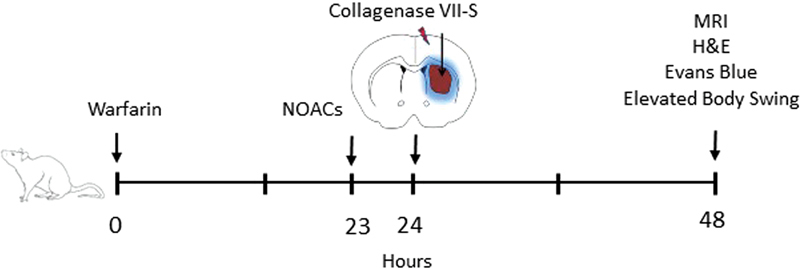
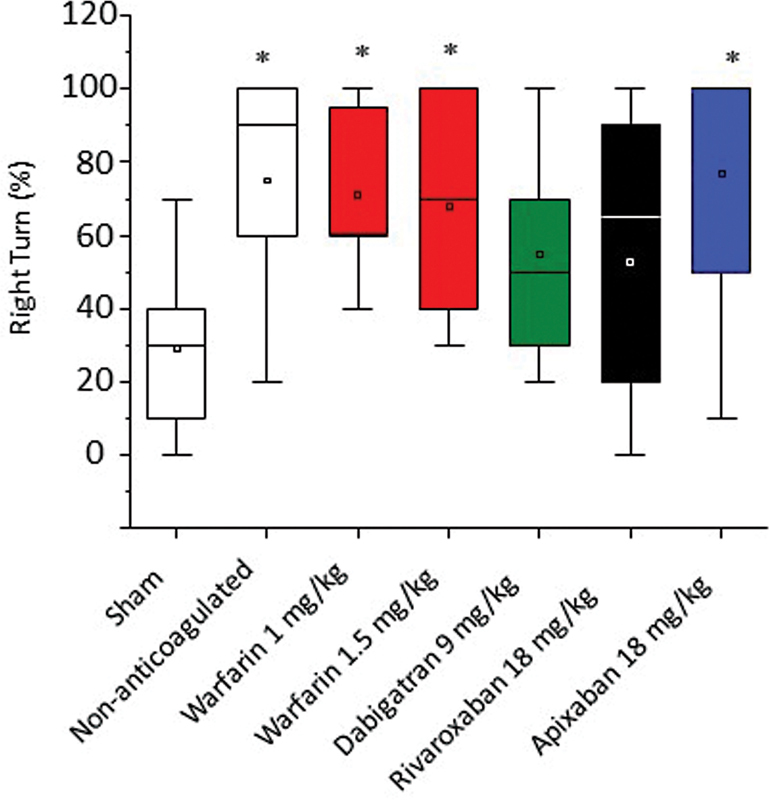
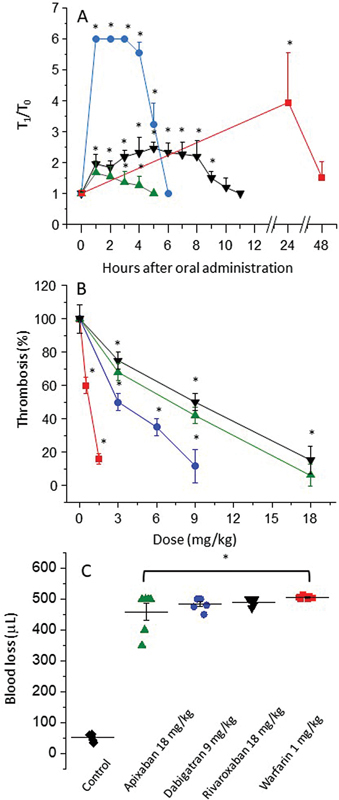
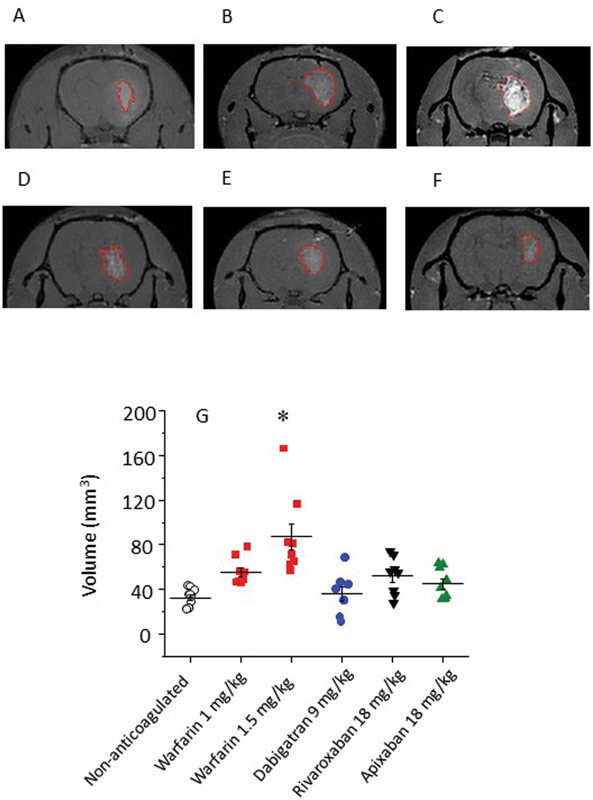
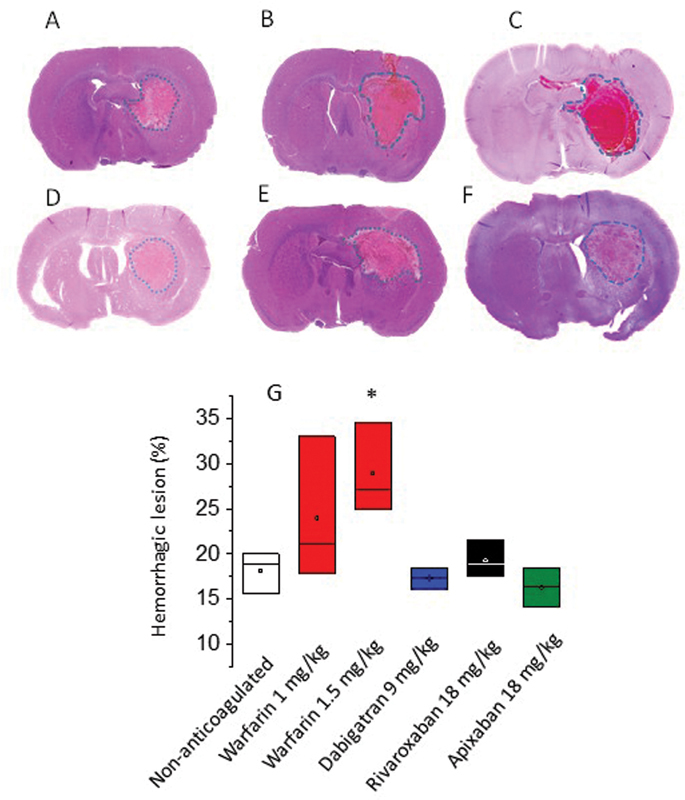
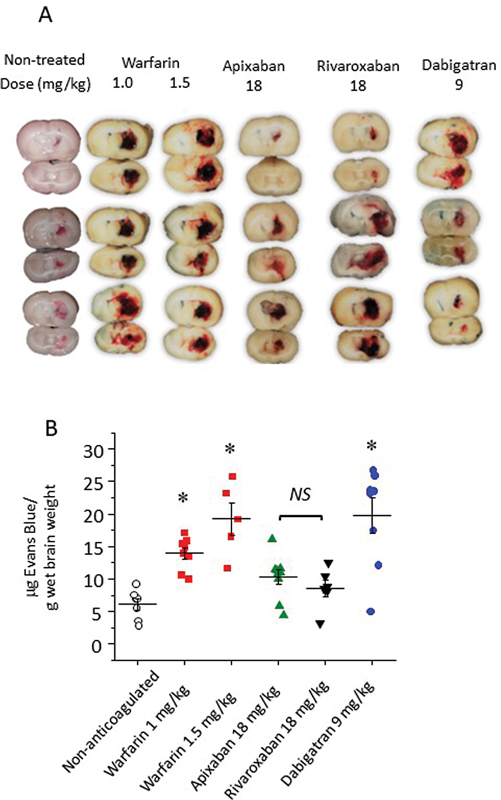
Intracerebral hemorrhage is the most serious complication of anticoagulant therapy but the effects of different types of oral anticoagulants on the expansion of these hemorrhages are still unclear. Clinical studies have revealed controversial results; more robust and long-term clinical evaluations are necessary to define their outcomes. An alternative is to test the effect of these drugs in experimental models of intracerebral bleeding induced in animals. To test new oral anticoagulants (dabigatran etexilate, rivaroxaban, and apixaban) in an experimental model of intracerebral hemorrhage induced by collagenase injection into the brain striatum of rats. Warfarin was used for comparison. Ex vivo anticoagulant assays and an experimental model of venous thrombosis were employed to determine the doses and periods of time required for the anticoagulants to achieve their maximum effects. Subsequently, volumes of brain hematoma were evaluated after administration of the anticoagulants, using these same parameters. Volumes of brain hematoma were evaluated by magnetic resonance imaging, H&E (hematoxylin and eosin) staining, and Evans blue extravasation. Neuromotor function was assessed by the elevated body swing test. The new oral anticoagulants did not increase intracranial bleeding compared with control animals, while warfarin markedly favored expansion of the hematomas, as revealed by magnetic resonance imaging and H&E staining. Dabigatran etexilate caused a modest but statistically significant increase in Evans blue extravasation. We did not observe significant differences in elevated body swing tests among the experimental groups. The new oral anticoagulants may provide a better control over a brain hemorrhage than warfarin.
脑出血是抗凝治疗最严重的并发症,但不同类型口服抗凝剂对这些出血灶扩大的影响仍不明确。临床研究结果存在争议;需要更有力和长期的临床评估来确定其结果。另一种方法是在动物脑内出血实验模型中测试这些药物的效果。
为了在大鼠脑纹状体注射胶原酶诱导的脑出血实验模型中测试新型口服抗凝剂(达比加群酯、利伐沙班和阿哌沙班)。使用华法林作为对照。
采用体外抗凝测定和静脉血栓形成实验模型来确定抗凝剂达到最大效果所需的剂量和时间。随后,在给予抗凝剂后,使用相同参数评估脑血肿体积。通过磁共振成像、苏木精和伊红(H&E)染色以及伊文思蓝外渗来评估脑血肿体积。通过抬高身体摆动试验评估神经运动功能。
与对照动物相比,新型口服抗凝剂并未增加颅内出血,而磁共振成像和H&E染色显示,华法林明显促进血肿扩大。达比加群酯导致伊文思蓝外渗有适度但具有统计学意义的增加。我们在各实验组的抬高身体摆动试验中未观察到显著差异。新型口服抗凝剂可能比华法林能更好地控制脑出血。