Universidade Federal do Oeste da Bahia, Barreiras, BA, Brasil.
Rev Paul Pediatr. 2023 Jul 10;42:e2022107. doi: 10.1590/1984-0462/2024/42/2022107. eCollection 2023.
To systematically review the literature in search of the most suitable and effective nutritional interventions and indications for the nutritional treatment of children and adolescents with cerebral palsy (CP).
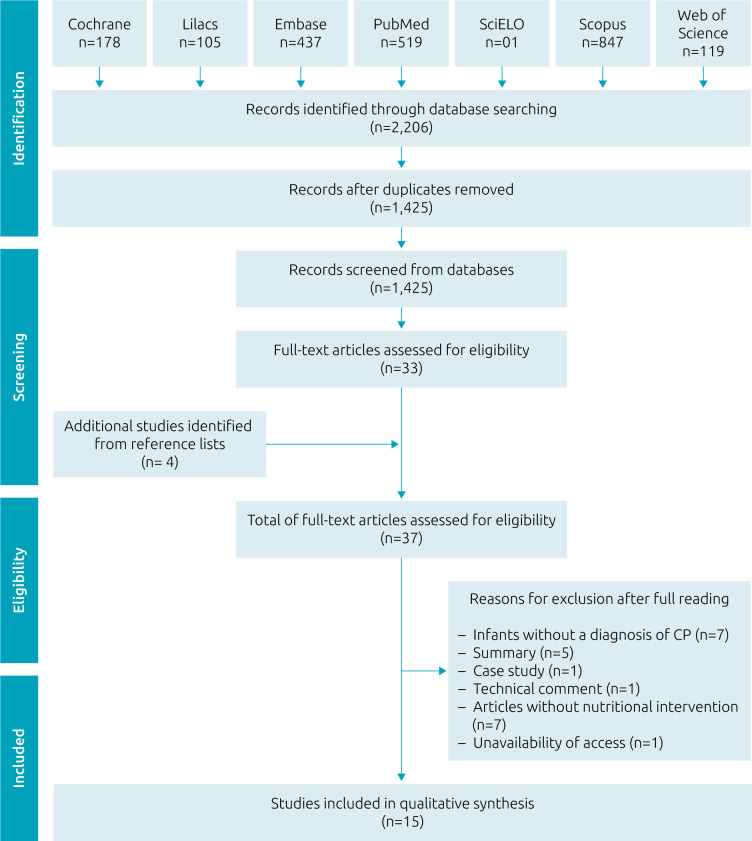
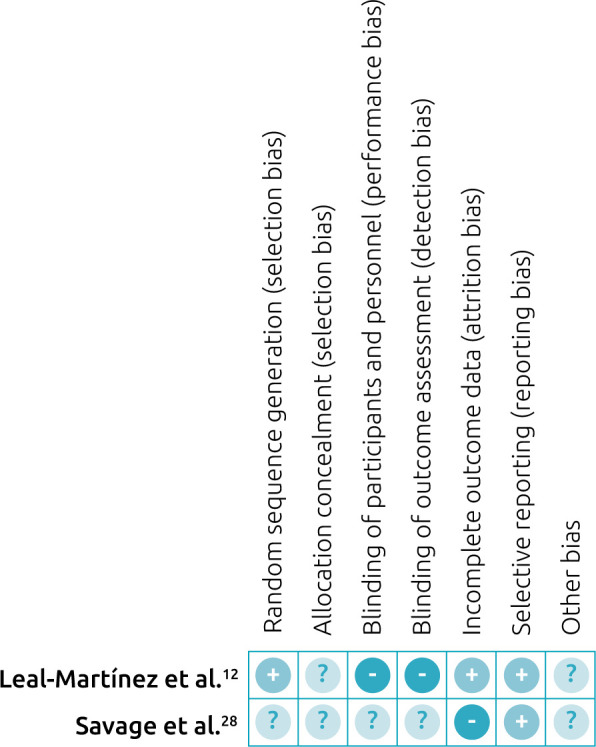
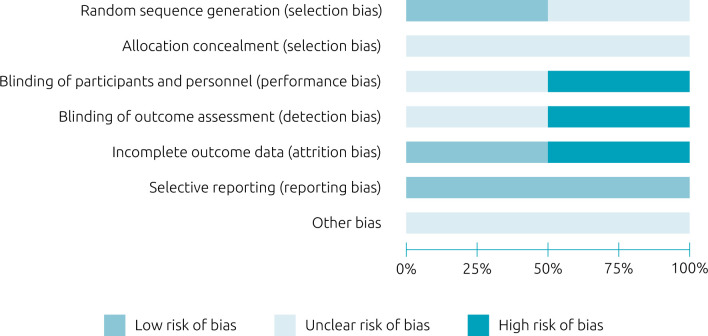
This review was conducted in accordance with the Preferred Reporting Items for Systematic Reviews and Meta-Analyses (PRISMA) guidelines. The articles were selected from seven databases (Cochrane, Literatura Latino-Americana e do Caribe em Ciências da Saúde - Lilacs, Embase, United States National Library of Medicine - PubMed, Scientific Electronic Library Online - SciELO, Scopus, and Web of Science). Studies from a pediatric group (0 to 18 years old) diagnosed with CP were included and the search strategy included the descriptors: "children" OR "childhood" AND "nutritional therapy" OR "nutritional intervention" OR "nutrition" OR "nutritional support" OR "diet" AND "cerebral palsy" OR "cerebral injury". Methodological quality was assessed using the checklist for cross-sectional analytical studies, the Newcastle-Ottawa scale or the Cochrane Collaboration tool for clinical trials.
Fifteen studies (n=658) published from 1990 to 2020 met the inclusion criteria. All of them had a low risk of bias. The data showed that children and adolescents with CP have worse nutritional status than those normally developed. Those who received hypercaloric and hyperprotein nutritional supplementation benefited from its use. Studies indicate that enteral nutrition should be considered when nutritional needs are not met by the oral diet, especially in cases where oral motor functions are impaired. In addition, there was a direct relationship between the consistency of food, the level of motor function and nutritional status.
Children and adolescents with CP have a greater risk of malnutrition. The use of nutritional supplementation may help with weight gain. In addition, enteral nutrition and modification of food texture have been used to improve the nutritional status of this group.
系统地回顾文献,寻找最适合和有效的营养干预措施及适应证,用于治疗脑瘫(CP)患儿和青少年。
本综述按照系统评价和荟萃分析的首选报告项目(PRISMA)指南进行。从 7 个数据库(Cochrane、拉丁美洲和加勒比健康科学文献库-Lilacs、Embase、美国国立医学图书馆-PubMed、科学电子图书馆在线-SciELO、Scopus 和 Web of Science)中选择文章。纳入儿科组(0 至 18 岁)诊断为 CP 的研究,搜索策略包括以下术语:“儿童”或“童年”和“营养治疗”或“营养干预”或“营养”或“营养支持”或“饮食”和“脑瘫”或“脑损伤”。使用横断面分析研究检查表、纽卡斯尔-渥太华量表或 Cochrane 协作临床试验工具评估方法学质量。
从 1990 年至 2020 年发表的 15 项研究(n=658)符合纳入标准。所有研究的偏倚风险均较低。数据表明,脑瘫患儿和青少年的营养状况比正常发育的儿童和青少年差。接受高热量和高蛋白营养补充的患者受益于其使用。研究表明,当无法通过口服饮食满足营养需求时,特别是在口腔运动功能受损的情况下,应考虑肠内营养。此外,食物的稠度、运动功能水平和营养状况之间存在直接关系。
脑瘫患儿和青少年有更高的营养不良风险。营养补充可能有助于体重增加。此外,肠内营养和食物质地的改变已被用于改善该人群的营养状况。