Gurage Zone Health Department, Welkite, Ethiopia.
School of Public Health, College of Medicine and Health Science, Hawassa University, Hawassa, Ethiopia.
BMC Womens Health. 2023 Jul 12;23(1):369. doi: 10.1186/s12905-023-02526-6.
The third delay is a delay in accessing emergency obstetric care timely and appropriately once a woman reaches a health facility. The third delay plays a crucial role as an indicator to assess the quality of obstetrics services and is often the leading contributing factor to maternal mortality in developing countries. Although considerable research has been conducted on pre-facility delays in healthcare access, there is a lack of focus on delays experienced upon arrival at health facilities, particularly in Ethiopia and the specific study areas of Gurage zone. This study aimed to assess the magnitude of the third delay and associated factors among women who gave birth at Public Health Facilities of Gurage Zone, Southern Ethiopia.
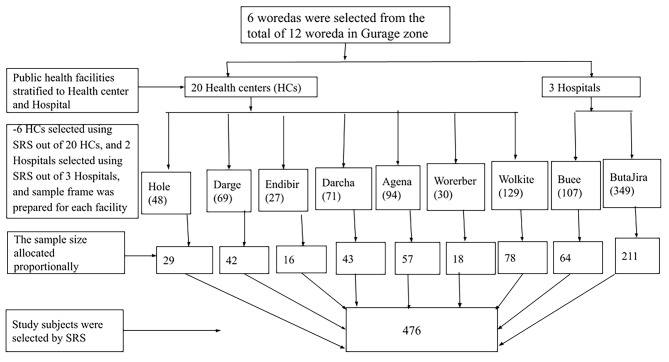
A facility-based cross-sectional study was conducted with 558 women who gave birth at public health facilities of Gurage Zone from January 01/2020 to March 30/2020. Multi-stage stratified sampling technique was used to select the nine facilities. The data was collected using a structured interviewer administer questionnaire and an observational checklist. Women who waited more than an hour to receive delivery services after arriving at the health facility were classified as experiencing the third delay. The data were entered and analyzed using Epi Data version 3.1 and SPSS version 20.0 software, respectively. Binary logistic regression was employed to identify the determinant factors for the third delay. Variables having a P-value < 0.25 in the binary analysis were a candidate for multivariable analysis. Variables with P < 0.05 were considered statistically significant.
The magnitude of the third delay was 193 [(34.8%; 95% CI; (30.8%, 38.8%)]. Complication during labor [AOR = 2.0; 95% CI, (1.4, 3.0)], Presence of functional generator in a health facility [AOR = 2.8; 95% CI, (1.3, 6.3)], level of health institution [AOR = 2.8; 95% CI, (1.04, 7.8)] and BEMONC training in the last two years [AOR = 1.6; 95% CI, (2.0, 6.5)] were significantly associated with third delay.
The magnitude of third delay was high compared to some low income countries, which shows most of mothers were not getting the service timely after they arrived at the health facility. Equipping health facilities with trained manpower and with necessary materials and infrastructure will contribute to hastening the provision of obstetric care.
第三延迟是指妇女一旦到达医疗机构,就无法及时、适当地获得紧急产科护理。第三延迟是评估产科服务质量的一个关键指标,也是发展中国家产妇死亡的主要原因之一。尽管已经对医疗保健获取方面的产前延迟进行了大量研究,但对于到达医疗机构时所经历的延迟,特别是在埃塞俄比亚和古拉格地区的具体研究领域,关注甚少。本研究旨在评估在埃塞俄比亚古拉格地区公立卫生设施分娩的妇女中第三延迟的程度及其相关因素。
这是一项在 2020 年 1 月 1 日至 3 月 30 日期间在古拉格地区公立卫生设施分娩的 558 名妇女中进行的基于设施的横断面研究。采用多阶段分层抽样技术选择了 9 个设施。使用结构化访谈员管理问卷和观察检查表收集数据。在到达医疗机构后等待 1 小时以上才接受分娩服务的妇女被归类为经历了第三延迟。数据分别使用 EpiData 版本 3.1 和 SPSS 版本 20.0 软件进行录入和分析。采用二元逻辑回归分析确定第三延迟的决定因素。在二元分析中 P 值<0.25 的变量是多变量分析的候选变量。P<0.05 的变量被认为具有统计学意义。
第三延迟的发生率为 193 例(34.8%;95%置信区间;(30.8%,38.8%))。分娩期间出现并发症(AOR=2.0;95%CI,(1.4,3.0))、医疗机构内有功能发生器(AOR=2.8;95%CI,(1.3,6.3))、医疗机构级别(AOR=2.8;95%CI,(1.04,7.8))和在过去两年内接受 BEMONC 培训(AOR=1.6;95%CI,(2.0,6.5))与第三延迟显著相关。
与一些低收入国家相比,第三延迟的发生率较高,这表明大多数产妇在到达医疗机构后无法及时获得服务。为医疗机构配备训练有素的人力以及必要的物资和基础设施,将有助于加快提供产科护理。