Miotto Mattia, Di Rienzo Lorenzo, Grassmann Greta, Desantis Fausta, Cidonio Gianluca, Gosti Giorgio, Leonetti Marco, Ruocco Giancarlo, Milanetti Edoardo
Center for Life Nano-& Neuro-Science, Istituto Italiano di Tecnologia, Rome, Italy.
Department of Biochemical Sciences "Alessandro Rossi Fanelli", Sapienza University of Rome, Rome, Italy.
Front Mol Biosci. 2023 Jun 27;10:1205919. doi: 10.3389/fmolb.2023.1205919. eCollection 2023.
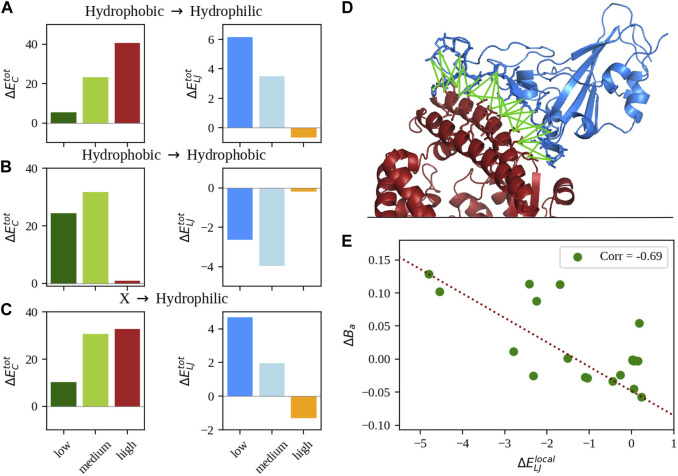
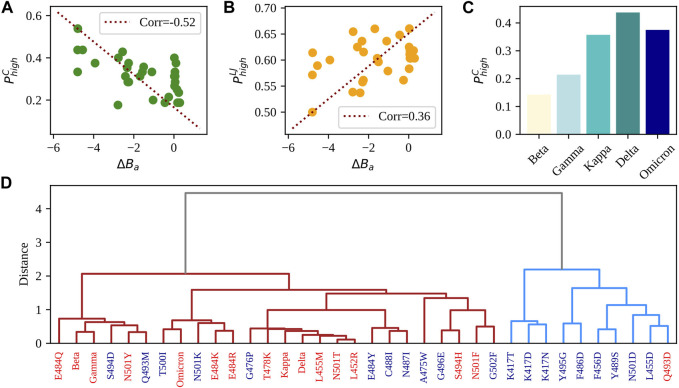
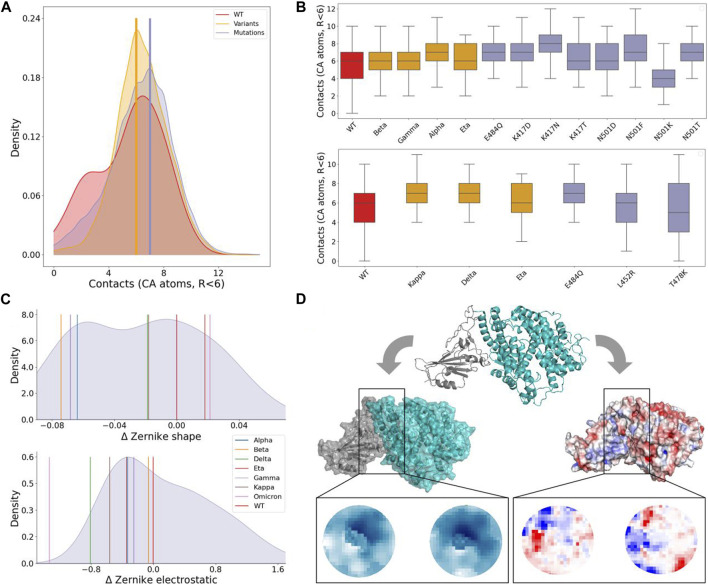
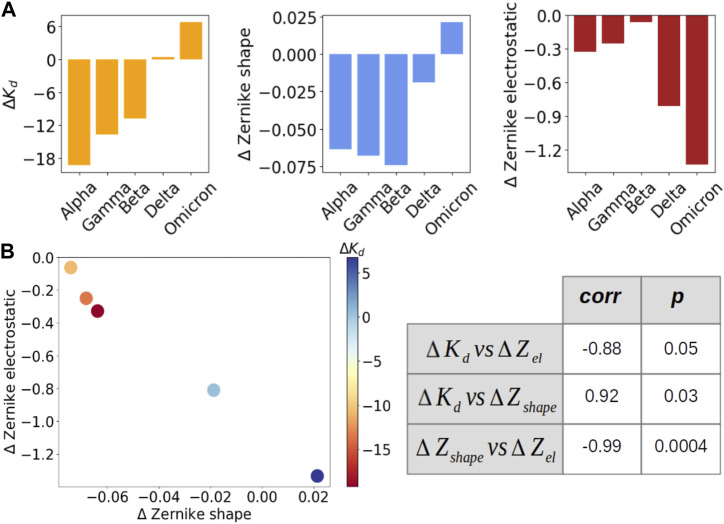
The continuous emergence of novel variants represents one of the major problems in dealing with the SARS-CoV-2 virus. Indeed, also due to its prolonged circulation, more than ten variants of concern emerged, each time rapidly overgrowing the current viral version due to improved spreading features. As, up to now, all variants carry at least one mutation on the spike Receptor Binding Domain, the stability of the binding between the SARS-CoV-2 spike protein and the human ACE2 receptor seems one of the molecular determinants behind the viral spreading potential. In this framework, a better understanding of the interplay between spike mutations and complex stability can help to assess the impact of novel variants. Here, we characterize the peculiarities of the most representative variants of concern in terms of the molecular interactions taking place between the residues of the spike RBD and those of the ACE2 receptor. To do so, we performed molecular dynamics simulations of the RBD-ACE2 complexes of the seven variants of concern in comparison with a large set of complexes with different single mutations taking place on the RBD solvent-exposed residues and for which the experimental binding affinity was available. Analyzing the strength and spatial organization of the intermolecular interactions of the binding region residues, we found that (i) mutations producing an increase of the complex stability mainly rely on instaurating more favorable van der Waals optimization at the cost of Coulombic ones. In particular, (ii) an anti-correlation is observed between the shape and electrostatic complementarities of the binding regions. Finally, (iii) we showed that combining a set of dynamical descriptors is possible to estimate the outcome of point mutations on the complex binding region with a performance of 0.7. Overall, our results introduce a set of dynamical observables that can be rapidly evaluated to probe the effects of novel isolated variants or different molecular systems.
新型变体的不断出现是应对新冠病毒(SARS-CoV-2)的主要问题之一。事实上,由于其长期传播,已出现了十多种值得关注的变体,每次都因传播特性的改善而迅速超过当前的病毒版本。截至目前,所有变体在刺突受体结合域上至少携带一个突变,SARS-CoV-2刺突蛋白与人ACE2受体之间结合的稳定性似乎是病毒传播潜力背后的分子决定因素之一。在此框架下,更好地理解刺突突变与复合物稳定性之间的相互作用有助于评估新型变体的影响。在这里,我们根据刺突RBD残基与ACE2受体残基之间发生的分子相互作用,表征了最具代表性的值得关注的变体的特性。为此,我们对七种值得关注的变体的RBD-ACE2复合物进行了分子动力学模拟,并与一大组在RBD溶剂暴露残基上发生不同单突变且具有实验结合亲和力的复合物进行了比较。通过分析结合区域残基的分子间相互作用的强度和空间组织,我们发现:(i)导致复合物稳定性增加的突变主要依赖于以库仑相互作用为代价建立更有利的范德华优化。特别是,(ii)在结合区域的形状和静电互补性之间观察到反相关。最后,(iii)我们表明,结合一组动力学描述符可以估计点突变对复合物结合区域的影响,性能为0.7。总体而言,我们的结果引入了一组可以快速评估的动力学可观测量,以探测新分离的变体或不同分子系统的影响。