Chen Jintao, Wang Xinyi, Xu Zherong
Department of Geriatrics, The First Affiliated Hospital, Zhejiang University, School of Medicine, Hangzhou, People's Republic of China.
Department of Zhejiang University School of Medicine, Hangzhou, People's Republic of China.
J Pain Res. 2023 Jul 7;16:2309-2319. doi: 10.2147/JPR.S416253. eCollection 2023.
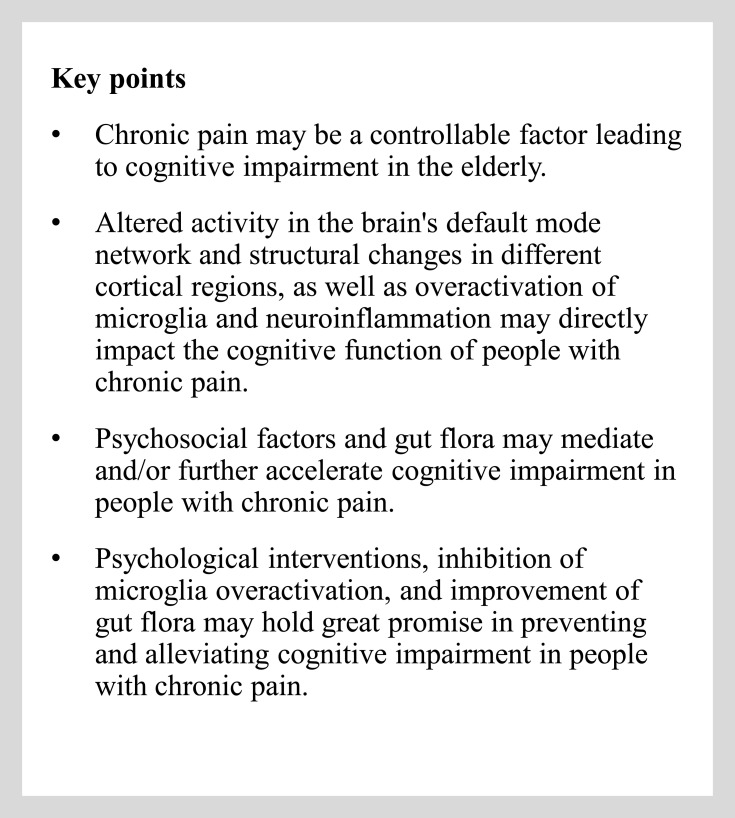
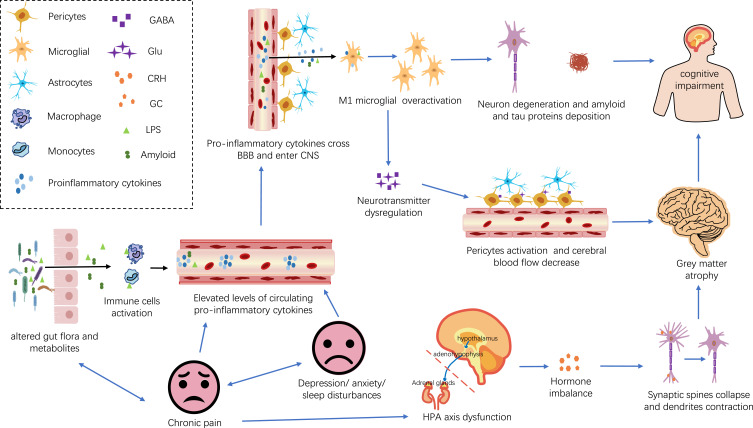
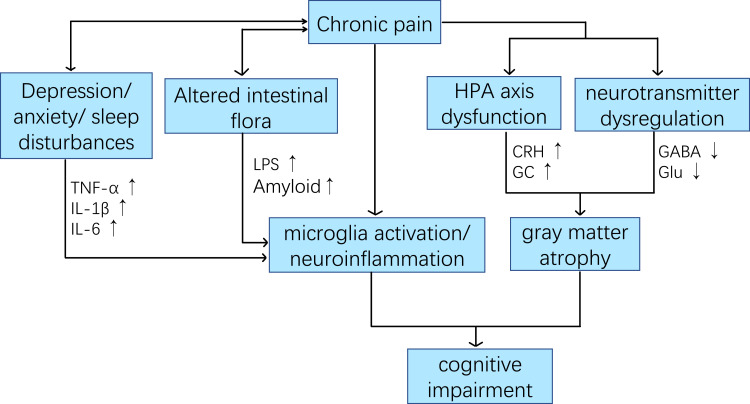
Chronic pain and cognitive impairment are prevalent geriatric syndromes in the population of older adults, and they are the main cause of disability in people over sixty-five years of age. As the global population continues to age, chronic pain and cognitive impairment will affect an increasing number of older adults. While numerous studies in recent years have shown that chronic pain is associated with cognitive decline, the exact mechanisms linking the two remain unclear. In this review, we aim to present the available evidence on the connection between chronic pain and cognitive impairment and to discuss the potential mechanisms by which chronic pain affects cognitive function. In addition, we review potential therapeutic interventions targeting psychological factors, microglia activation, and altered gut flora that may improve and prevent cognitive decline in people with chronic pain.
慢性疼痛和认知障碍是老年人群中普遍存在的老年综合征,也是65岁以上人群残疾的主要原因。随着全球人口持续老龄化,慢性疼痛和认知障碍将影响越来越多的老年人。尽管近年来众多研究表明慢性疼痛与认知衰退有关,但两者之间的确切联系机制仍不清楚。在本综述中,我们旨在展示关于慢性疼痛与认知障碍之间联系的现有证据,并讨论慢性疼痛影响认知功能的潜在机制。此外,我们还综述了针对心理因素、小胶质细胞激活以及肠道菌群改变的潜在治疗干预措施,这些措施可能改善并预防慢性疼痛患者的认知衰退。