Sultana Tania, Islam Md Tariqul, Rahman Md Shajjadur, Siddique Abu Bokkar, Huda A N M Samiul, Sarker Subrata
Department of Geography and Environment, Shahjalal University of Science and Technology, Sylhet, 3114, Bangladesh.
Department of Oceanography, Shahjalal University of Science and Technology, Sylhet, 3114, Bangladesh.
Heliyon. 2023 Jun 15;9(6):e17368. doi: 10.1016/j.heliyon.2023.e17368. eCollection 2023 Jun.
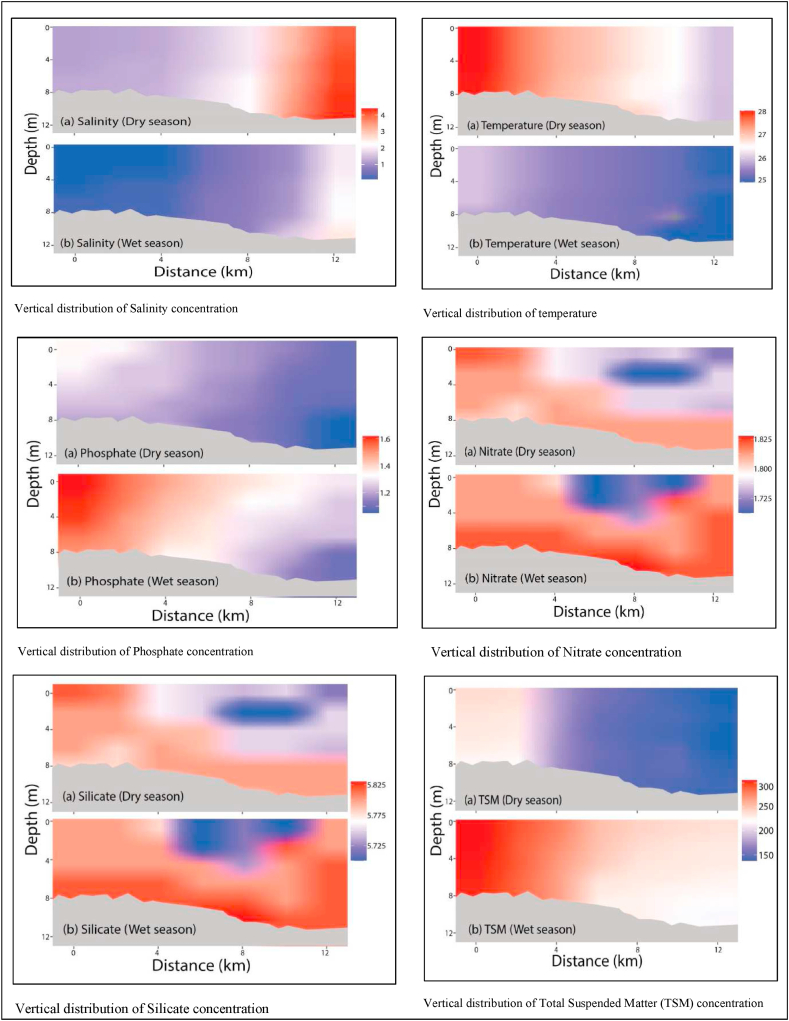
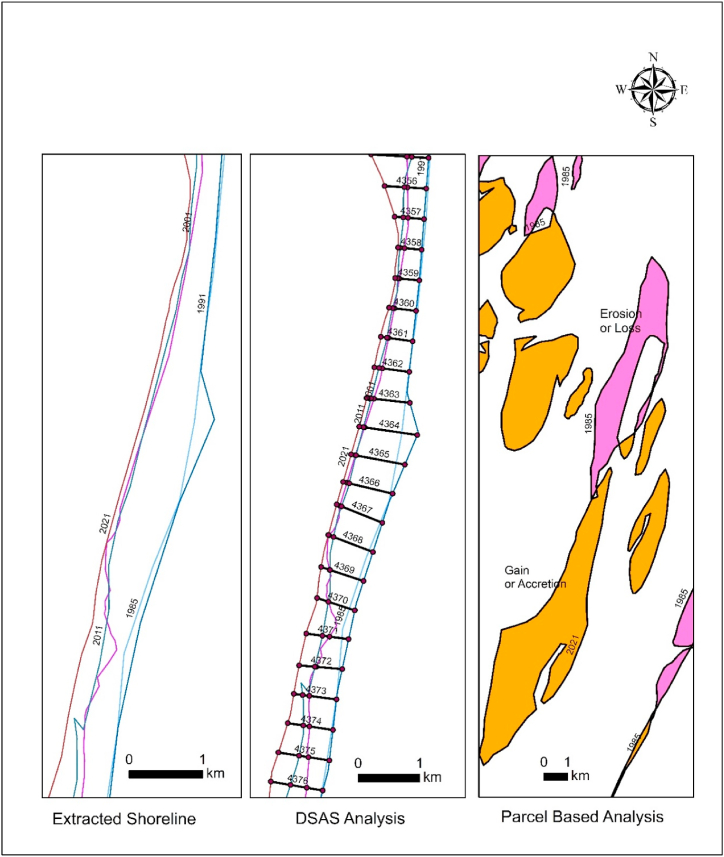
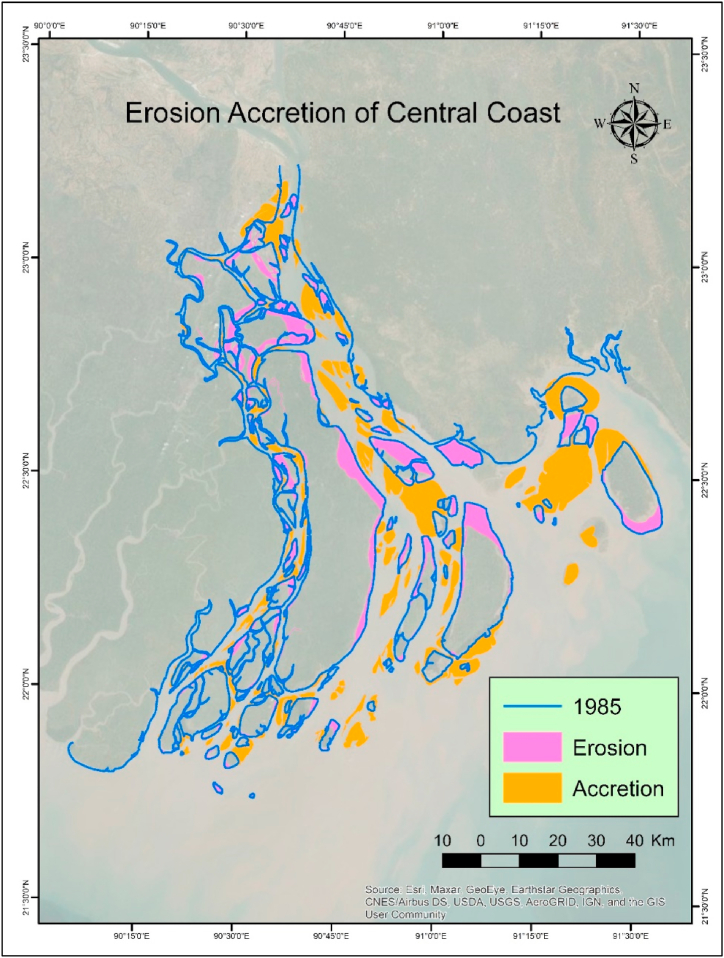
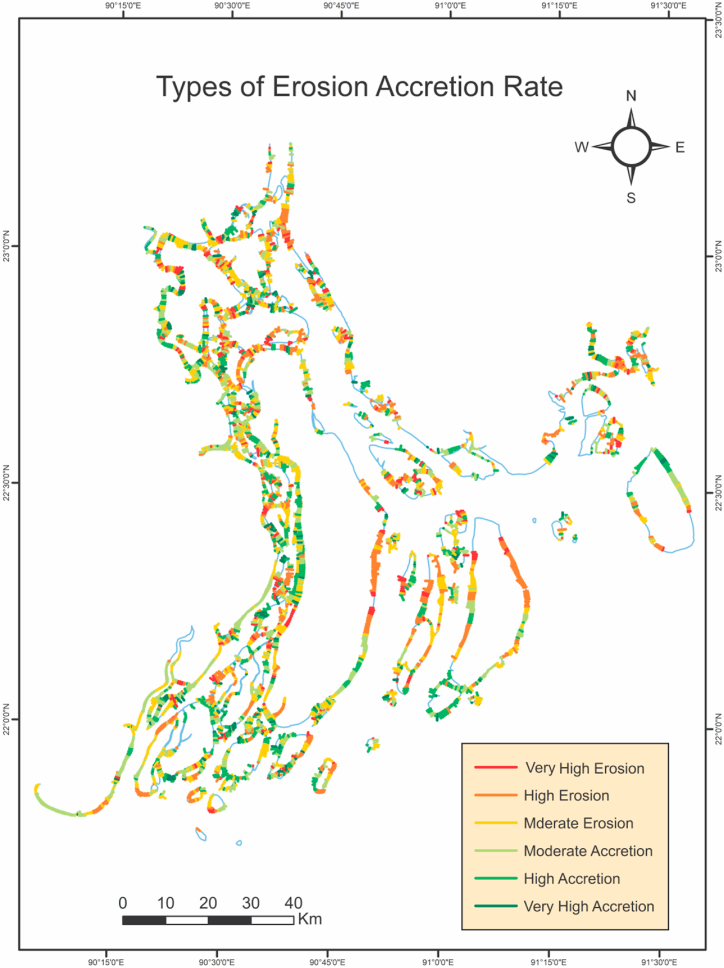
The central coast of Bangladesh is dynamic for its geographical location, hydrodynamic characteristics and residual flow. The research employed the Digital Shoreline Analysis System (DSAS), an ArcGIS extension tool, to conduct a historical trend analysis of shoreline. The study demonstrates that the central coast is eroding to the north and accreting to the south. The highest accretion value was found as 195.42 m/year, whereas the maximum value of erosion was estimated as -185.83 m/year, according to End Point Rate (EPR). The Linear Regression Rate (LRR) indicates that the average rate of erosion and accretion are -17.77 m/year and 17.88 m/year, respectively. Meanwhile, using Weighted Linear Regression (WLR), 0.48% of all transects demonstrated statistically significant erosion, while 0.43% showed statistically significant accretion. During the wet season, heavy river discharge leads to a low salt level in the ocean. Ocean currents hit central coast of Bangladesh from east to west, affecting the majority of the islands in the Meghna Estuary in the dry season. Changes in current directions can be seen during the wet seasons. Southern central coast areas are hit by south-east currents that split in two directions. The Sandwip Channel has a flow of 10,000 to 15,000 m³ s northward. The Tetulia River, Shahbazpur Channel, and Hatia-Sandwip flow southward at rates ranging from 3000 to 17,000 m³ s, 14,000 to 60,000 m³ s, and 7000 to 39,000 m³ s, respectively. In the Meghna Estuary, the combined forces result in a counter-clockwise residual circulation, with the northward flow in the Sandwip channel and southbound flow in the Hatia and Shahbazpur channels. As a result of hydrodynamic, ocean currents, and residual flow, the Central Coast of Bangladesh is continually changing in appearance.
孟加拉国中部海岸因其地理位置、水动力特征和余流而充满活力。该研究采用了数字海岸线分析系统(DSAS),这是一种ArcGIS扩展工具,对海岸线进行历史趋势分析。研究表明,中部海岸北部正在侵蚀,南部正在淤积。根据终点速率(EPR),最高淤积值为195.42米/年,而最大侵蚀值估计为-185.83米/年。线性回归速率(LRR)表明,侵蚀和淤积的平均速率分别为-17.77米/年和17.88米/年。同时,使用加权线性回归(WLR),所有断面中有0.48%显示出具有统计学意义的侵蚀,而0.43%显示出具有统计学意义的淤积。在雨季,河流大量排放导致海洋盐度降低。洋流从东向西冲击孟加拉国中部海岸,在旱季影响梅克纳河口的大部分岛屿。在雨季可以看到洋流方向的变化。中部海岸南部地区受到向两个方向分流的东南洋流的冲击。桑德维普海峡向北的流量为10000至15000立方米/秒。特图利亚河、沙阿巴兹布尔海峡和哈蒂亚-桑德维普分别以3000至17000立方米/秒、14000至60000立方米/秒和7000至39000立方米/秒的速率向南流动。在梅克纳河口,这些合力导致了逆时针方向的余环流,桑德维普海峡向北流动,哈蒂亚和沙阿巴兹布尔海峡向南流动。由于水动力、洋流和余流的作用,孟加拉国中部海岸的面貌在不断变化。