Molloy Ciara J, Cooke Jennifer, Gatford Nicholas J F, Rivera-Olvera Alejandro, Avazzadeh Sahar, Homberg Judith R, Grandjean Joanes, Fernandes Cathy, Shen Sanbing, Loth Eva, Srivastava Deepak P, Gallagher Louise
Department of Psychiatry, School of Medicine, Trinity College Dublin, Dublin, Ireland.
Forensic and Neurodevelopmental Sciences, Institute of Psychiatry, Psychology and Neuroscience, King's College London, London, United Kingdom.
Front Mol Neurosci. 2023 Jun 27;16:1191323. doi: 10.3389/fnmol.2023.1191323. eCollection 2023.
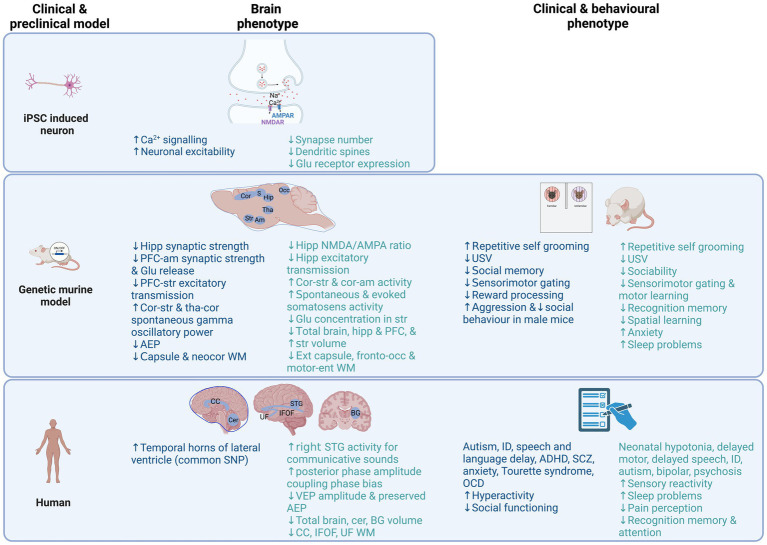
Multiple molecular pathways and cellular processes have been implicated in the neurobiology of autism and other neurodevelopmental conditions. There is a current focus on synaptic gene conditions, or synaptopathies, which refer to clinical conditions associated with rare genetic variants disrupting genes involved in synaptic biology. Synaptopathies are commonly associated with autism and developmental delay and may be associated with a range of other neuropsychiatric outcomes. Altered synaptic biology is suggested by both preclinical and clinical studies in autism based on evidence of differences in early brain structural development and altered glutamatergic and GABAergic neurotransmission potentially perturbing excitatory and inhibitory balance. This review focusses on the NRXN-NLGN-SHANK pathway, which is implicated in the synaptic assembly, trans-synaptic signalling, and synaptic functioning. We provide an overview of the insights from preclinical molecular studies of the pathway. Concentrating on NRXN1 deletion and SHANK3 mutations, we discuss emerging understanding of cellular processes and electrophysiology from induced pluripotent stem cells (iPSC) models derived from individuals with synaptopathies, neuroimaging and behavioural findings in animal models of Nrxn1 and Shank3 synaptic gene conditions, and key findings regarding autism features, brain and behavioural phenotypes from human clinical studies of synaptopathies. The identification of molecular-based biomarkers from preclinical models aims to advance the development of targeted therapeutic treatments. However, it remains challenging to translate preclinical animal models and iPSC studies to interpret human brain development and autism features. We discuss the existing challenges in preclinical and clinical synaptopathy research, and potential solutions to align methodologies across preclinical and clinical research. Bridging the translational gap between preclinical and clinical studies will be necessary to understand biological mechanisms, to identify targeted therapies, and ultimately to progress towards personalised approaches for complex neurodevelopmental conditions such as autism.
多种分子途径和细胞过程与自闭症及其他神经发育疾病的神经生物学有关。目前重点关注突触基因疾病,即突触病变,它指的是与破坏参与突触生物学的基因的罕见遗传变异相关的临床疾病。突触病变通常与自闭症和发育迟缓有关,也可能与一系列其他神经精神疾病的结果相关。基于早期脑结构发育差异以及谷氨酸能和γ-氨基丁酸能神经传递改变可能扰乱兴奋性和抑制性平衡的证据,自闭症的临床前和临床研究均表明突触生物学发生了改变。本综述聚焦于NRXN-NLGN-SHANK途径,该途径与突触组装、跨突触信号传导及突触功能有关。我们概述了该途径临床前分子研究的见解。集中讨论NRXN1缺失和SHANK3突变,我们探讨了从患有突触病变个体的诱导多能干细胞(iPSC)模型中获得的关于细胞过程和电生理学的新认识、Nrxn1和Shank3突触基因疾病动物模型中的神经影像学和行为学发现,以及突触病变人类临床研究中关于自闭症特征、脑和行为表型的关键发现。从临床前模型中识别基于分子的生物标志物旨在推动靶向治疗方法的开发。然而,将临床前动物模型和iPSC研究转化以解释人类脑发育和自闭症特征仍然具有挑战性。我们讨论了临床前和临床突触病变研究中存在的挑战,以及使临床前和临床研究方法保持一致的潜在解决方案。弥合临床前和临床研究之间的转化差距对于理解生物学机制、确定靶向治疗方法并最终朝着针对自闭症等复杂神经发育疾病的个性化方法取得进展而言是必要的。