Touitou Robert, Bidet Philippe, Dubois Constance, Partouche Henri, Bonacorsi Stéphane, Jung Camille, Cohen Robert, Levy Corinne, Cohen Jérémie F
Association Enseignement Formation Généralistes Hospitaliers - Croix Saint Simon, Paris, France.
Department of Microbiology, Robert Debré Hospital, AP-HP, Université Paris Cité, Paris, France.
Diagn Progn Res. 2023 Jul 13;7(1):13. doi: 10.1186/s41512-023-00150-4.
Group A streptococcus is found in 20-40% of cases of childhood pharyngitis; the remaining cases are viral. Streptococcal pharyngitis ("strep throat") is usually treated with antibiotics, while these are not indicated in viral cases. Most guidelines recommend relying on a diagnostic test confirming the presence of group A streptococcus before prescribing antibiotics. Conventional first-line tests are rapid antigen detection tests based on throat swabs. Recently, rapid nucleic acid tests were developed; they allow the detection of elements of the genome of group A streptococcus. We hypothesize that these rapid nucleic acid tests are sensitive enough to be performed on saliva samples instead of throat swabs, which could be more convenient in practice.
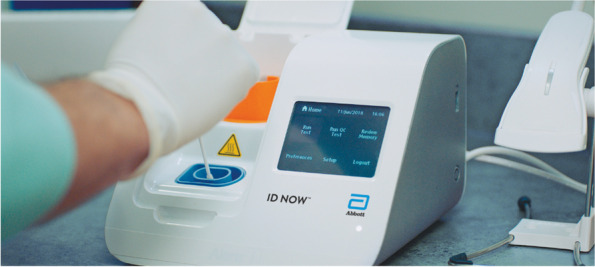
This is a multicenter, prospective diagnostic accuracy study evaluating the performance of a rapid nucleic acid test for group A streptococcus (Abbott ID NOW STREP A2) in saliva, compared with a conventional pharyngeal rapid antigen detection test (EXACTO PRO STREPTATEST, lateral flow assay, comparator test), with a composite reference standard of throat culture and group A streptococcus PCR in children with pharyngitis in primary care (i.e., 27 primary care pediatricians or general practitioners). To ensure group A streptococcus is not missed, the salivary rapid nucleic acid test requires a minimally acceptable value of sensitivity (primary outcome) set at 80%. Assuming 35% of participants will have group A streptococcus, we will recruit 800 consecutive children with pharyngitis. Secondary outcomes will include difference in sensitivity between the pharyngeal rapid antigen detection test and the salivary rapid nucleic acid test; variability in sensitivity and specificity of the salivary rapid nucleic acid test with the level of McIsaac score; time to obtain the result of the salivary rapid nucleic acid test; patient, physician, and parents satisfaction; and barriers and facilitators to using rapid tests for group A streptococcus in primary care.
Approved by the Institutional Review Board "Comité de protection des personnes Ile de France I" (no. 2022-A00085-38). Results will be presented at international meetings and disseminated in peer-reviewed journals.
ClinicalTrials.gov: NCT05521568.
在儿童咽炎病例中,20%-40%由A组链球菌引起;其余病例由病毒引起。链球菌性咽炎(“脓毒性咽喉炎”)通常用抗生素治疗,而病毒感染病例则无需使用抗生素。大多数指南建议在开抗生素之前依靠诊断测试来确认A组链球菌的存在。传统的一线检测是基于咽拭子的快速抗原检测试验。最近,快速核酸检测得以开发;它们能够检测A组链球菌基因组的成分。我们假设这些快速核酸检测足够灵敏,可以在唾液样本而非咽拭子上进行检测,这在实际操作中可能更方便。
这是一项多中心、前瞻性诊断准确性研究,评估一种用于检测A组链球菌的快速核酸检测(雅培ID NOW STREP A2)在唾液中的性能,与传统的咽快速抗原检测试验(EXACTO PRO STREPTATEST,侧向流动分析法,对照试验)进行比较,采用基层医疗中咽炎患儿咽拭子培养和A组链球菌聚合酶链反应的综合参考标准(即27名基层医疗儿科医生或全科医生)。为确保不遗漏A组链球菌,唾液快速核酸检测的最低可接受灵敏度值(主要结局)设定为80%。假设35%的参与者感染A组链球菌,我们将连续招募800名咽炎患儿。次要结局将包括咽快速抗原检测试验和唾液快速核酸检测之间的灵敏度差异;唾液快速核酸检测的灵敏度和特异性随麦克伊萨克评分水平的变化;获得唾液快速核酸检测结果的时间;患者、医生和家长的满意度;以及在基层医疗中使用A组链球菌快速检测的障碍和促进因素。
经机构审查委员会“法兰西岛大区第一保护人类委员会”批准(编号2022-A00085-38)。研究结果将在国际会议上公布,并在同行评审期刊上发表。
ClinicalTrials.gov:NCT05521568。