Shao Yuming, Dang Yingnan, Cheng Yuejuan, Gui Yang, Chen Xueqi, Chen Tianjiao, Zeng Yan, Tan Li, Zhang Jing, Xiao Mengsu, Yan Xiaoyi, Lv Ke, Zhou Zhuhuang
Department of Ultrasound, Peking Union Medical College Hospital, Chinese Academy of Medical Sciences and Peking Union Medical College, Beijing 100730, China.
Department of Biomedical Engineering, Faculty of Environment and Life, Beijing University of Technology, Beijing 100124, China.
Diagnostics (Basel). 2023 Jun 27;13(13):2183. doi: 10.3390/diagnostics13132183.
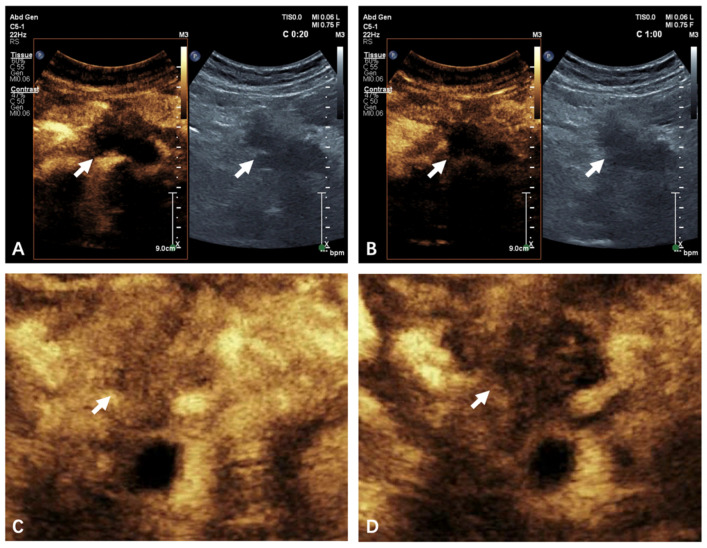
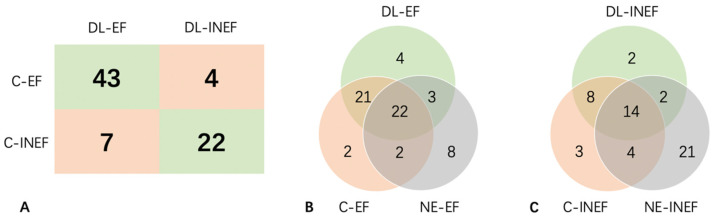
Contrast-enhanced ultrasound (CEUS) is a promising imaging modality in predicting the efficacy of neoadjuvant chemotherapy for pancreatic cancer, a tumor with high mortality. In this study, we proposed a deep-learning-based strategy for analyzing CEUS videos to predict the prognosis of pancreatic cancer neoadjuvant chemotherapy. Pre-trained convolutional neural network (CNN) models were used for binary classification of the chemotherapy as effective or ineffective, with CEUS videos collected before chemotherapy as the model input, and with the efficacy after chemotherapy as the reference standard. We proposed two deep learning models. The first CNN model used videos of ultrasound (US) and CEUS (US+CEUS), while the second CNN model only used videos of selected regions of interest (ROIs) within CEUS (CEUS-ROI). A total of 38 patients with strict restriction of clinical factors were enrolled, with 76 original CEUS videos collected. After data augmentation, 760 and 720 videos were included for the two CNN models, respectively. Seventy-six-fold and 72-fold cross-validations were performed to validate the classification performance of the two CNN models. The areas under the curve were 0.892 and 0.908 for the two models. The accuracy, recall, precision and F1 score were 0.829, 0.759, 0.786, and 0.772 for the first model. Those were 0.864, 0.930, 0.866, and 0.897 for the second model. A total of 38.2% and 40.3% of the original videos could be clearly distinguished by the deep learning models when the naked eye made an inaccurate classification. This study is the first to demonstrate the feasibility and potential of deep learning models based on pre-chemotherapy CEUS videos in predicting the efficacy of neoadjuvant chemotherapy for pancreas cancer.
超声造影(CEUS)是一种很有前景的成像方式,可用于预测胰腺癌新辅助化疗的疗效,胰腺癌是一种死亡率很高的肿瘤。在本研究中,我们提出了一种基于深度学习的策略,用于分析CEUS视频以预测胰腺癌新辅助化疗的预后。使用预训练的卷积神经网络(CNN)模型对化疗效果进行有效或无效的二元分类,以化疗前收集的CEUS视频作为模型输入,并以化疗后的疗效作为参考标准。我们提出了两种深度学习模型。第一个CNN模型使用超声(US)和CEUS(US + CEUS)的视频,而第二个CNN模型仅使用CEUS(CEUS-ROI)内选定感兴趣区域(ROI)的视频。共纳入38例临床因素严格受限的患者,收集了76份原始CEUS视频。经过数据增强后,两个CNN模型分别纳入了760和720份视频。进行了76倍和72倍交叉验证以验证两个CNN模型的分类性能。两个模型的曲线下面积分别为0.892和0.908。第一个模型的准确率、召回率、精确率和F1分数分别为0.829、0.759、0.786和0.772。第二个模型的这些指标分别为0.864、0.930、0.866和0.897。当肉眼分类不准确时,深度学习模型能够清晰区分38.2%和40.3%的原始视频。本研究首次证明了基于化疗前CEUS视频的深度学习模型在预测胰腺癌新辅助化疗疗效方面的可行性和潜力。