Zhang Yafang, Wei Qingyue, Huang Yini, Yao Zhao, Yan Cuiju, Zou Xuebin, Han Jing, Li Qing, Mao Rushuang, Liao Ying, Cao Lan, Lin Min, Zhou Xiaoshuang, Tang Xiaofeng, Hu Yixin, Li Lingling, Wang Yuanyuan, Yu Jinhua, Zhou Jianhua
Department of Ultrasound, Sun Yat-Sen University Cancer Center, State Key Laboratory of Oncology in South China, Collaborative Innovation Center for Cancer Medicine, Guangzhou, China.
School of Information Science and Technology, Fudan University, Shanghai, China.
Front Oncol. 2022 Jul 7;12:878061. doi: 10.3389/fonc.2022.878061. eCollection 2022.
Microvascular invasion (MVI) is a well-known risk factor for poor prognosis in hepatocellular carcinoma (HCC). This study aimed to develop a deep convolutional neural network (DCNN) model based on contrast-enhanced ultrasound (CEUS) to predict MVI, and thus to predict prognosis in patients with HCC.
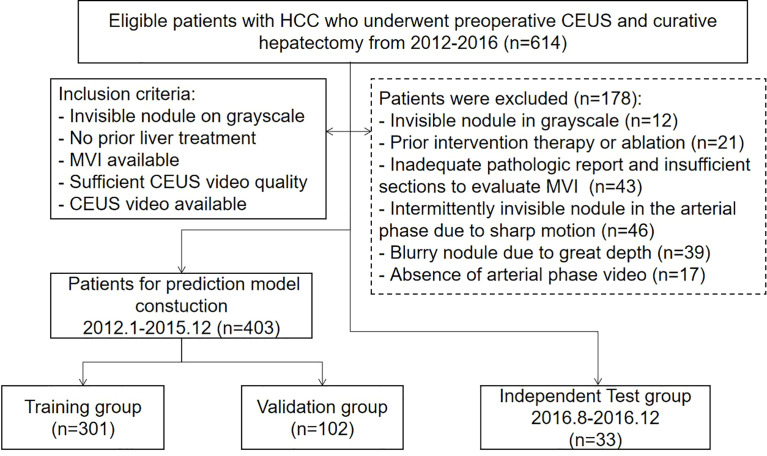
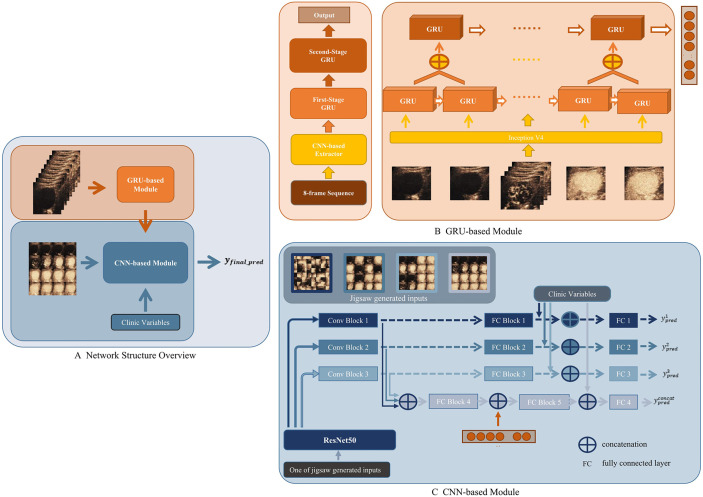
A total of 436 patients with surgically resected HCC who underwent preoperative CEUS were retrospectively enrolled. Patients were divided into training ( = 301), validation ( = 102), and test ( = 33) sets. A clinical model (Clinical model), a CEUS video-based DCNN model (CEUS-DCNN model), and a fusion model based on CEUS video and clinical variables (CECL-DCNN model) were built to predict MVI. Survival analysis was used to evaluate the clinical performance of the predicted MVI.
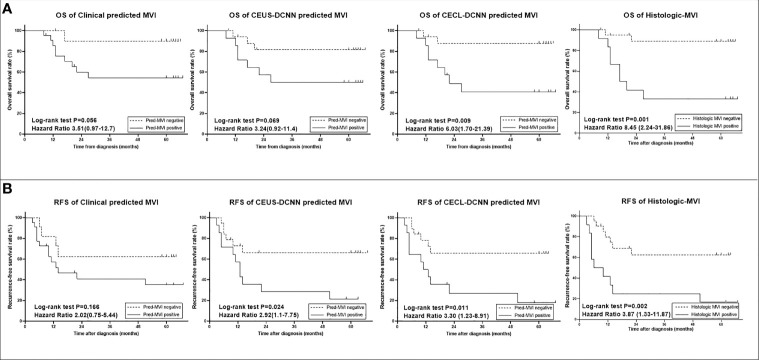
Compared with the Clinical model, the CEUS-DCNN model exhibited similar sensitivity, but higher specificity (71.4% vs. 38.1%, = 0.03) in the test group. The CECL-DCNN model showed significantly higher specificity (81.0% vs. 38.1%, = 0.005) and accuracy (78.8% vs. 51.5%, = 0.009) than the Clinical model, with an AUC of 0.865. The Clinical predicted MVI could not significantly distinguish OS or RFS (both > 0.05), while the CEUS-DCNN predicted MVI could only predict the earlier recurrence (hazard ratio [HR] with 95% confidence interval [CI 2.92 [1.1-7.75], = 0.024). However, the CECL-DCNN predicted MVI was a significant prognostic factor for both OS (HR with 95% CI: 6.03 [1.7-21.39], = 0.009) and RFS (HR with 95% CI: 3.3 [1.23-8.91], = 0.011) in the test group.
The proposed CECL-DCNN model based on preoperative CEUS video can serve as a noninvasive tool to predict MVI status in HCC, thereby predicting poor prognosis.
微血管侵犯(MVI)是肝细胞癌(HCC)预后不良的一个众所周知的危险因素。本研究旨在开发一种基于超声造影(CEUS)的深度卷积神经网络(DCNN)模型来预测MVI,从而预测HCC患者的预后。
回顾性纳入436例接受手术切除且术前行CEUS检查的HCC患者。患者被分为训练集(n = 301)、验证集(n = 102)和测试集(n = 33)。构建了一个临床模型(Clinical model)、一个基于CEUS视频的DCNN模型(CEUS-DCNN模型)和一个基于CEUS视频与临床变量的融合模型(CECL-DCNN模型)来预测MVI。采用生存分析评估预测的MVI的临床性能。
在测试组中,与临床模型相比,CEUS-DCNN模型表现出相似的敏感性,但特异性更高(71.4%对38.1%,P = 0.03)。CECL-DCNN模型显示出比临床模型显著更高的特异性(81.0%对38.1%,P = 0.005)和准确性(78.8%对51.5%,P = 0.009),曲线下面积(AUC)为0.865。临床预测的MVI不能显著区分总生存期(OS)或无复发生存期(RFS)(均P>0.05),而CEUS-DCNN预测的MVI只能预测更早的复发(风险比[HR],95%置信区间[CI]:2.92[1.1 - 7.75],P = 0.024)。然而,在测试组中,CECL-DCNN预测的MVI是OS(HR,95%CI:6.03[1.7 - 21.39],P = 0.009)和RFS(HR,95%CI:3.3[1.23 - 8.91],P = 0.011)的显著预后因素。
所提出的基于术前CEUS视频的CECL-DCNN模型可作为一种非侵入性工具来预测HCC中的MVI状态,从而预测不良预后。