Shafi Imran, Fatima Anum, Afzal Hammad, Díez Isabel de la Torre, Lipari Vivian, Breñosa Jose, Ashraf Imran
College of Electrical and Mechanical Engineering, National University of Sciences and Technology (NUST), Islamabad 44000, Pakistan.
National Centre for Robotics, National University of Sciences and Technology (NUST), Islamabad 44000, Pakistan.
Diagnostics (Basel). 2023 Jun 28;13(13):2196. doi: 10.3390/diagnostics13132196.
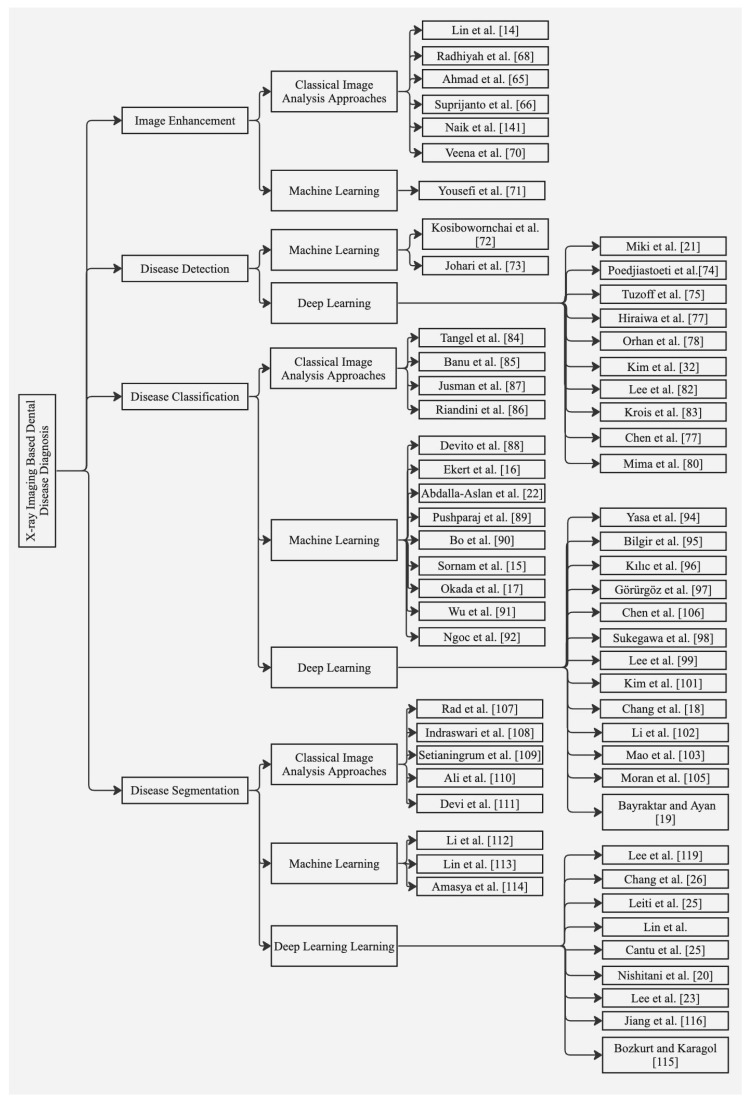
Artificial intelligence has made substantial progress in medicine. Automated dental imaging interpretation is one of the most prolific areas of research using AI. X-ray and infrared imaging systems have enabled dental clinicians to identify dental diseases since the 1950s. However, the manual process of dental disease assessment is tedious and error-prone when diagnosed by inexperienced dentists. Thus, researchers have employed different advanced computer vision techniques, and machine- and deep-learning models for dental disease diagnoses using X-ray and near-infrared imagery. Despite the notable development of AI in dentistry, certain factors affect the performance of the proposed approaches, including limited data availability, imbalanced classes, and lack of transparency and interpretability. Hence, it is of utmost importance for the research community to formulate suitable approaches, considering the existing challenges and leveraging findings from the existing studies. Based on an extensive literature review, this survey provides a brief overview of X-ray and near-infrared imaging systems. Additionally, a comprehensive insight into challenges faced by researchers in the dental domain has been brought forth in this survey. The article further offers an amalgamative assessment of both performances and methods evaluated on public benchmarks and concludes with ethical considerations and future research avenues.
人工智能在医学领域取得了重大进展。自动牙科影像解读是使用人工智能进行研究的最多产的领域之一。自20世纪50年代以来,X射线和红外成像系统已使牙科临床医生能够识别牙科疾病。然而,当由经验不足的牙医进行诊断时,牙科疾病评估的手工过程既繁琐又容易出错。因此,研究人员采用了不同的先进计算机视觉技术以及机器学习和深度学习模型,利用X射线和近红外图像进行牙科疾病诊断。尽管人工智能在牙科领域取得了显著进展,但某些因素会影响所提出方法的性能,包括数据可用性有限、类别不均衡以及缺乏透明度和可解释性。因此,考虑到现有挑战并利用现有研究的结果,研究界制定合适的方法至关重要。基于广泛的文献综述,本次调查简要概述了X射线和近红外成像系统。此外,本次调查还深入洞察了牙科领域研究人员面临的挑战。本文进一步对在公共基准上评估的性能和方法进行了综合评估,并以伦理考量和未来研究方向作为结论。