College of Public Health, University of South Florida, Tampa, FL 33612, USA.
Obstetrics and Gynecology, Kaiser Permanente, Antioch Medical Center, Antioch, CA 94531, USA.
Int J Environ Res Public Health. 2023 Jul 4;20(13):6289. doi: 10.3390/ijerph20136289.
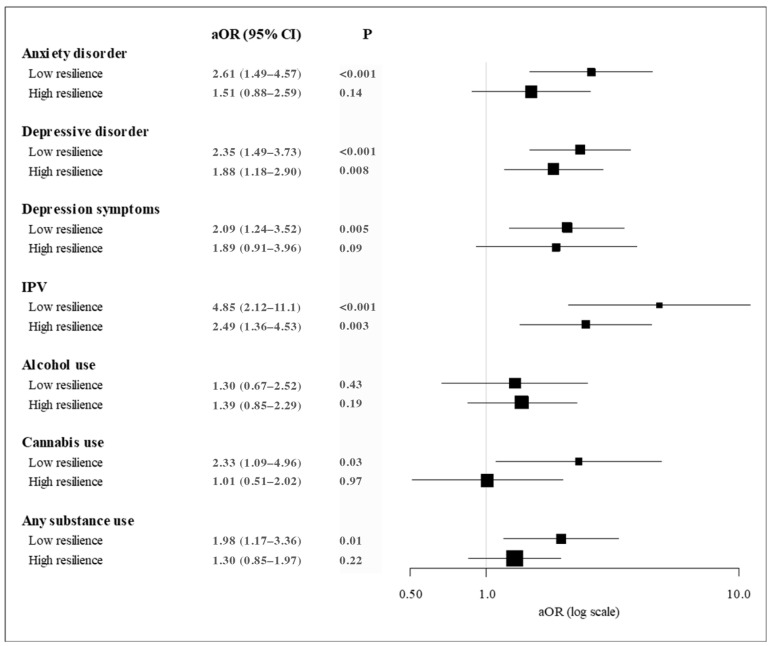
Adverse childhood experiences (ACEs) are common and increase the risk of poor health outcomes. Resilience may offer protection against the impacts of ACEs. This study examined the association between maternal ACEs and mental/behavioral health outcomes during pregnancy overall and by resilience. The sample comprised pregnant patients in two pilot studies screened for eight ACEs and resilience during standard prenatal care in Kaiser Permanente Northern California from 1 March 2016 to 30 July 2016 (Study 1, medical centers A, B) and from 1 April 2018 to 31 March 2019 (Study 2, medical centers A, C). Early pregnancy outcomes included anxiety and depressive disorders, depression symptoms, intimate partner violence (IPV), and substance use. Multivariable logistic regression was used in this cross-sectional study to examine associations between maternal ACEs (0, 1-2, ≥3) and mental/behavioral health outcomes overall and among those with low and high resilience. Patients (n = 1084) averaged 30.8 years (SD 5.1); 41.7% were non-Hispanic White; 41.7% experienced ≥1 ACE, and 40.3% had low resilience. Patients with 1-2 ACEs or ≥3 ACEs (versus 0 ACEs) had higher odds of anxiety and depressive disorders, depressive symptoms, IPV, and any prenatal substance use (OR 1.44-4.40, < 0.05). Each individual ACE was associated with ≥2 mental/behavioral health outcomes. In stratified analyses, having ≥1 ACE (vs. 0) was associated with a greater number of mental/behavioral health outcomes among patients with low versus high resilience. ACEs were associated with prenatal mental/behavioral health conditions, particularly in the context of low resilience, highlighting the importance of trauma-informed prenatal care and the need to study resilience-building interventions during pregnancy.
不良的童年经历(ACEs)很常见,会增加健康状况不佳的风险。适应力可能提供对 ACEs 影响的保护。本研究总体上和通过适应力来检查母体 ACEs 与怀孕期间的精神/行为健康结果之间的关联。该样本包括在 Kaiser Permanente 北加利福尼亚州标准产前护理期间筛查出八项 ACEs 和适应力的两名试点研究中的怀孕患者,时间为 2016 年 3 月 1 日至 7 月 30 日(研究 1,医疗中心 A、B)和 2018 年 4 月 1 日至 2019 年 3 月 31 日(研究 2,医疗中心 A、C)。早期妊娠结局包括焦虑和抑郁障碍、抑郁症状、亲密伴侣暴力(IPV)和物质使用。本横断面研究使用多变量逻辑回归来检查母体 ACEs(0、1-2、≥3)与总体精神/行为健康结果之间的关联,以及在低和高适应力者中的关联。患者(n=1084)平均年龄为 30.8 岁(标准差 5.1);41.7%为非西班牙裔白人;41.7%经历过≥1 ACE,40.3%的人适应力低。与 0 ACEs 相比,有 1-2 ACEs 或≥3 ACEs 的患者(vs. 0 ACEs)有更高的焦虑和抑郁障碍、抑郁症状、IPV 和任何产前物质使用的可能性(OR 1.44-4.40,<0.05)。每个个体 ACE 都与≥2 种精神/行为健康结果相关。在分层分析中,与低适应力的患者相比,在高适应力的患者中,有≥1 ACE(vs. 0)与更多的精神/行为健康结果相关。ACEs 与产前精神/行为健康状况有关,特别是在适应力较低的情况下,这突出表明了创伤知情的产前护理的重要性,以及在怀孕期间研究建立适应力的干预措施的必要性。