Oliver Javier, Onieva Juan Luis, Garrido-Barros María, Cobo-Dols Manuel, Martínez-Gálvez Beatriz, García-Pelícano Ana Isabel, Dubbelman Jaime, Benítez José Carlos, Martín Juan Zafra, Cantero Alejandra, Pérez-Ruiz Elisabeth, Rueda-Domínguez Antonio, Barragán Isabel
Medical Oncology Service (Group of Translational Research in Cancer Immunotherapy), Regional and Virgen de la Victoria University Hospitals, Institute of Biomedical Research in Malaga and BIONAND Nanomedicine Platform (IBIMA BIONAND Platform), C/Marqués de Beccaría n°3, 29010 Málaga, Spain.
Faculty of Medicine, Campus de Teatinos s/n, Universidad de Málaga, 29071 Málaga, Spain.
Cancers (Basel). 2023 Jun 26;15(13):3357. doi: 10.3390/cancers15133357.
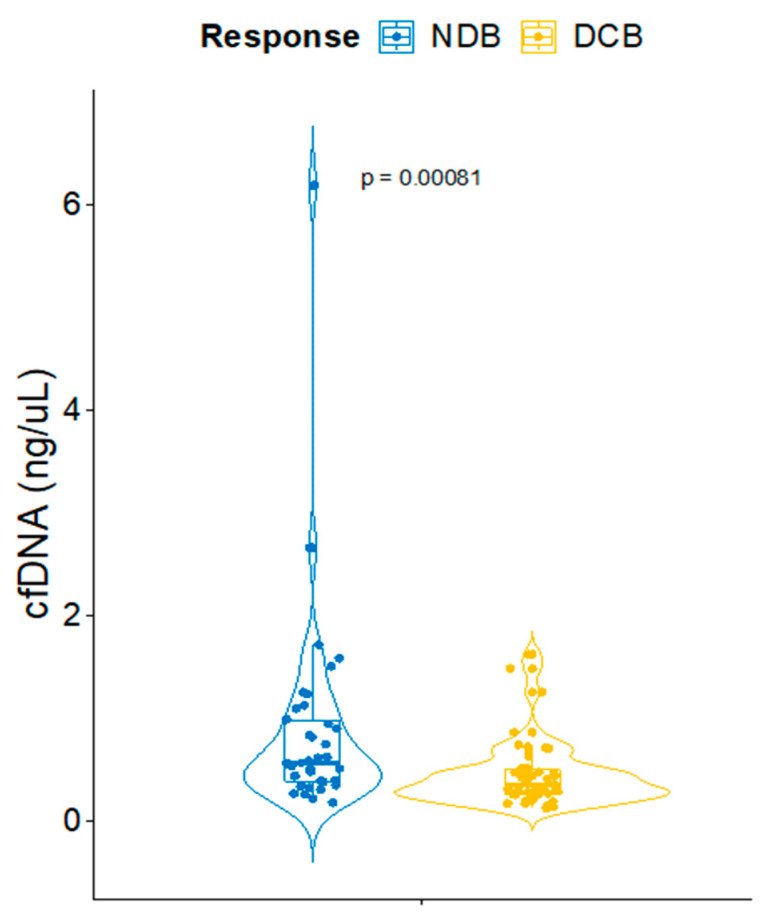
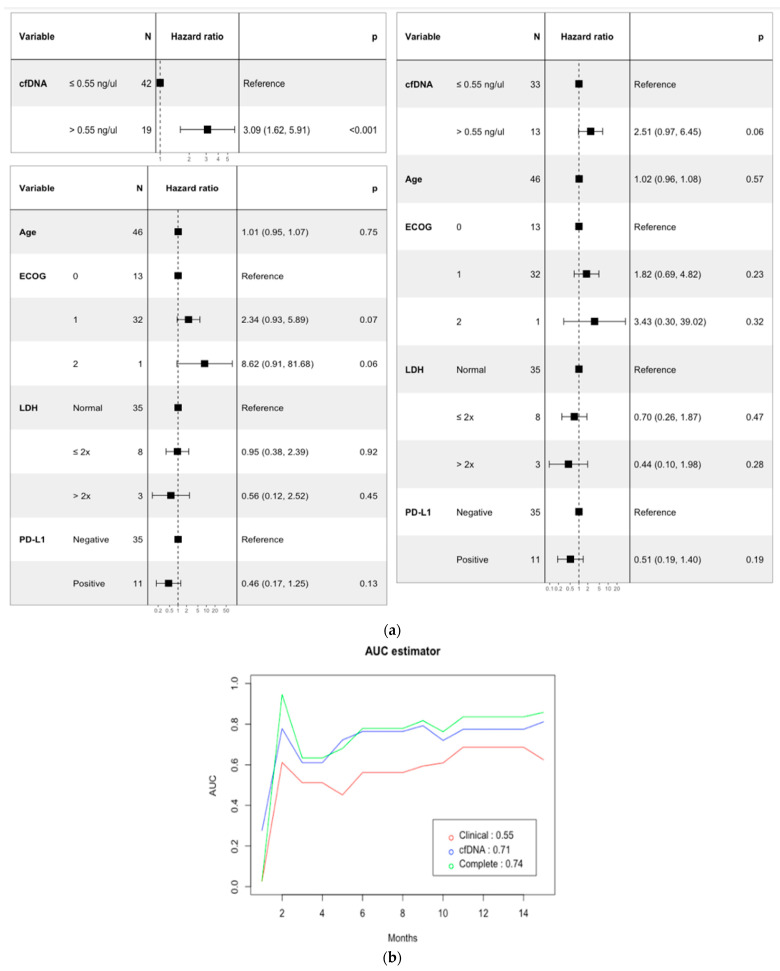
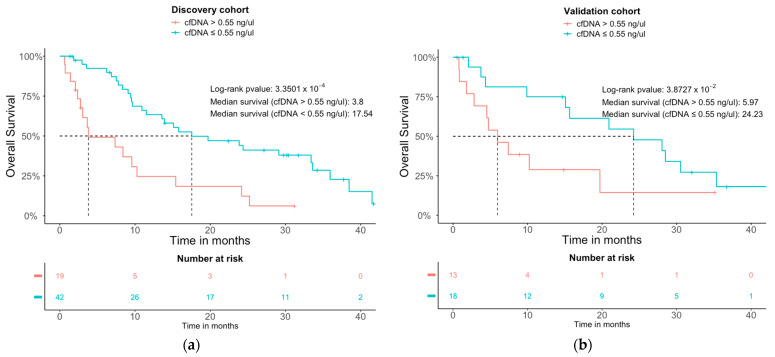
The present study aimed to investigate the potential of basal cell-free fluorometric DNA (cfDNA) quantification as a prognostic biomarker in advanced non-small cell lung cancer (NSCLC) patients treated with an Immune Checkpoint Blockade (ICB). A discovery and validation cohort of 61 and 31 advanced lung cancer patients treated with ICB were included in this study. Quantification of cfDNA concentration was performed before the start of the treatment and patients were followed up for a median of 34 (30-40) months. The prognostic predicted value of cfDNA was evaluated based on ROC, and Cox regression was conducted via univariate and multivariate analyses to estimate the hazard ratio. We observed that a cfDNA cut-off of 0.55 ng/µL before the ICB determines the overall survival of patients with a log rank -value of 3.3 × 10. That represents median survivals of 3.8 vs. 17.5 months. Similar results were obtained in the validation cohort being the log rank -value 3.8 × 10 with median survivals of 5.9 vs. 24.3. The univariate and multivariate analysis revealed that the cut-off of 0.55 ng/µL before ICB treatment was an independent predictive factor and was significantly associated with a better survival outcome. High cfDNA concentrations identify patients with advanced NSCLC who do not benefit from the ICB. The determination of cfDNA is a simple test that could select a group of patients in whom new therapeutic strategies are needed.
本研究旨在探讨基础无细胞荧光DNA(cfDNA)定量作为免疫检查点阻断(ICB)治疗的晚期非小细胞肺癌(NSCLC)患者预后生物标志物的潜力。本研究纳入了61例和31例接受ICB治疗的晚期肺癌患者作为发现队列和验证队列。在治疗开始前对cfDNA浓度进行定量,并对患者进行了中位34(30 - 40)个月的随访。基于ROC评估cfDNA的预后预测价值,并通过单变量和多变量分析进行Cox回归以估计风险比。我们观察到,ICB治疗前cfDNA临界值为0.55 ng/µL可确定患者的总生存期,对数秩检验值为3.3×10。这代表中位生存期分别为3.8个月和17.5个月。在验证队列中也获得了类似结果,对数秩检验值为3.8×10,中位生存期分别为5.9个月和24.3个月。单变量和多变量分析显示,ICB治疗前0.55 ng/µL的临界值是一个独立的预测因素,并且与更好的生存结果显著相关。高cfDNA浓度可识别出不能从ICB治疗中获益的晚期NSCLC患者。cfDNA的测定是一项简单的检测方法,可筛选出需要新治疗策略的患者群体。