Segal Dana, Dostie Josée
Department of Biochemistry, McGill University, Montréal, QC H3G 1Y6, Canada.
Rosalind and Morris Goodman Cancer Institute, McGill University, Montréal, QC H3A 1A3, Canada.
Cancers (Basel). 2023 Jun 30;15(13):3433. doi: 10.3390/cancers15133433.
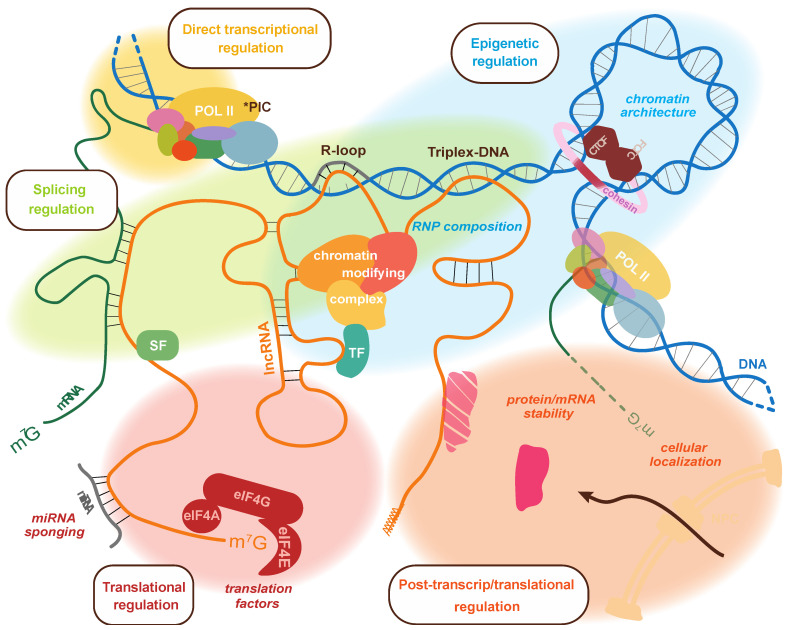
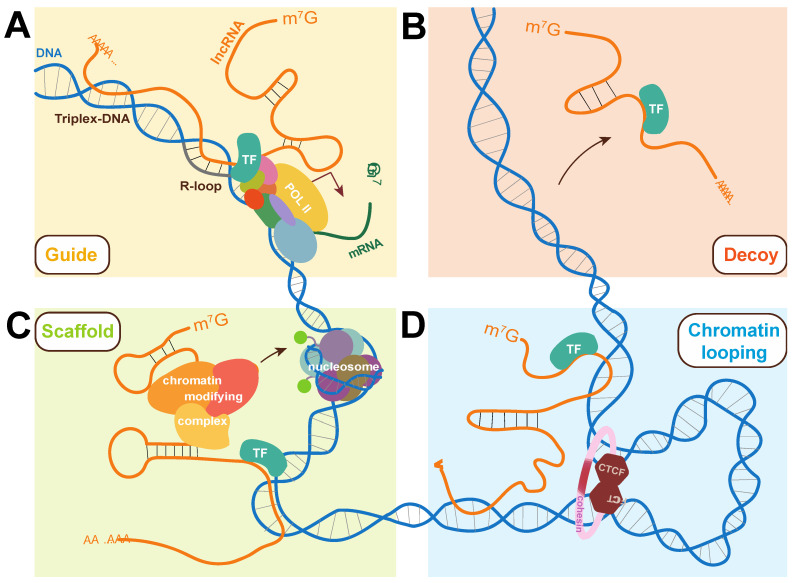
As a group of diseases characterized by uncontrollable cell growth, cancer is highly multifaceted in how it overrides checkpoints controlling proliferation. Amongst the regulators of these checkpoints, long non-coding RNAs (lncRNAs) can have key roles in why natural biological processes go haywire. LncRNAs represent a large class of regulatory transcripts that can localize anywhere in cells. They were found to affect gene expression on many levels from transcription to mRNA translation and even protein stability. LncRNA participation in such control mechanisms can depend on cell context, with given transcripts sometimes acting as oncogenes or tumor suppressors. Importantly, the tissue-specificity and low expression levels of lncRNAs make them attractive therapeutic targets or biomarkers. Here, we review the various cellular processes affected by lncRNAs and outline molecular strategies they use to control gene expression, particularly in cancer and in relation to transcription factors.
作为一组以细胞生长失控为特征的疾病,癌症在其如何超越控制增殖的检查点方面具有高度的多面性。在这些检查点的调节因子中,长链非编码RNA(lncRNA)在自然生物过程为何失控方面可能起着关键作用。lncRNA代表一大类调控转录本,可定位于细胞内的任何位置。人们发现它们在从转录到mRNA翻译甚至蛋白质稳定性的许多层面上影响基因表达。lncRNA参与此类控制机制可能取决于细胞背景,特定的转录本有时充当癌基因或肿瘤抑制因子。重要的是,lncRNA的组织特异性和低表达水平使其成为有吸引力的治疗靶点或生物标志物。在这里,我们综述了受lncRNA影响的各种细胞过程,并概述了它们用于控制基因表达的分子策略,特别是在癌症中以及与转录因子相关的方面。