Da'ar Omar B, Jradi Hoda, Alkaiyat Mohammad, Alolayan Ashwaq, Jazieh Abdul Rahman
Department of Health Systems Management, College of Public Health and Health Informatics, King Saud bin Abdulaziz University for Health Sciences, Riyadh 11481, Saudi Arabia.
King Abdullah International Medical Research Center, Riyadh 11481, Saudi Arabia.
Healthcare (Basel). 2023 Jun 28;11(13):1876. doi: 10.3390/healthcare11131876.
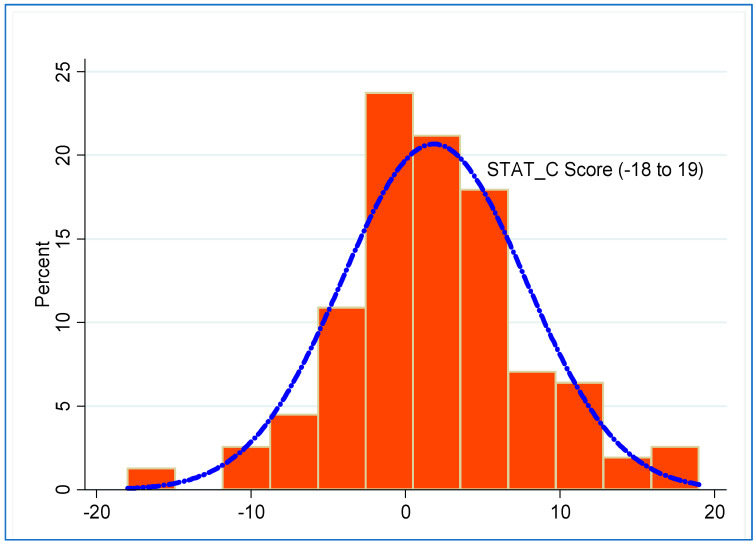
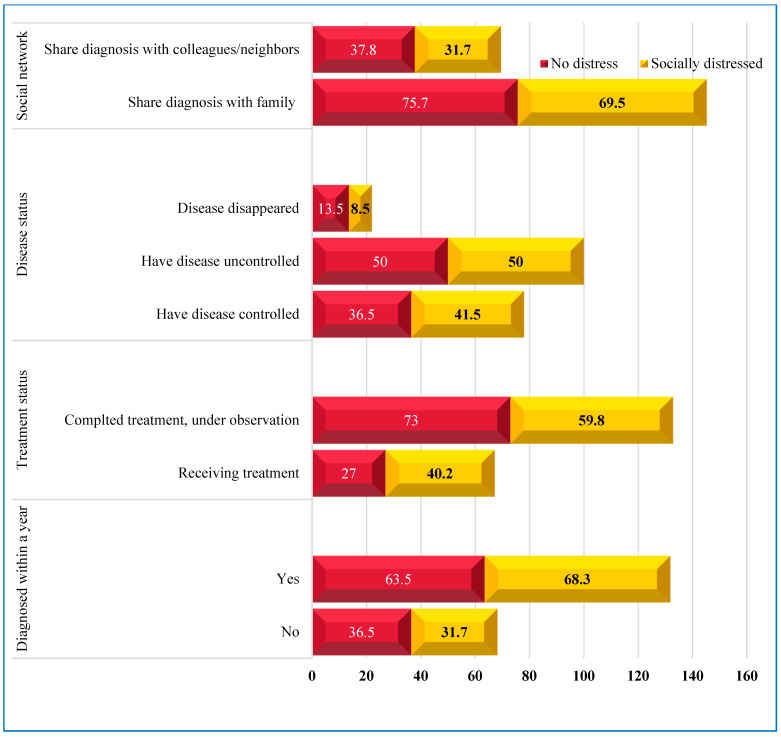
: We investigated the association between social distress or toxicity and patients' clinical conditions, demographic characteristics, and social support and networks, and whether this association differs along the distribution of patients' distress levels. This study included 156 patients treated at King Abdulaziz Medical City, Riyadh, Saudi Arabia. : We used the previously validated Social Toxicity Assessment Tool in Cancer (STAT-C) to assess cancer patients' distress. We analyzed distress level, the outcome variable of interest, and covariates to show distribution and identify associations. We then used logistic quantile regression for bounded outcomes to assess the association between social distress or toxicity and patients' clinical conditions, demographic characteristics, and social support and network. As an extension, we examined the interaction between disease status and social support, focusing on the moderating role of social support in attenuating the impact of disease status on social distress. : The median age of the patients was 51.2 (SD = 21.4, range 22 to 89), with 48.1% being older than 50 years. Of the 156 cancer patients analyzed, 82 (52.6%) were classified as burdened, and 50% of those with uncontrolled disease status were socially distressed. However, there were more socially distressed patients diagnosed within a year and patients undergoing treatment. There was a greater number of patients who shared their diagnosis with family, colleagues, and neighbors with social distress. The odds of suffering from social distress were higher in younger patients (50 years or younger) than in older patients. Social distress was lower in patients who underwent combined chemotherapy, surgery, and radiation compared with patients who received a single treatment regimen (OR = 0.65, CI, -0.820 to -0.036, = 0.033). The odds of social distress were 67% higher in patients diagnosed within one year than in patients diagnosed more than one year prior (OR = 1.664, CI, 0.100-0.918, = 0.015). Patients with uncontrolled disease conditions who shared their diagnosis and treatment with social networks were 48% less likely to experience social distress. Thus, sharing cancer diagnoses with social networks has a statistically significant moderating effect by attenuating the impact of disease status on social distress. : Understanding the risk factors for social distress may be important for cancer management. Additionally, identifying the moderating role that patients' sharing of cancer diagnoses in social networks plays in attenuating the impact of disease status on social distress may provide healthcare providers with valuable insights for holistic culture-specific care.
我们调查了社会困扰或毒性与患者临床状况、人口统计学特征、社会支持和社交网络之间的关联,以及这种关联是否因患者困扰水平的分布而异。本研究纳入了在沙特阿拉伯利雅得阿卜杜勒阿齐兹国王医疗城接受治疗的156名患者。我们使用先前验证的癌症社会毒性评估工具(STAT-C)来评估癌症患者的困扰程度。我们分析了困扰水平(感兴趣的结果变量)和协变量,以显示分布情况并确定关联。然后,我们使用逻辑分位数回归来分析有界结果,以评估社会困扰或毒性与患者临床状况、人口统计学特征、社会支持和社交网络之间的关联。作为拓展,我们研究了疾病状态与社会支持之间的相互作用,重点关注社会支持在减轻疾病状态对社会困扰影响方面的调节作用。患者的中位年龄为51.2岁(标准差 = 21.4,范围22至89岁),其中48.1%的患者年龄超过50岁。在分析的156名癌症患者中,82名(52.6%)被归类为负担过重,疾病状态未得到控制的患者中有50%存在社会困扰。然而,在确诊一年内以及正在接受治疗的患者中,社会困扰患者更多。与家人、同事和邻居分享诊断结果的社会困扰患者数量更多。年轻患者(50岁及以下)遭受社会困扰的几率高于老年患者。与接受单一治疗方案的患者相比,接受联合化疗、手术和放疗的患者社会困扰程度更低(比值比 = 0.65,可信区间,-0.820至-0.036,P = 0.033)。确诊一年内的患者出现社会困扰的几率比确诊一年以上的患者高67%(比值比 = 1.664,可信区间,0.100 - 0.918,P = 0.015)。与社交网络分享诊断和治疗情况的疾病状态未得到控制的患者经历社会困扰的可能性降低48%。因此,通过减轻疾病状态对社会困扰的影响,与社交网络分享癌症诊断结果具有统计学上显著的调节作用。了解社会困扰的风险因素可能对癌症管理很重要。此外,确定患者在社交网络中分享癌症诊断结果在减轻疾病状态对社会困扰影响方面所起的调节作用,可能为医疗服务提供者提供针对特定文化的整体护理的宝贵见解。