
用于高性能钠离子电池的碳负极的间距纳米工程最新进展
The Recent Progress of Pitch Nanoengineering to Obtain the Carbon Anode for High-Performance Sodium Ion Batteries.
作者信息
Du Wen-Sheng, Sun Chen, Sun Qiang
机构信息
School of Metallurgy, Northeastern University, Shenyang 110819, China.
出版信息
Materials (Basel). 2023 Jul 7;16(13):4871. doi: 10.3390/ma16134871.
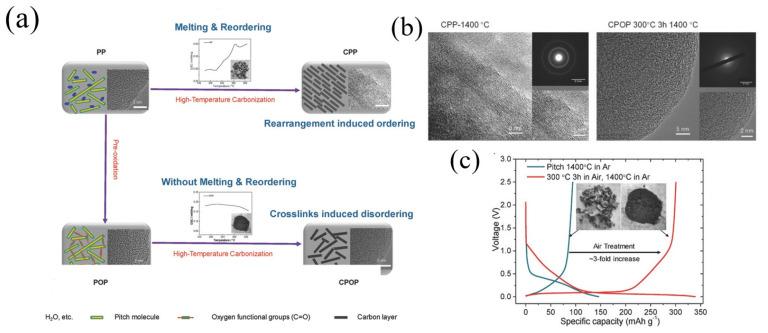
As an anode material for sodium ion batteries (SIBs), carbon materials have attracted people's interest because of their abundant resources, good structural stability and low cost. Among most carbon precursors, pitch is viewed as a promising one because of a higher carbon content, good oxidation reversibility and low cost. However, the pitch-based carbon obtained with direct pyrolysis of pitch displays a high degree of graphitization and small layer spacing, which is unfavorable for the storage of sodium ions. In recent years, with the aid of the development of the nanoengineering process, the storage of sodium ions with pitch-based carbon has been drastically improved. This review article summarizes the recent progress of pitch nanoengineering to obtain the carbon anode for high-performance SIBs, including porous structure adjustment, heteroatom doping, co-carbonization and pre-oxidation. In addition, the merits and demerits of a variety of nanoengineering processes are discussed, and future research directions of pitch-based carbon are prospected.
作为钠离子电池(SIBs)的阳极材料,碳材料因其资源丰富、结构稳定性好和成本低而备受关注。在大多数碳前驱体中,沥青因其碳含量高、氧化可逆性好和成本低而被视为一种很有前景的材料。然而,通过沥青直接热解得到的沥青基碳具有高度的石墨化和较小的层间距,这不利于钠离子的存储。近年来,借助纳米工程工艺的发展,沥青基碳对钠离子的存储性能得到了显著改善。本文综述了沥青纳米工程在制备高性能SIBs碳阳极方面的最新进展,包括多孔结构调整、杂原子掺杂、共碳化和预氧化。此外,还讨论了各种纳米工程工艺的优缺点,并对沥青基碳的未来研究方向进行了展望。


 Zotero 插件