Kneizeh Kinan, Milzi Andrea, Vogt Felix, Witte Klaus, Marx Nikolaus, Lehrke Michael, Almalla Mohammad, Schröder Jörg
Department of Cardiology, Angiology and Critical Care (Medical Clinic 1), University Hospital RWTH Aachen, 52074 Aachen, Germany.
J Clin Med. 2023 Jun 24;12(13):4243. doi: 10.3390/jcm12134243.
We aimed to evaluate the efficacy and safety of low-dose protamine in reducing access site-related complications during Transcatheter Aortic Valve Implantation (TAVI) as compared to full-dose protamine.
Access site-related complications represent an independent predictor of poor outcomes of TAVI. Data regarding heparin reversal with protamine and the dosage needed to prevent bleeding complications are scarce among patients undergoing TAVI.
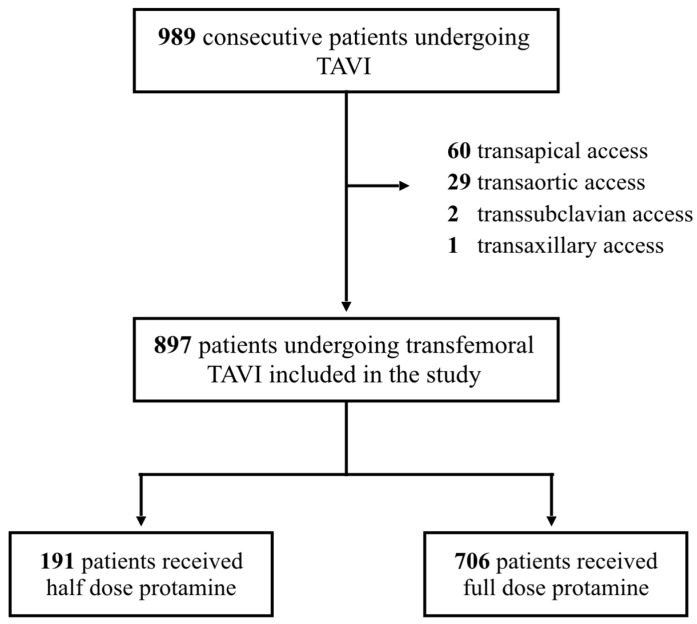
A total of 897 patients were retrospectively included in the study. Patients who underwent percutaneous coronary intervention within 4 weeks before or concomitantly with TAVI ( = 191) were given 0.5 mg protamine for each 100 units of unfractionated heparin. All other patients ( = 706) were considered as a control group and 1 mg protamine for each 100 units of heparin was administered.
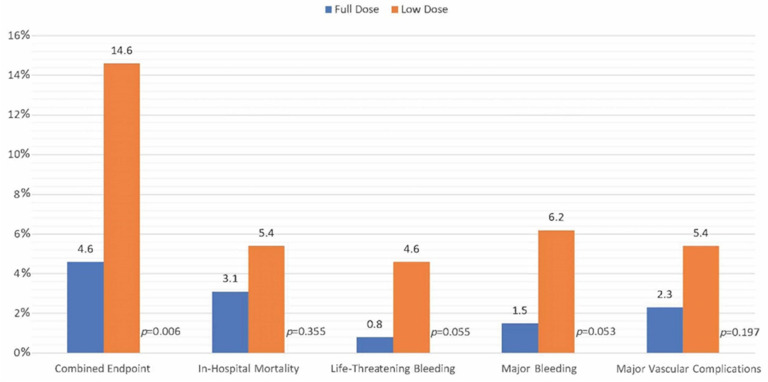
The combined intra-hospital endpoint of death, life-threatening major bleeding, and major vascular complications were significantly more frequent in patients receiving low-dose protamine [29 (15.2%) vs. 50 (7.1%), < 0.001]. After propensity matching ( = 130 for each group) for relevant clinical characteristics including anti-platelet therapy [19 (14.6%) vs. 6 (4.6%), = 0.006], low-dose protamine predicted the combined endpoint (OR 3.54, 95%-CI 1.36-9.17, = 0.009), and even in multivariable analysis, low-dose protamine continued to be a predictor of the combined endpoint in the matched model (OR 3.07, 95%-CI 1.17-8.08, = 0.023) alongside baseline hemoglobin.
In this propensity-matched retrospective analysis, a low-dose protamine regime is associated with a higher rate of major adverse events compared to a full-dose protamine regime following transfemoral TAVI.
我们旨在评估与全剂量鱼精蛋白相比,低剂量鱼精蛋白在经导管主动脉瓣植入术(TAVI)期间减少穿刺部位相关并发症的疗效和安全性。
穿刺部位相关并发症是TAVI预后不良的独立预测因素。在接受TAVI的患者中,关于鱼精蛋白用于肝素中和以及预防出血并发症所需剂量的数据很少。
本研究共纳入897例患者,进行回顾性分析。在TAVI前4周内或同时接受经皮冠状动脉介入治疗的患者(n = 191),每100单位普通肝素给予0.5毫克鱼精蛋白。所有其他患者(n = 706)作为对照组,每100单位肝素给予1毫克鱼精蛋白。
接受低剂量鱼精蛋白的患者中,院内死亡、危及生命的大出血和主要血管并发症的联合终点事件显著更频繁(29例[15.2%] vs. 50例[7.1%],P < 0.001)。在对包括抗血小板治疗在内的相关临床特征进行倾向匹配(每组n = 130)后,低剂量鱼精蛋白可预测联合终点事件(OR 3.54,95% CI 1.36 - 9.17,P = 0.009),即使在多变量分析中,低剂量鱼精蛋白在匹配模型中仍是联合终点事件的预测因素(OR 3.07,95% CI 1.17 - 8.08,P = 0.023),与基线血红蛋白水平相当。
在这项倾向匹配的回顾性分析中,与经股动脉TAVI术后全剂量鱼精蛋白方案相比,低剂量鱼精蛋白方案与更高的主要不良事件发生率相关。