Moriya Kei, Sato Shinya, Nishimura Norihisa, Kawaratani Hideto, Takaya Hiroaki, Kaji Kosuke, Namisaki Tadashi, Uejima Masakazu, Nagamatsu Shinsaku, Matsuo Hideki, Yoshiji Hitoshi
Department of Gastroenterology, Nara Medical University, Kashihara 634-8521, Japan.
Department of Gastroenterology, Nara Prefecture General Medical Center, 897-5, 2-Chome, Shichijo-Nishimachi, Nara 630-8581, Japan.
J Clin Med. 2023 Jul 3;12(13):4463. doi: 10.3390/jcm12134463.
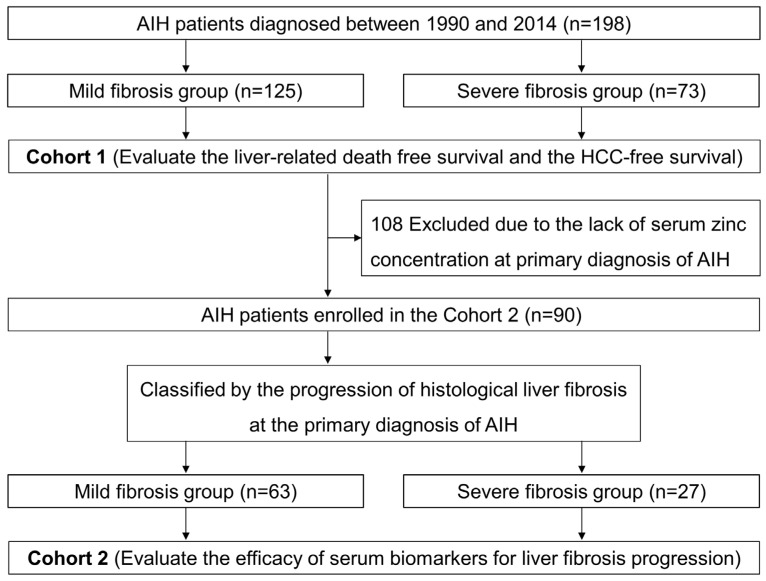
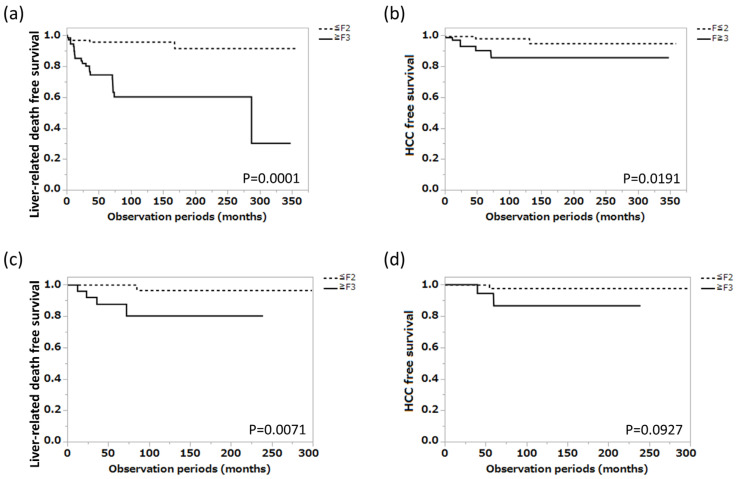
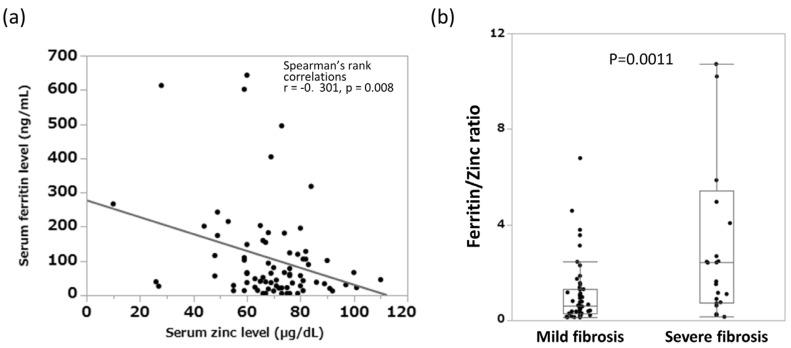
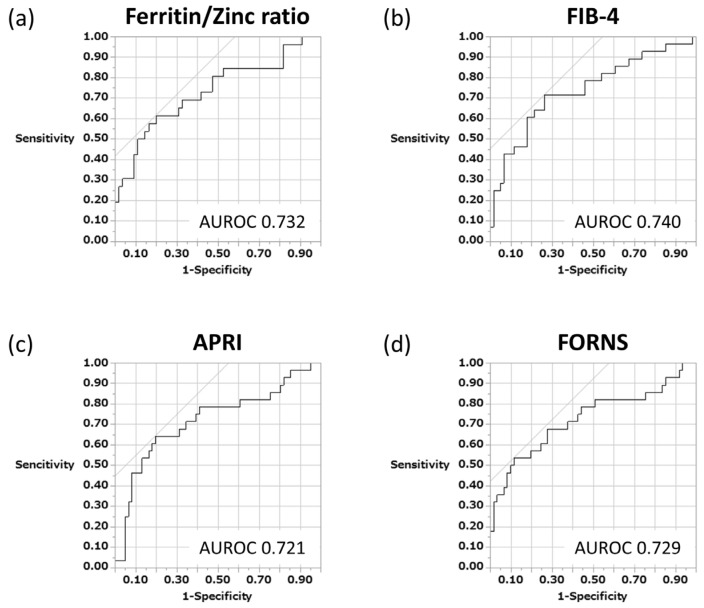
The search for noninvasive biomarkers that can efficiently estimate the extent of liver fibrosis progression is ongoing. Although Fibrosis-4 (FIB-4), the aspartate transaminase-to-platelet ratio index (APRI), and the Forns index have been reported as useful biomarkers, their investigation in autoimmune hepatitis (AIH) is limited. This study aimed to examine the usefulness of these serological indices and a newly developed index in predicting liver fibrosis progression in AIH. The study analyzed data from 190 patients diagnosed with AIH at our institution between 1990 and 2015. Their histological liver fibrosis progression and clinical long-term prognosis were evaluated retrospectively (cohort 1). In 90 patients, receiver operating characteristic (ROC) curves were compared to choose severe fibrosis cases with respect to existing indices (FIB-4, APRI, and Forns index) and the ferritin-zinc ratio (cohort 2). In cohort 1, liver-related death and hepatocellular carcinoma rates were significantly higher in the severe (n = 27) than in the mild (n = 63) fibrosis group ( = 0.0001 and 0.0191, respectively). In cohort 2, liver-related death in the severe fibrosis group was significantly frequent ( = 0.0071), and their ferritin-zinc ratio was higher (median 2.41 vs. 0.62, = 0.0011). ROC analyses were performed to compare the ability of the ferritin-zinc ratio, FIB-4, APRI, and the Forns index to predict severe and mild fibrosis. Accordingly, areas under the ROC were 0.732, 0.740, 0.721, and 0.729, respectively. The serum ferritin-zinc ratio can noninvasively predict liver fibrosis progression in AIH and be applied to predict long-term prognosis.
寻找能够有效评估肝纤维化进展程度的非侵入性生物标志物的研究正在进行中。尽管纤维化-4(FIB-4)、天冬氨酸转氨酶与血小板比值指数(APRI)和福尔恩斯指数已被报道为有用的生物标志物,但它们在自身免疫性肝炎(AIH)中的研究有限。本研究旨在检验这些血清学指标以及一种新开发的指标在预测AIH肝纤维化进展中的有用性。该研究分析了1990年至2015年间在我们机构诊断为AIH的190例患者的数据。回顾性评估了他们的组织学肝纤维化进展和临床长期预后(队列1)。在90例患者中,比较了受试者操作特征(ROC)曲线,以根据现有指标(FIB-4、APRI和福尔恩斯指数)和铁蛋白-锌比值选择重度纤维化病例(队列2)。在队列1中,重度(n = 27)纤维化组的肝相关死亡率和肝细胞癌发生率显著高于轻度(n = 63)纤维化组(分别为 = 0.0001和0.0191)。在队列2中,重度纤维化组的肝相关死亡明显更频繁( = 0.0071),且他们的铁蛋白-锌比值更高(中位数2.41对0.62, = 0.0011)。进行ROC分析以比较铁蛋白-锌比值、FIB-4、APRI和福尔恩斯指数预测重度和轻度纤维化的能力。相应地,ROC曲线下面积分别为0.732、0.740、0.721和0.729。血清铁蛋白-锌比值可以非侵入性地预测AIH的肝纤维化进展,并可用于预测长期预后。