Noordman Alwin B P, Rienstra Michiel, Blaauw Yuri, Mulder Bart A, Maass Alexander H
Department of Cardiology, Heart Center, University of Groningen, University Medical Center Groningen, 9713 GZ Groningen, The Netherlands.
J Clin Med. 2023 Jul 4;12(13):4479. doi: 10.3390/jcm12134479.
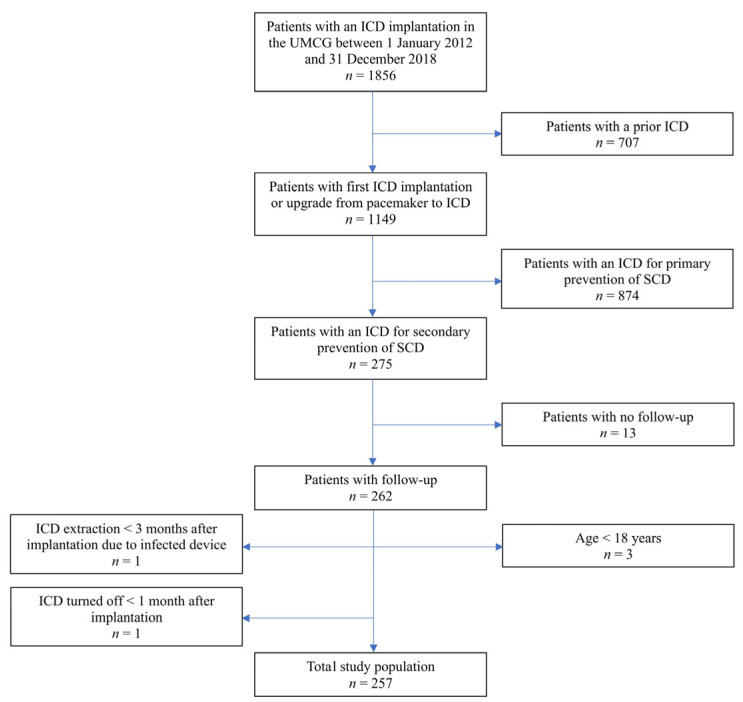
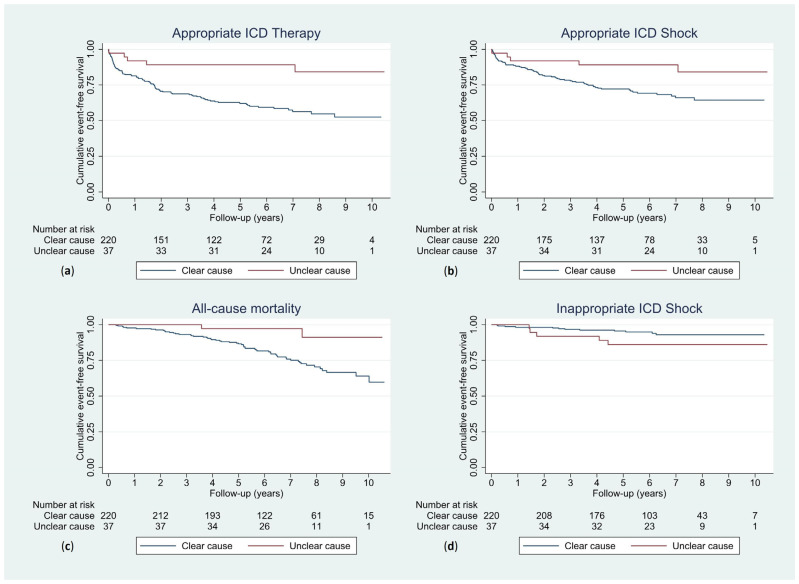
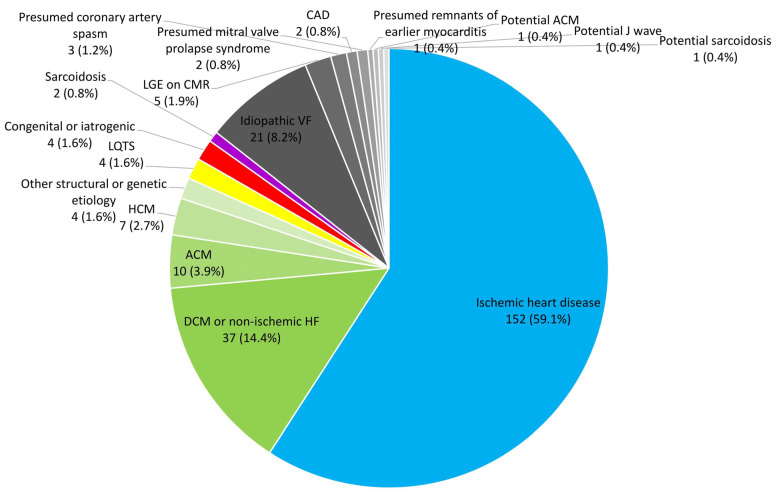
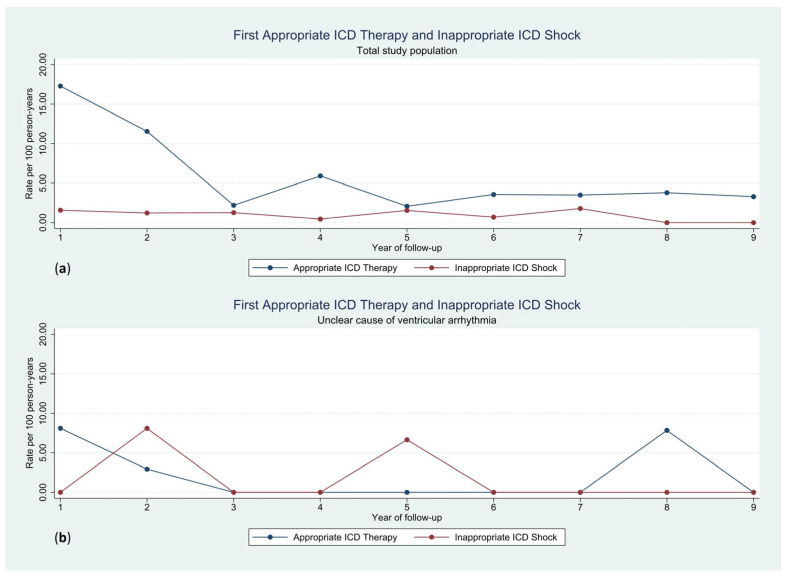
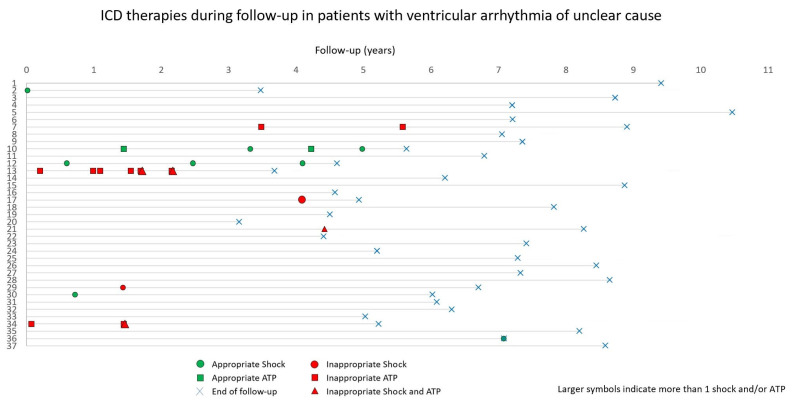
In this study, we sought to investigate the occurrence of appropriate implantable cardioverter-defibrillator (ICD) therapies and inappropriate shocks in secondary prevention ICD recipients with ventricular arrhythmia of unclear cause and ventricular arrhythmia in the context of underlying heart disease. In this retrospective study, consecutive patients with an ICD implanted for secondary prevention in the University Medical Center Groningen (UMCG), the Netherlands between 1 January 2012 and 31 December 2018 were included. Patients were classified as having ventricular arrhythmia of unclear cause if no clear cause was found which could explain the index ventricular arrhythmia. The primary outcome was appropriate ICD therapy. The study population consisted of 257 patients. In 220 patients, an underlying heart disease could be identified as the cause of ventricular arrhythmia, while 37 patients had an unclear cause of ventricular arrhythmia. The median age was 64 years (interquartile range (IQR) 53-72 years). Forty-five (18%) patients were women. During a median duration of follow-up of 6.2 years (IQR 4.8-7.8 years), appropriate ICD therapy occurred in 95 (37%) patients. This number was 90 (41%) in the group with a clear etiology and 5 (14%) in the group with an unclear etiology. In multivariable analysis, index ventricular arrhythmia of unclear cause was associated with fewer appropriate ICD therapies (HR 0.37 [95% CI 0.14-0.99]; = 0.048), as well as an increased risk of inappropriate ICD shocks (HR 3.71 [95% CI 1.17-11.80]; = 0.026). Index ventricular arrhythmia of unclear cause was significantly associated with fewer appropriate ICD therapies.
在本研究中,我们试图调查在二级预防植入式心律转复除颤器(ICD)的患者中,病因不明的室性心律失常以及存在基础心脏病情况下的室性心律失常时,适当的ICD治疗和不适当电击的发生情况。在这项回顾性研究中,纳入了2012年1月1日至2018年12月31日期间在荷兰格罗宁根大学医学中心(UMCG)接受二级预防植入ICD的连续患者。如果未发现可解释索引室性心律失常的明确病因,则将患者分类为病因不明的室性心律失常。主要结局是适当的ICD治疗。研究人群包括257名患者。在220名患者中,可以确定基础心脏病是室性心律失常的病因,而37名患者的室性心律失常病因不明。中位年龄为64岁(四分位间距[IQR] 53 - 72岁)。45名(18%)患者为女性。在中位随访期6.2年(IQR 4.8 - 7.8年)内,95名(37%)患者接受了适当的ICD治疗。病因明确组的这一数字为90名(41%),病因不明组为5名(14%)。在多变量分析中,病因不明的索引室性心律失常与较少的适当ICD治疗相关(风险比[HR] 0.37 [95%置信区间0.14 - 0.99];P = 0.048),同时不适当ICD电击的风险增加(HR 3.71 [95%置信区间1.17 - 11.80];P = 0.026)。病因不明的索引室性心律失常与较少的适当ICD治疗显著相关。