Thai-Van Hung, Veuillet Evelyne, Le Normand Marie-Thérèse, Damien Maxime, Joly Charles-Alexandre, Reynard Pierre
Institut de l'Audition, Institut Pasteur, Inserm, 75012 Paris, France.
Service d'Audiologie et d'Explorations Oto-Neurologiques, Hôpital Edouard Herriot, Hospices Civils de Lyon, 69003 Lyon, France.
J Clin Med. 2023 Jul 7;12(13):4553. doi: 10.3390/jcm12134553.
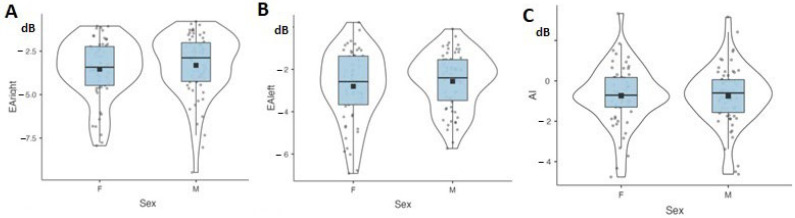
The maturation of the uncrossed medial olivocochlear (UMOC) efferent remains poorly documented to date. The UMOC efferent system allows listeners to not only detect but also to process, recognize, and discriminate auditory stimuli. Its fibers can be explored non-invasively by recording the effect of contralateral acoustic stimulation (CAS), resulting in a decrease in the amplitude of transient evoked otoacoustic emissions (TEOAE). The objective of the present cross-sectional study was to investigate how the effectiveness of this system varies with age in healthy subjects aged 8 years to adulthood. For this purpose, 120 right-handed native French-speaking subjects (57 females and 63 males) were divided into five age groups of 24 subjects each: 8y-10y, 10y-11y6m, 11y6m-13y, 13y-17y, and ≥18y. TEOAE amplitudes with and without CAS were recorded. The equivalent attenuation (EA) was calculated, corresponding to the change in TEOAE amplitude equivalent to the effect generated by CAS. General linear models were performed to control for the effect of ear, sex, and age on EA. No sex effect was found. A stronger EA was consistently found regardless of age group in the right ear compared to the left. In contrast to the right ear, for which, on average, EA remained constant across age groups, an increasingly weaker TEOAE suppression effect with age was found in the left ear, reinforcing the asymmetrical functioning of the UMOC efferent system in favor of the right ear in adulthood. Further studies are needed to investigate the lateralization of the UMOC efferent system and its changes over time in cases of atypical or reversed cortical asymmetries, especially in subjects with specific learning disorders.
迄今为止,未交叉的内侧橄榄耳蜗(UMOC)传出神经的成熟情况仍缺乏充分的文献记载。UMOC传出神经系统使听众不仅能够检测,还能处理、识别和区分听觉刺激。通过记录对侧声刺激(CAS)的效应,可以无创地探测其纤维,这会导致瞬态诱发耳声发射(TEOAE)的幅度降低。本横断面研究的目的是调查该系统在8岁至成年的健康受试者中,其有效性如何随年龄变化。为此,将120名以法语为母语的右利手受试者(57名女性和63名男性)分为五个年龄组,每组24人:8岁至10岁、10岁至11岁6个月、11岁6个月至13岁、13岁至17岁和≥18岁。记录有和没有CAS时的TEOAE幅度。计算等效衰减(EA),它对应于与CAS产生的效应等效的TEOAE幅度变化。采用一般线性模型来控制耳朵、性别和年龄对EA的影响。未发现性别效应。与左耳相比,无论年龄组如何,右耳始终表现出更强的EA。与右耳不同,右耳的EA在各年龄组中平均保持恒定,而左耳则发现随着年龄增长TEOAE抑制效应越来越弱,这强化了UMOC传出神经系统在成年期有利于右耳的不对称功能。需要进一步研究来调查UMOC传出神经系统的侧化情况及其在非典型或反向皮质不对称情况下随时间的变化,特别是在患有特定学习障碍的受试者中。