Department of Physics, Freie Universität Berlin, Arnimallee 14, 14195 Berlin, Germany.
Computer Chemistry Center, Friedrich-Alexander Universität (FAU) Erlangen-Nürnberg, Nägelsbachstrasse 25, 91052 Erlangen, Germany.
Int J Mol Sci. 2023 Jun 21;24(13):10464. doi: 10.3390/ijms241310464.
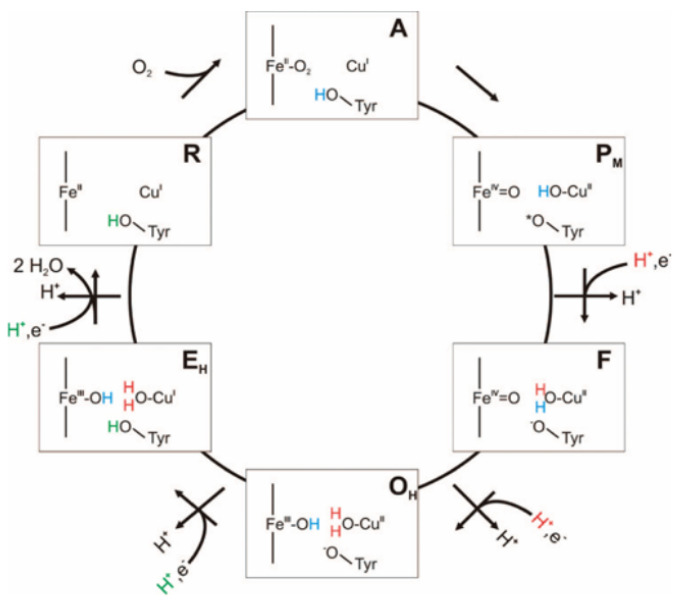
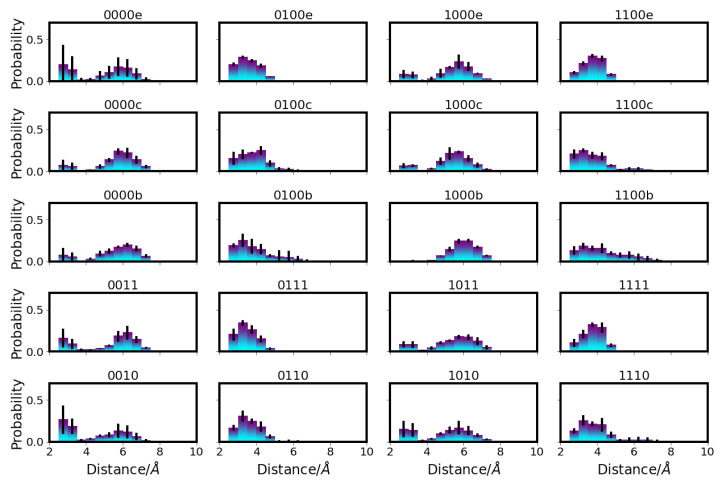
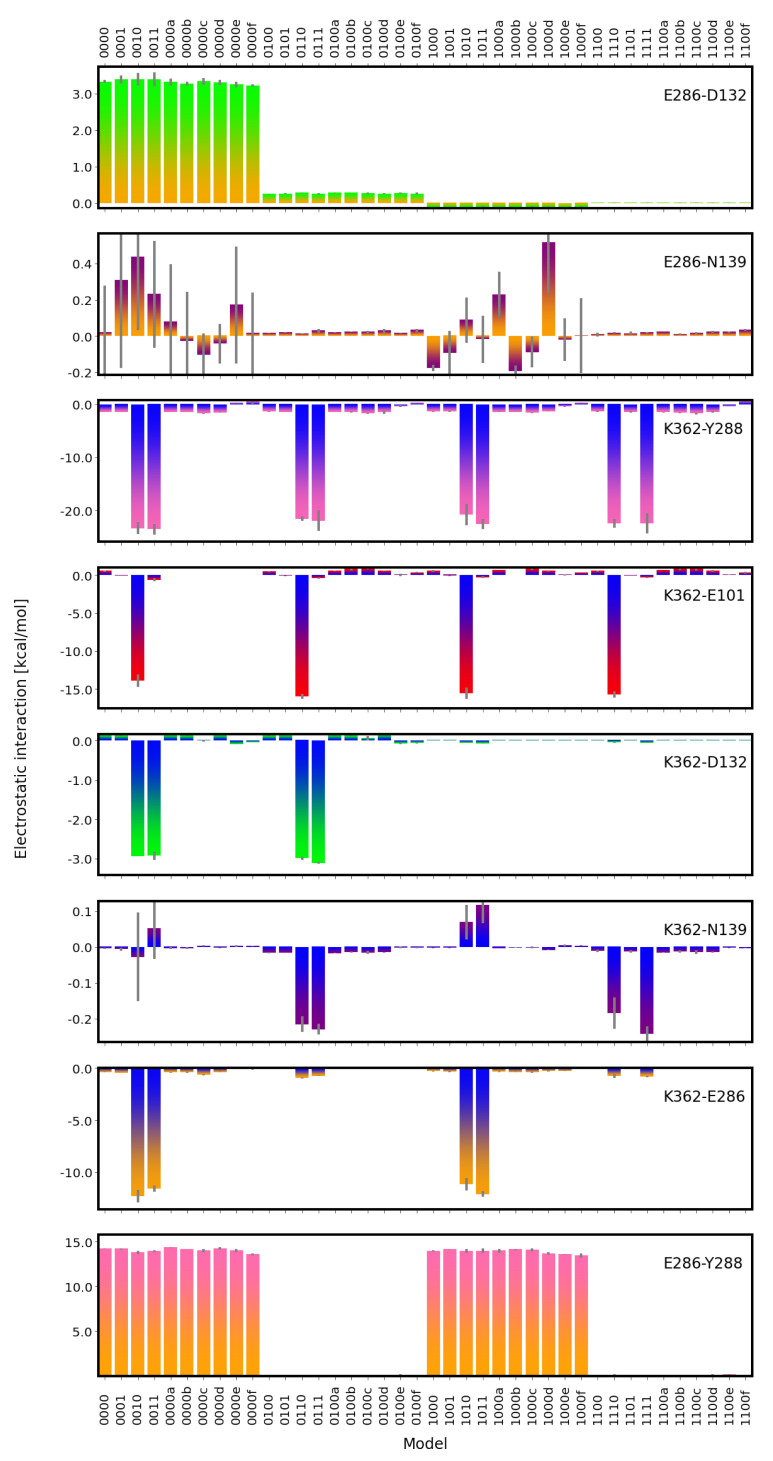
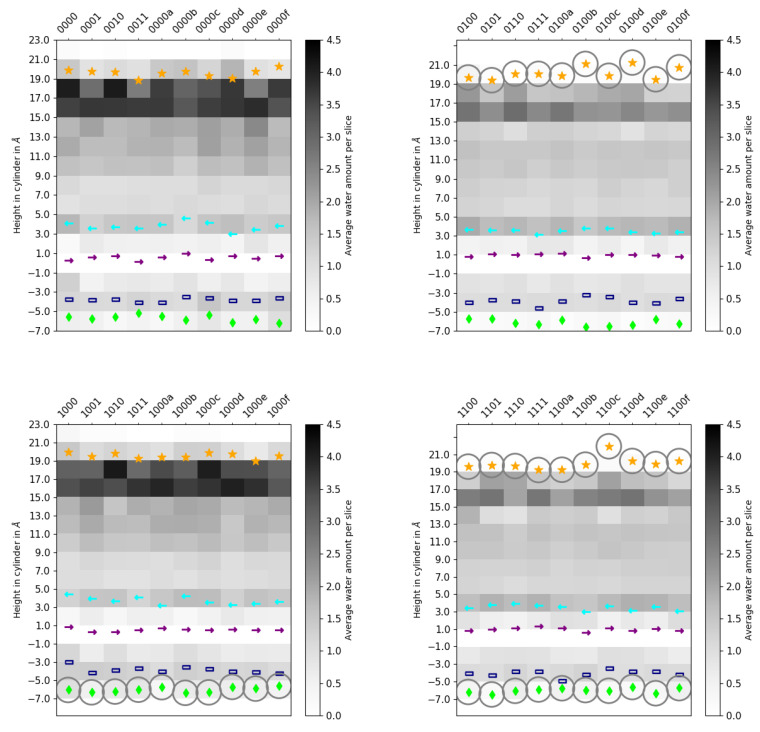
Cytochrome c Oxidase (CcO), a membrane protein of the respiratory chain, pumps protons against an electrochemical gradient by using the energy of oxygen reduction to water. The ("chemical") protons required for this reaction and those pumped are taken up via two distinct channels, named D-channel and K-channel, in a step-wise and highly regulated fashion. In the reductive phase of the catalytic cycle, both channels transport protons so that the pumped proton passes the D-channel before the "chemical" proton has crossed the K-channel. By performing molecular dynamics simulations of CcO in the O→E redox state (after the arrival of the first reducing electron) with various combinations of protonation states of the D- and K-channels, we analysed the effect of protonation on the two channels. In agreement with previous work, the amount of water observed in the D-channel was significantly higher when the terminal residue E286 was not (yet) protonated than when the proton arrived at this end of the D-channel and E286 was neutral. Since a sufficient number of water molecules in the channel is necessary for proton transport, this can be understood as E286 facilitating its own protonation. K-channel hydration shows an even higher dependence on the location of the excess proton in the K-channel. Also in agreement with previous work, the K-channel exhibits a very low hydration level that likely hinders proton transfer when the excess proton is located in the lower part of the K-channel, that is, on the N-side of S365. Once the proton has passed S365 (towards the reaction site, the bi-nuclear centre (BNC)), the amount of water in the K-channel provides hydrogen-bond connectivity that renders proton transfer up to Y288 at the BNC feasible. No significant direct effect of the protonation state of one channel on the hydration level, hydrogen-bond connectivity, or interactions between protein residues in the other channel could be observed, rendering proton conductivity in the two channels independent of each other. Regulation of the order of proton uptake and proton passage in the two channels such that the "chemical" proton leaves its channel last must, therefore, be achieved by other means of communication, such as the location of the reducing electron.
细胞色素 c 氧化酶(CcO)是呼吸链中的一种膜蛋白,通过利用氧还原为水的能量,逆电化学梯度泵出质子。该反应所需的(“化学”)质子和被泵出的质子通过两个不同的通道,即 D 通道和 K 通道,以逐步和高度调节的方式被摄取。在催化循环的还原阶段,两个通道都运输质子,因此在“化学”质子穿过 K 通道之前,被泵出的质子通过 D 通道。通过对 CcO 在 O→E 氧化还原状态(第一个还原电子到达后)进行各种 D-和 K-通道质子化状态组合的分子动力学模拟,我们分析了质子化对两个通道的影响。与之前的工作一致,当末端残基 E286 尚未(尚未)质子化时,在 D 通道中观察到的水量明显高于质子到达 D 通道的这一端且 E286 呈中性时的水量。由于通道中需要足够数量的水分子才能进行质子运输,因此可以理解为 E286 促进了自身的质子化。K 通道的水合作用对 K 通道中过剩质子的位置依赖性更高。与之前的工作一致,K 通道表现出非常低的水合水平,当过剩质子位于 K 通道的下部,即 S365 的 N 侧时,可能会阻碍质子转移。一旦质子通过 S365(朝向反应位点,双核中心(BNC)),K 通道中的水量提供氢键连接,使得质子转移到 BNC 处的 Y288 成为可能。没有观察到一个通道的质子化状态对另一个通道的水合水平、氢键连接或蛋白质残基之间相互作用的显著直接影响,这使得两个通道中的质子传导相互独立。因此,必须通过其他通信方式(例如还原电子的位置)来调节两个通道中质子摄取和质子传递的顺序,使得“化学”质子最后离开其通道。