Department of Internal Medicine and Gastroenterology, Polish Red Cross Memorial Municipal Hospital, 79 Henryk Sienkiewicz Street, 15-003 Bialystok, Poland.
Department of Hygiene, Epidemiology and Metabolic Disorders, Medical University of Bialystok, 2C Adam Mickiewicz Street, 15-222 Bialystok, Poland.
Int J Mol Sci. 2023 Jun 29;24(13):10867. doi: 10.3390/ijms241310867.
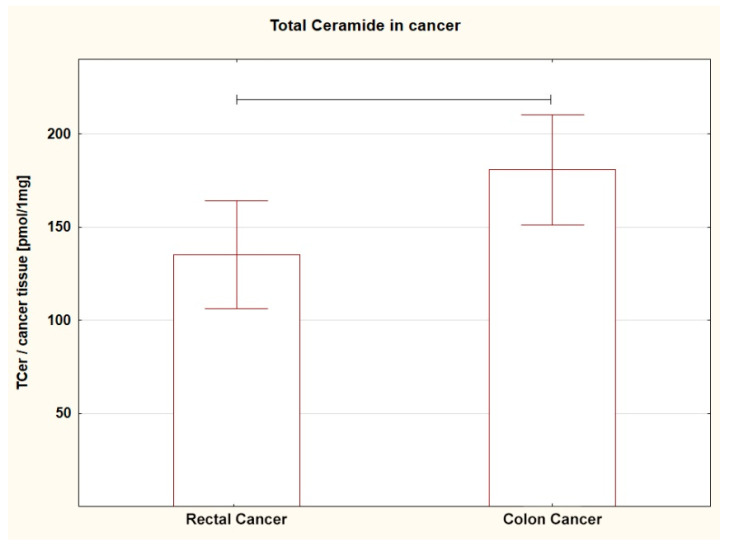
Colorectal cancer is a heterogenous group of neoplasms showing a variety of clinical and pathological features depending on their anatomical location. Sphingolipids are involved in the formation and progression of cancers, and their changes are an important part of the abnormalities observed during carcinogenesis. Because the course of rectal and colonic cancer differs, the aim of the study was to assess whether the sphingolipid profile is also different in tumors of these two regions. Using a combination of ultra-high-performance liquid chromatography combined with triple quadrupole mass spectrometry, differences in the amounts of cellular sphingolipids were found in colorectal cancer. Sphingosine content was higher in rectal cancer than in adjacent healthy tissue, while the content of two ceramides (C18:0-Cer and C20:0-Cer) was lower. In colon cancer, a higher content of sphingosine, sphinganine, sphingosine-1-phosphate, and two ceramides (C14:0-Cer and C24:0-Cer) was found compared to healthy tissue, but there was no decrease in the amount of any of the assessed sphingolipids. In rectal cancer, the content of sphinganine and three ceramides (C16:0-Cer, C22:0-Cer, C24:0-Cer), as well as the entire pool of ceramides, was significantly lower compared to colon cancer. The S1P/Cer ratio in rectal cancer (S1P/C18:1-Cer, S1P/C20:0-Cer, S1P/C22:0-Cer, S1P/C24:1-Cer) and in colon cancer (S1P/C18:0-Cer, S1P/C18:1-Cer, S1P/C20:0-Cer) was higher than in adjacent healthy tissue and did not differ between the two sites (rectal cancer vs. colonic cancer). It seems that the development of colorectal cancer is accompanied by complex changes in the metabolism of sphingolipids, causing not only qualitative shifts in the ceramide pool of cancer tissue but also quantitative disturbances, depending on the location of the primary tumor.
结直肠癌是一组异质性肿瘤,其临床表现和病理特征因解剖部位而异。鞘脂参与癌症的发生和发展,其变化是癌变过程中观察到的异常的重要组成部分。由于直肠和结肠癌的病程不同,因此本研究旨在评估这两个区域的肿瘤中鞘脂谱是否也存在差异。使用超高效液相色谱与三重四极杆质谱联用的方法,发现结直肠癌中细胞鞘脂的含量存在差异。直肠癌中神经醇含量高于相邻的健康组织,而两种神经酰胺(C18:0-Cer 和 C20:0-Cer)的含量较低。在结肠癌中,与健康组织相比,神经醇、神经酰胺、神经酰胺-1-磷酸和两种神经酰胺(C14:0-Cer 和 C24:0-Cer)的含量较高,但评估的任何一种鞘脂的含量都没有减少。与结肠癌相比,直肠癌中神经酰胺含量、三种神经酰胺(C16:0-Cer、C22:0-Cer、C24:0-Cer)以及整个神经酰胺池的含量明显较低。直肠癌中 S1P/Cer 比值(S1P/C18:1-Cer、S1P/C20:0-Cer、S1P/C22:0-Cer、S1P/C24:1-Cer)和结肠癌中 S1P/Cer 比值(S1P/C18:0-Cer、S1P/C18:1-Cer、S1P/C20:0-Cer)均高于相邻的健康组织,且两个部位之间没有差异(直肠癌与结肠癌)。似乎结直肠癌的发生伴随着鞘脂代谢的复杂变化,不仅导致癌症组织中神经酰胺池的定性变化,而且还导致定量紊乱,这取决于原发性肿瘤的位置。